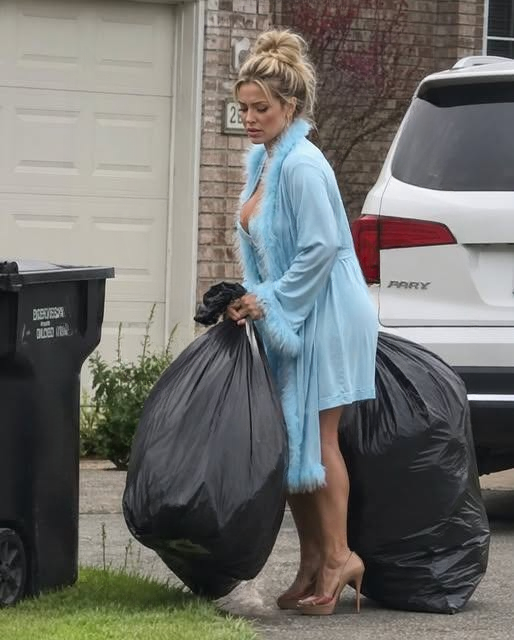
For weeks, I watched my neighbor Barbara carry heavy black trash bags to the curb every morning.
She handled every bag with unusual care, almost like she was carrying something valuable instead of something meant to be thrown away.
I convinced myself there was something strange happening inside that house.
I was wrong.
The truth inside those bags changed the way I saw Barbara forever.
The street outside our home was always peaceful at sunrise.
The sprinklers clicked across freshly cut lawns. Birds filled the trees. Garage doors slowly opened as the neighborhood prepared for another day.
I loved those quiet mornings.
Then I started noticing Barbara.
Her house was the kind of place people admired while driving by. The hedges were perfectly trimmed, the flowers always looked cared for, and her silver SUV was spotless no matter the weather.
Barbara matched her home.
She dressed neatly every day, wore scarves around her neck, and always looked polished when she collected her mail.
We were neighbors, but we were never close. We exchanged smiles and polite greetings, nothing more.
Then the bags began appearing.
Every morning at exactly seven, Barbara stepped outside carrying a large black contractor bag.
Sometimes one.
Sometimes two.
She placed them at the curb, then stood there for a moment before walking back inside.
A garbage truck arrived shortly afterward and took them away.
At first, I assumed she was cleaning out her attic.
But days turned into weeks.
No renovation happened.
No furniture was removed.
No workers came.
Just the bags.
One morning, my wife Anna watched from the kitchen window.
“Have you ever wondered what’s inside those?” she asked.
I looked up from my coffee.
“Trash.”
Anna smiled.
“That’s a very confident answer.”
“What else would be in a trash bag?”
She pointed outside.
Barbara had stopped halfway down her driveway. She placed a hand against her chest and caught her breath before continuing.
“She looks exhausted,” Anna said.
“She’s probably just tired.”
“She looks sick.”
I wanted to dismiss it, but Anna had noticed something I hadn’t.
I had been watching the bags.
She had been watching Barbara.
Over the next few days, my curiosity grew.
One morning, Barbara left before the garbage truck arrived.
Two bags remained outside.
Anna noticed me looking.
“Don’t,” she said.
“I’m checking the mail.”
“The mail doesn’t come until afternoon.”
I ignored her and crossed the street.
I knew I shouldn’t touch the bag.
I knew it wasn’t my business.
But curiosity won.
I untied the larger bag.
What I found inside immediately made me regret everything.
There were children’s clothes.
A pink cardigan.
A denim jacket with a butterfly patch.
Small shoes with the laces still tied.
School folders.
Books.
A stuffed rabbit missing one ear.
Then I saw three picture frames.
Inside each photo was the same girl.
A little girl smiling on a beach.
A girl playing piano in a white dress.
A teenager blowing out sixteen birthday candles.
On the back of one photo was a name.
Emily.
My stomach dropped.
I quickly closed the bag, but I couldn’t tie it the way Barbara had.
My knot looked careless.
Guilty.
When I returned home, Anna immediately knew.
“You opened it.”
I sat down.
“There were a girl’s belongings inside.”
Anna stared at me.
“Why would you do that?”
“I thought something was wrong.”
“Something was wrong,” she said. “You went through someone’s private things.”
She was right.
But I couldn’t stop wondering.
Who was Emily?
And why was Barbara throwing away her belongings?
That afternoon, we spoke with Patterson, an older neighbor who had lived on our street for decades.
When we mentioned Emily’s name, her expression changed.
“She was Barbara’s daughter,” Patterson said.
Anna covered her mouth.
“What happened?”
“She died eleven years ago.”
The room went silent.
“She was sixteen,” Patterson continued. “A terrible accident. She left the house after an argument with Barbara and was hit by a drunk driver.”
I felt a weight settle in my chest.
“Did Barbara blame herself?”
Patterson nodded.
“She always has.”
She told us Barbara also had a son named David.
He had left for college after Emily died and rarely returned.
“He blamed his mother,” Patterson explained. “He believed their argument was the reason Emily left that night.”
That evening, I couldn’t stop thinking about Barbara.
I had imagined something suspicious.
Something terrible.
Instead, I was looking at a mother carrying eleven years of grief.
The next morning, Barbara collapsed beside one of the bags.
Anna and I ran across the street.
She tried to stand.
“I’m fine,” she whispered.
She wasn’t.
Her face was pale. Her scarf slipped, revealing thinning hair.
Inside her house, we saw medication bottles and a calendar full of medical appointments.
Anna helped her sit down.
Then I finally admitted the truth.
“I opened one of the bags.”
Barbara looked at me.
Her expression hurt more than anger.
“You had no right.”
“I know.”
And this time, I truly meant it.
She looked away.
“I’m sorry,” I said.
After a long silence, she explained.
“I have stage-four ovarian cancer.”
My heart sank.
“The doctors think I have only a short time left.”
Then she told us why she was clearing the room.
“David is coming home this weekend.”
Her son.
The child who had stayed away for eleven years.
“He hasn’t been inside Emily’s room since the funeral,” Barbara said. “I thought if I emptied it, he wouldn’t have to lose Emily again while losing me.”
Anna gently asked the question I hadn’t considered.
“Did you ask him what he wanted?”
Barbara froze.
“No.”
“Then you’re deciding his grief for him.”
Those words stayed with all of us.
Barbara wasn’t trying to erase Emily.
She was trying to protect her son.
But she was protecting him by taking away his choice.
That afternoon, we helped Barbara sort the room.
Not destroy it.
Not erase it.
Sort it.
Some things went to charity.
Some things Barbara kept.
And some things were saved for David to decide.
As we worked, Barbara told us stories.
Emily’s science projects.
Her music.
Her stubborn personality.
Her laughter.
The room stopped feeling like a place frozen in death.
It became a place filled with a life that had existed.
By Friday night, Emily’s room was still there.
The bed remained.
The books remained.
The photographs remained.
The memories remained.
Saturday morning, David arrived.
He stood outside the house for several minutes before entering.
Later, he came to our door.
His eyes were red.
“My mother told me you helped with Emily’s room.”
“We did.”
He nodded.
“I sat on her bed for an hour.”
“Was it painful?” Anna asked.
“Yes.”
He looked across the street.
“But I needed it.”
That evening, Barbara invited us over.
David sat beside his mother holding one of Emily’s photographs.
“I blamed you for eleven years,” he said.
Barbara cried.
“I know.”
“I thought if I blamed you, I didn’t have to admit that sometimes terrible things just happen.”
His mother reached for his hand.
“I was wrong to tell her to leave that night.”
“And I was wrong to make you carry all the blame.”
For the first time in eleven years, they grieved together.
Not separately.
Not behind locked doors.
Together.
David stayed with Barbara until the end.
Neighbors helped.
Meals were shared.
Appointments were handled.
And slowly, the house across the street became less a place of sadness and more a place of remembrance.
Barbara passed away two months later.
Afterward, David kept the home.
He said it would always be a place where he remembered both his mother and his sister.
Looking back now, I think about those trash bags differently.
I thought Barbara was throwing away memories.
She wasn’t.
She was trying to decide how much pain her son should carry.
Grief can make people do strange things.
Sometimes we hold on because we are afraid to let go.
Sometimes we let go because we are afraid holding on will hurt someone else.
Barbara’s greatest mistake wasn’t loving Emily too much.
It was believing she had to carry that love and that pain alone.
And maybe that is the lesson she left behind:
The people we love don’t always need us to protect them from grief.
Sometimes they just need us to let them grieve with us.