There are some objects from the past that seem completely ordinary at first glance, yet become surprisingly fascinating once you understand what they were actually designed to do. A vintage medicine spoon is one of those objects.
For many people, seeing one can immediately bring back memories of childhood. Its unusual shape, cool metal surface, and strange-looking handle may seem almost mysterious to someone who has never encountered one before. But for generations of parents, grandparents, and children, this small household tool had a very practical purpose: helping caregivers administer liquid medicine.
Long before modern dosing syringes became commonplace, parents had to rely on simple household tools to measure and deliver medication. A regular kitchen spoon could be used, but it was not always ideal. Children could easily spill medicine, caregivers could accidentally pour too much, and getting a reluctant child to swallow something unpleasant was often a challenge.
The vintage medicine spoon was designed to make that process easier.
Although these spoons may look unusual today, their design reflects a time when everyday household objects were often created with a specific practical problem in mind. The unusual bowl, hollow or slotted handle, and sometimes even a rubber bulb were not decorative features. They were part of an attempt to make giving liquid medicine cleaner, easier, and more controlled.
A Classic Example
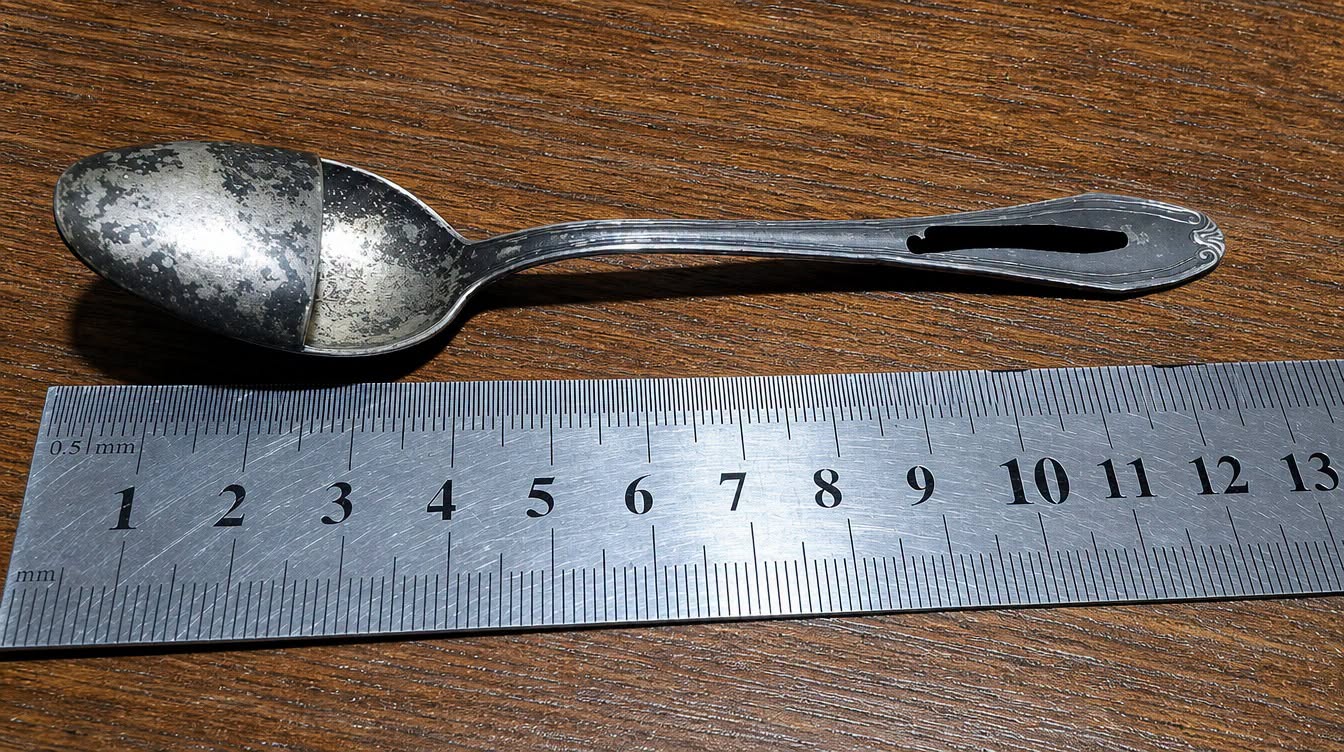
The vintage medicine spoon pictured above is the type of object that can leave modern viewers wondering what they are looking at. At first glance, it resembles an ordinary spoon. Look more closely, however, and its unusual construction becomes apparent.
This particular style, dating from the middle decades of the 20th century, features a sealed or semi-sealed bowl and a hollowed-out or slotted section running through the handle. Other versions incorporated a rubber bulb at the end.
The basic idea was simple. Rather than pouring medicine directly into an open spoon, the liquid could be introduced through the handle and directed toward the bowl. Depending on the particular design, a caregiver could use the mechanism to control the movement of the liquid.
Some versions worked somewhat like a small pump. A rubber bulb could be pressed or manipulated to help move the liquid through the spoon. This gave the caregiver more control over the amount being delivered and helped reduce the chances of medicine being spilled before it reached the child’s mouth.
The design also addressed another problem familiar to anyone who has ever tried to give medicine to a young child: movement.
Children do not always sit still when they are being given medicine. A traditional spoon filled with liquid can easily be tipped, especially when the child turns away or pushes the caregiver’s hand aside. A more contained design offered a practical solution.
The people who designed these objects were not simply trying to make a spoon look different. They were attempting to solve an everyday problem that families faced repeatedly.
Design That Is Functional
The most interesting thing about vintage medicine spoons is that their strange appearance is actually the result of their function.
Today, parents have access to a wide variety of measuring devices specifically designed for children’s medications. Oral syringes, measuring cups, droppers, and other dosing devices are common. These tools are designed to make it easier to measure a particular volume of liquid.
That was not always the case.
Before dosing syringes became widespread, families frequently relied on spoons and other simple measuring implements. A medicine spoon could offer several advantages over an ordinary kitchen spoon. Its shape could make it easier to hold, while its specialized construction could help contain the medicine and reduce spills.
Some vintage examples were manufactured from durable metals, including nickel silver and other metal alloys. That durability explains why these objects can still be found decades after they were originally used.
Unlike disposable medical products, a well-made metal spoon could remain in a household for many years. It might be used repeatedly, cleaned, stored away, and eventually forgotten in a kitchen drawer or medicine cabinet.
Years later, someone cleaning out an old house might find it tucked inside a box with other household objects.
And suddenly, a seemingly meaningless piece of metal becomes a conversation starter.
Why Does It Look So Strange?
Part of the fascination with these objects comes from their appearance.
A normal spoon has an obvious purpose. You see the bowl, you see the handle, and you immediately understand how it works. A vintage medicine spoon can look almost like a miniature piece of laboratory equipment.
The unusual handle often catches people’s attention first.
Why is there a hole?
Why does the handle appear hollow?
Why is the bowl shaped differently from a regular spoon?
These questions are exactly what make vintage household objects so interesting. Modern viewers often judge an object by what it resembles rather than by the problem it was originally designed to solve.
Once the purpose of the handle is understood, the unusual construction begins to make sense.
The spoon was not intended to be used like a normal eating utensil. It was a specialized household medical tool. Every unusual feature served a purpose.
The contained bowl helped keep liquid from spilling, while the handle’s internal passage or opening was part of the delivery mechanism on applicable models.
Some examples were more elaborate than others. Certain spoons were designed with bulbs or other components, while simpler examples relied on the caregiver manually introducing liquid into the spoon.
Because different manufacturers produced different versions over the years, there was not necessarily one universal design.
That variety is part of what makes identifying vintage medicine spoons so interesting to collectors today.
A Common Childhood Memory
For people who grew up during the 1950s, 1960s, 1970s, and into the early 1980s, objects like these could be part of an ordinary household routine.
The spoon might have been kept in the same drawer as a glass thermometer, a bottle of cough medicine, a jar of vapor rub, and other items associated with taking care of a sick child.
When someone in the family came down with a cold, fever, cough, or another common childhood illness, the medicine drawer could suddenly become very important.
The experience of taking medicine was rarely a favorite childhood memory.
There was the smell of the medicine.
There was the distinctive taste.
There was the anticipation of the spoon approaching.
And then there was the familiar voice of a parent or grandparent encouraging the child to take just one more swallow.
For many adults, encountering an old medicine spoon decades later can bring all of those memories rushing back.
The spoon itself may have been cold when it touched the lips. Its unusual shape may have seemed enormous when viewed from a child’s perspective. The medicine might have tasted bitter, sweet, fruity, or medicinal depending on what was being administered.
Even the sound of a medicine bottle being opened could become part of the memory.
These are the kinds of ordinary moments that rarely seem important when they happen. Years later, however, they can become some of the strongest reminders of childhood.
More Than Just a Spoon
It is tempting to look at a vintage medicine spoon simply as an old medical utensil. But household objects often tell us more about everyday life than major historical artifacts do.
A medicine spoon represents the practical realities of raising children in another era.
Parents still had to deal with sick children. Children still disliked unpleasant medicine. Caregivers still wanted to make the process as easy and safe as possible.
What changed was the technology available to them.
Instead of reaching for a modern oral syringe, a parent might have reached for a specialized metal spoon. Instead of opening a brightly packaged dosing device, they might have pulled an unusual-looking utensil from the medicine cabinet.
The object reflects the technology and manufacturing practices of its time.
It also reflects something more universal: the desire to make difficult moments a little easier.
The designers of these spoons were addressing a very ordinary problem, but the solution demonstrates how much thought can go into a seemingly simple household object.
Why These Objects Survived
One reason vintage medicine spoons continue to appear today is their construction.
Many were made from materials intended to withstand repeated use. Metal alloys could survive years of handling and storage without the same deterioration associated with some disposable or inexpensive household products.
A spoon that was used for only a few years could then spend several decades sitting inside a drawer.
Eventually, it might be packed into an attic box.
It might move with a family from one home to another.
It might end up in an estate sale, flea market, antique shop, or online marketplace.
By the time a collector discovers it, the object may be several decades old.
That longevity gives these spoons an unusual quality. They were designed to perform a practical job, but they also happened to become miniature time capsules.
Collectibles Today
Today, vintage medicine spoons can be found through antique dealers, flea markets, estate sales, vintage shops, and online marketplaces such as Etsy and auction sites.
Their value varies considerably depending on factors such as age, manufacturer, condition, rarity, materials, and overall design. Some examples are relatively inexpensive, while unusual or particularly well-preserved pieces may attract greater interest from collectors.
For many people, however, monetary value is not the main attraction.
Nostalgia can be much more important.
Someone who remembers seeing one in their family’s medicine cabinet may want one simply because it reminds them of a parent, grandparent, childhood home, or a particular period of their life.
That emotional connection is one reason seemingly mundane objects can become meaningful collectibles.
A vintage medicine spoon does not have to be made from precious materials or associated with a famous historical event to have significance. Its importance may come from the memories attached to it.
A Small Object With a Big Story
The vintage medicine spoon is a good reminder that history is not always found in museums.
Sometimes, it is hiding in a kitchen drawer.
An unusual spoon can tell us about medical practices, household technology, manufacturing, parenting, and childhood memories all at once. Its strange-looking handle was not an accident. Its specialized shape was created to solve a practical problem that families encountered every day.
Most importantly, the spoon represents an era when ordinary household objects were frequently designed to serve very specific purposes.
For today’s viewer, the object may look confusing or even comical. But to someone who once used it to care for a sick child, it could represent something much more personal.
It represents the quiet routines of family life.
It represents a caregiver trying to make medicine easier to take.
It represents a child reluctantly opening their mouth while an adult says, “Almost done.”
And perhaps that is why these little spoons continue to capture people’s attention decades after their everyday usefulness has largely disappeared.
They are more than pieces of old metal.
They are reminders of a time when a simple, cleverly designed household tool could make an unpleasant moment just a little easier.
Today, modern dosing devices have made administering liquid medication more precise and convenient. The old medicine spoon has largely moved into the world of antiques and collectibles.
But when one turns up in an old box or appears at a flea market, it can still do something that no modern medical device can quite accomplish.
It can bring the past back for a moment.
One glance at that strange little spoon can recall a medicine cabinet, a warm kitchen, a bottle of cough syrup, and the reassuring presence of a parent nearby.
For an object that was created simply to deliver medicine, that is a surprisingly lasting legacy.