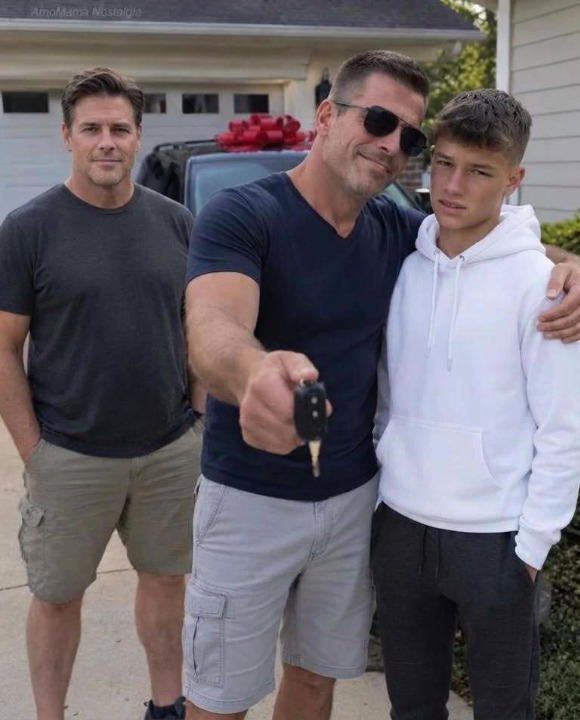
“Come on, son,” my biological father said, holding out the sleek silver keys to a brand-new black sports car parked at the curb. He flicked a dismissive glance toward my stepfather, Ray, who was standing quietly on the porch. “He could never afford to give you something like this.”
He expected me to be breathless, dazzled by the flash of chrome and cash. Instead, without a word, I turned on my heel, walked inside the house, and came right back out carrying a modest, scuffed wooden box.
I hadn’t seen my biological father since I was three years old. For fourteen years, it was just Mom and me, and money was always a tight, suffocating ghost hanging over our heads. Then, when I was fifteen, Mom met Ray. He already had two kids of his own, but he never treated me like a burden or an extra responsibility. He didn’t try to buy his way into my life; he just quietly showed up.
Ray attended every single Friday night football game, even during the seasons when I sat entirely on the bench. When I was drowning in high school chemistry, he sat beside me at the kitchen table until midnight, working through chemical equations until the concepts finally clicked. Once, when I asked him why he bothered putting in so much overtime for a kid who wasn’t biologically his, he just shrugged and said, “Parents don’t quit before their kids do.” He said parents without a second thought. I never forgot it.
On my seventeenth birthday earlier that day, Ray had handed me a heavy, handmade wooden box. Inside were crisp college savings statements accompanied by handwritten sticky notes detailing his daily sacrifices: Winter boots can wait — $40. Brought packed lunch all week — $25. Delayed truck service next month — $60. One note even read: Danny needed new glasses. Tight month — $0.
At the very bottom was a final index card: Kid, it isn’t enough yet. But we’ll keep building. — Ray.
It was easily the least expensive birthday gift I had ever received, but it carried more weight than anything money could ever buy.
Then, three hours later, my biological father rolled up unannounced in a rented SUV, flashing a wide, expensive smile and presenting the brand-new car as his grand re-entry into my life.
He dropped the keys into my palm and called it a long-overdue fresh start. Then he turned his sights on Ray, sneering, “Bet that’s a whole lot better than whatever scrap he handed you.”
I looked at the keys, then at my biological father, and asked him three simple questions: What position did I play on the team? What colleges was I actively applying to? What subject had I nearly failed last semester?
He stood there blinking, utterly speechless, unable to answer a single one.
I walked over to the porch, picked up Ray’s wooden box, and brought it back out to the driveway.
“You bought that car with disposable cash you didn’t know what to do with,” I told my father, my voice steady. “He’s been building my future with money he genuinely needed.”
My father immediately shifted the blame to Mom, claiming she had kept us apart, and shoved the keys back toward my chest. For a split second, the shiny metal tempted me. Then I remembered the sound of Ray’s tired footsteps coming home from a twelve-hour shift, and the way he never complained.
I took the keys, placed them right back into my biological father’s hand, and closed his fingers over them.
“I’ve wanted a car for two years,” I said quietly. “But I wanted a dad for fourteen.”
When he scoffed and asked if I was choosing Ray over him, I shook my head. “No. He chose me.”
My biological father stared at me for a long, heavy beat, realized his checkbook couldn’t buy this moment, and drove away.
A month later, Ray finally bought himself a new pair of work boots, while my college savings account continued to grow. His notes on the deposits changed, too, shifting to things like: Proud of you, kid — $100.
Years later, I still keep that wooden box on my desk. One man showed me what money could buy when it was convenient. Ray showed me what love actually looked like: time, relentless sacrifice, unbreakable consistency, and the simple grace of just being there.