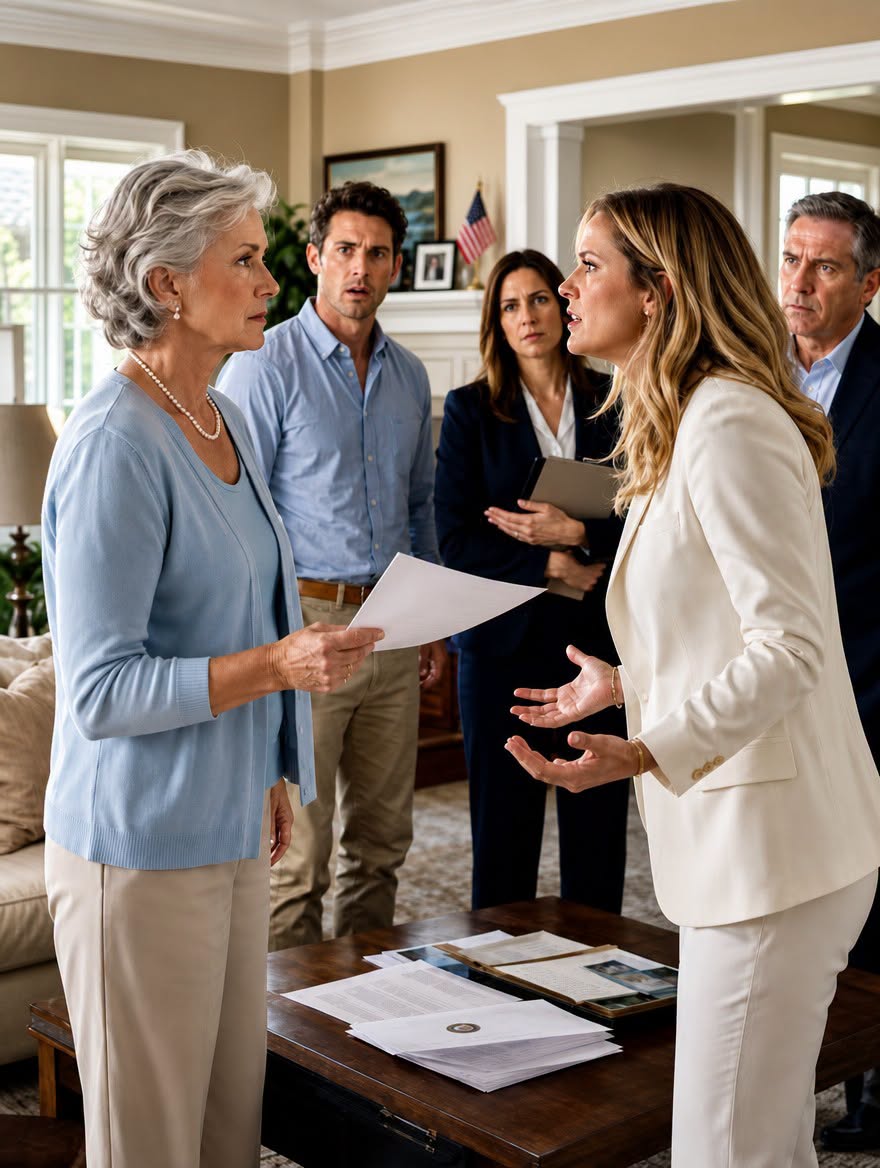
When my son got married, I never mentioned the $553 million my late husband had left me, and thank goodness I kept it private, because only days after the wedding, my new daughter-in-law appeared at my front door with an attorney and a stack of papers, confidently believing she already knew exactly what she was entitled to—until the lawyer opened the first document and suddenly stopped talking.
I believed him because I loved him. I had no idea he was right. The first store became three. Three became five. Five became eleven. By Harold’s fiftieth birthday, Williams Hardware had twenty-three locations spread across Michigan, Wisconsin, Indiana, and Ohio. Yet our lives changed very little. We remained in the same four-bedroom brick house we had bought when Jackson was a baby. Harold drove practical cars. I continued teaching long after we could afford for me to stop. We ate dinner at home most nights, took one family vacation each summer, and argued about whether paying twelve dollars for airport coffee should be considered a personal insult. Harold liked money. He simply did not like looking wealthy. “Money should make your life quieter,” he often said. “Not louder.” The people who knew us casually assumed we were comfortable. They were right. They just had no idea how comfortable. Harold reinvested profits aggressively, bought commercial property, purchased warehouse space rather than leasing it, and invested in boring companies he understood. He never chased trends. “If a business requires somebody on television to explain why it will eventually make money,” he once told me, “I don’t understand it well enough to own it.” Jackson grew up inside that philosophy. We gave him a safe childhood, a good education, and everything he reasonably needed. We did not give him the impression that life owed him luxury. At sixteen, he worked Saturdays in one of Harold’s stores. At eighteen, he received a used Honda, not a sports car. At twenty-two, when he graduated from college, Harold offered to cover graduate school only if Jackson maintained his grades and worked during the summers. Jackson never complained. In fact, he seemed relieved that nobody expected him to join the family business. Books were his passion. He eventually earned a doctorate in literature and accepted a teaching position at Westlake University, a respected private college in Michigan. Harold was delighted. Some fathers might have felt disappointed that their only child did not want the company they had built. Harold never did. “He’s building his own life,” he told me. “That’s the point.” Three years before Harold passed, a national home-improvement company approached him about purchasing Williams Hardware. The final offer was fifty million dollars. I remember sitting beside Harold at our kitchen table after the lawyers left. There were papers everywhere. Numbers I had once considered impossible were printed neatly in black ink. I expected Harold to celebrate. Instead, he poured himself a cup of coffee and stared through the window at the maple tree Jackson used to climb as a boy. “Funny,” he said. “What?” “I spent forty years building something so I could eventually be paid not to have it anymore.” He signed. Most of the proceeds went into investments and carefully structured accounts. We paid our taxes. We increased our charitable giving. We replaced the roof. Harold finally bought the fishing boat he had been talking about for fifteen years, although he chose a used one because, according to him, “Fish don’t know what year your boat was built.” Then came the diagnosis. A serious illness. Fourteen difficult months. Medical appointments. Long drives. Quiet conversations after midnight. Lists of passwords. Insurance policies. Investment statements. Names of attorneys. Instructions I never wanted to need. Harold prepared me for life without him long before I was emotionally prepared to accept that such a life would exist. One evening, near the end, he took my hand. “Bridge, promise me something.” “Anything.” “Take care of Jackson.” “Of course.” “But don’t make his life too easy.” I almost laughed. Even then, Harold was still Harold. “He’ll be fine.” “I know. That’s why I’m saying it.” Then he looked at me with surprising intensity. “Money attracts people who think they deserve a shortcut. Don’t let anybody turn our son into one.” Those words stayed with me. After Harold passed peacefully at home, I learned that the estate he had left under my control was worth approximately fifty-three million dollars. That included proceeds from the business sale, investments, insurance, real estate, and cash reserves. Jackson had his own one-million-dollar trust, established years earlier, scheduled to become accessible when he turned thirty-five. He knew about the trust. He did not know the size of my estate. That had been deliberate. Harold and I had agreed that the number itself served no useful purpose while Jackson was building his own career. For more than a year after Harold was gone, money barely mattered to me anyway. Grief turned our house into a museum. I would open Harold’s closet and stand there simply because his jackets still carried the faint smell of cedar. I slept in one of his old shirts. I watched home movies until the screen blurred. Some mornings I made two cups of coffee before remembering. Jackson carried me through those months. He called every morning before class. He came over several evenings a week. He checked the refrigerator to make sure I was eating. On Sundays, he would sit in Harold’s chair and read while I worked in the kitchen, and for a little while the house almost felt normal. Then Amelia arrived. Jackson met her at a university fundraising gala. She was twenty-nine, polished, energetic, socially confident, and working in pharmaceutical sales. When he called me the following morning, I heard a lightness in his voice I had not heard in years. “Mom, I met somebody.” I smiled. “That sounds serious.” “I met her twelve hours ago.” “Exactly why it sounds serious.” He laughed. For the first time since Harold’s passing, I felt something inside me relax. Maybe Jackson would build a family of his own. Maybe the next chapter would not be defined only by what we had lost. A month later, he brought Amelia to Sunday dinner. She arrived carrying an expensive bottle of wine and wearing a pale cream coat that probably cost more than my first car. She was beautiful. There was no point pretending otherwise. She was also charming when she wanted to be. She complimented the house, asked about my teaching career, admired the old family photographs in the hallway, and laughed at Jackson’s stories. Then, halfway through dinner, she asked her first question about money. “Jackson mentioned Harold owned some hardware stores.” “He did.” “Was it a small local business?” “Not by the time he finished.” She smiled. “And he sold it before he passed?” I looked across the table. Jackson was cutting his roast chicken. “Yes.” “That must have been a wonderful retirement cushion.” There was nothing openly inappropriate about the question. That was the problem. People who are skilled at asking inappropriate questions rarely make them sound inappropriate. “Harold planned carefully,” I said. Amelia nodded as though she had received one piece of a larger puzzle. The conversation moved on. But I noticed. After dinner, Jackson helped me with the dishes. Amelia excused herself to use the bathroom. She was gone almost twenty minutes. The bathroom was thirty feet from the kitchen. Later that evening, after they left, I walked upstairs and found the door to Harold’s study slightly open. I always kept it shut. Nothing appeared missing. Still, I stood in the doorway longer than I care to admit. On the desk was Harold’s old photograph. He was leaning against the counter of the original hardware store, smiling at something outside the frame. Trust what doesn’t fit, he used to say. Not everything wrong announces itself. I closed the study door. Two months after meeting Amelia, Jackson told me she had moved into his apartment. That surprised me. Jackson was methodical to the point of irritation. This was the same man who once spent three weeks comparing vacuum cleaners. Now he had reorganized his entire life around a woman he had known eight weeks. I invited him to coffee. We met near campus. “You’re happy?” I asked. “Very.” “Then I’m happy for you.” He narrowed his eyes. “But?” “No but.” “Mom.” I stirred my coffee. “All right. One small but. You’re moving quickly.” He smiled. “Dad proposed to you after six months.” “Your father spent four of those months trying to decide whether he could afford the ring.” Jackson laughed. “Amelia is different.” “I’m sure she is.” “That’s not a criticism.” “I didn’t say it was.” He reached across the table and squeezed my hand. “When you know, you know.” The phrase sounded confident. I wanted to believe it. Over the next two months, however, Jackson changed in small ways. A new watch appeared on his wrist. Then designer shoes. Then expensive dinners. He began considering replacing the Honda he had driven for eight years. “I’ve been too conservative,” he told me. “According to whom?” He smiled awkwardly. “According to life.” I did not press. Then one evening, during dinner at a restaurant Amelia had selected, the money questions became more specific. She asked whether Harold had invested after selling the company. She asked whether I owned other properties. She asked whether the house had a mortgage. She even asked whether I planned to stay there permanently. I answered every question truthfully without giving her anything useful. “Harold handled those matters.” That was technically true. What I did not mention was that he had taught me enough to understand every account before he was gone. Amelia seemed disappointed. Three weeks later, Jackson canceled our annual visit to Harold’s grave on his birthday because Amelia had scheduled a corporate gala. That hurt. Not because I believed a son must spend every important date with his mother. He was an adult. Life moves. Plans change. But Jackson and I had promised each other we would keep that one tradition. When I called him that night, Amelia answered his phone. “He’s getting ready,” she told me. “I was expecting him this afternoon.” “He feels awful. But this event is important for my career.” “I’m sure.” “And Harold would want Jackson supporting his wife.” I became very still. Amelia had never met my husband. Yet she had already learned how useful his memory could be. That was the first night I called my attorney, Linda Peterson. I did not accuse Amelia of anything. I simply asked a question. “Is my estate structured properly if Jackson gets married?” Linda had worked with Harold for years. She knew exactly what I was asking. “Do you have concerns?” “I have instincts.” “Harold trusted your instincts.” “So do I.” We scheduled a meeting. By the time Jackson announced his engagement, four months after meeting Amelia, Linda and I had already begun reviewing the estate. The wedding was scheduled for the following month. That surprised me less than the next part. “Mom,” Jackson said over the phone, “we were wondering if you’d help with expenses.” In thirty-two years, my son had almost never asked me for money. “Of course. What are you thinking?” There was a pause. “Amelia has some ideas.” That weekend they arrived with a spreadsheet. The small wedding had somehow become a 150-person event at the Grand Lakeside Hotel. Custom flowers. Live music. Premium catering. A photographer being flown in from Chicago. Specialty lighting. A designer gown. The total was just under seventy thousand dollars. Amelia slid the spreadsheet toward me. “We really tried to keep it reasonable.” I looked at Jackson. He stared at his coffee. “I’ll contribute twenty thousand,” I said. The silence lasted half a second too long. Amelia recovered first. “That’s generous.” “But?” She smiled. “No but.” I had heard that expression before. Jackson cleared his throat. “We were hoping maybe you could cover more.” “How much more?” Amelia folded her hands. “Traditionally, family helps with weddings.” “Families also traditionally choose weddings they can afford.” Her smile tightened. Jackson shifted. “Dad left you comfortable, Mom.” There it was. Harold again. I looked directly at my son. “Your father believed people should live within their means.” Jackson lowered his eyes. I pushed the spreadsheet back. “Twenty thousand.” Amelia did not argue. That worried me more than if she had. The following week, Linda completed the first stage of my estate restructuring. Several investment accounts were consolidated into trusts. Future inheritance for Jackson was protected through specific provisions. Access required defined conditions. Property ownership was reviewed. Authorization procedures were tightened. Nothing dramatic happened. That was the point. Good financial protection is usually boring. The people trying to get around it are the ones who create the drama. Then, during the final venue walkthrough before the wedding, I heard Amelia talking on the phone. I had arrived early. She was standing near a quiet corridor outside the hotel ballroom. I recognized her voice before I saw her. “Everything is moving,” she said. I slowed. There was a pause while whoever was on the other end spoke. “No. He doesn’t know the real amount.” Another pause. “But his mother does. That business sold for tens of millions. She lives like she has nothing, but nobody sells twenty-three stores and ends up with nothing.” My fingers tightened around my purse. Then came the sentence that removed almost every doubt I had. “Once we’re married, getting Jackson to ask will be easier. She isn’t going to say no forever.” I walked away before Amelia saw me. The following morning, I met Linda again. This time, I told her everything. When I finished, she closed her notebook. “Do you want to tell Jackson?” “Two weeks before his wedding?” “That’s why I’m asking.” I stared at the window behind her desk. Outside, people moved along the sidewalk carrying coffee and checking phones, unaware that one old woman was trying to decide whether protecting her child required breaking his heart. “What would you do?” Linda shook her head. “I’m your lawyer. I can tell you how to protect your property. I can’t tell you how to be his mother.” That answer annoyed me because it was exactly right. So I did what Harold had always done when facts were incomplete. I waited. The wedding took place on a bright Saturday in May. Grand Lakeside Hotel had been decorated so heavily that I barely recognized the ballroom. White flowers covered tables. Temporary chandeliers glittered above the dance floor. Servers moved through the room carrying trays. A string quartet played near the terrace. Everything was beautiful. Everything felt expensive. Jackson looked handsome, but tired. Amelia looked flawless. During the ceremony, I watched my son more than I watched the bride. Once, while the officiant was speaking, Jackson glanced toward me. For only a second, something in his face changed. Uncertainty. Then Amelia touched his arm and it disappeared. At the reception, I sat beside Amelia’s parents, Frank and Judith. They were kind, modest people who appeared almost as overwhelmed by the event as I was. “This is more than we expected,” Judith whispered. “I understand.” “We couldn’t contribute much.” “You don’t need to explain anything to me.” She hesitated. “Amelia has always had big plans.” There was something in the way she said it. Not criticism. Weariness. Later, while dessert was being served, Frank leaned toward me. “Can I ask you something?” “Of course.” “Did Jackson tell Amelia much about his father’s business?” I looked at him. “Why?” Frank immediately looked uncomfortable. “She talked about it a lot after they met. More than she talked about Jackson, sometimes.” Judith touched her husband’s arm. “Frank.” “I’m not trying to create trouble.” “I know.” He lowered his voice. “She told us Jackson came from a very wealthy family.” I looked toward the dance floor. Amelia was speaking with the photographer. Jackson stood several feet away, alone. “Jackson doesn’t come from wealth,” I said. Frank looked confused. “He comes from a family that has money. Those aren’t always the same thing.” During Amelia’s toast later that evening, she thanked her parents, friends, and finally me. “And especially Bridget,” she said, smiling toward my table, “for welcoming me into a family built on such wonderful security and success.” Most guests heard a compliment. I heard a confirmation. Then came another. Near the end of the reception, I walked into the hallway and heard Amelia talking to her maid of honor. “Stop worrying about the cards,” Amelia said. “They’ll be cleared soon.” “How?” “Jackson’s mother has plenty.” “You don’t know that.” “I know enough.” I kept walking. There was nothing left to investigate. My only question was how long it would take Jackson to see what I had seen. The answer was five days. That morning, I was outside pruning the rose bushes Harold and I had planted for our tenth anniversary when a black Mercedes rolled into my driveway. Amelia stepped out. She was supposed to be in Bali. A man in a navy suit climbed out from the driver’s side carrying a leather briefcase. I removed my gloves. “Amelia.” “Bridget.” “I thought you and Jackson were on your honeymoon.” “We came back early.” “Is Jackson inside the car?” “No. He’s handling something else.” She gestured toward the man. “This is Albert Wright. He’s advising us on family financial planning.” They had been married five days. Apparently, they already had family financial planning. I invited them inside. Not because I trusted them. Because Harold had taught me that people reveal more when they believe they control the room. I served coffee. Neither touched it. Albert opened his briefcase. “Mrs. Williams, we’ve learned information concerning the estate left by your husband.” I folded my hands. “What information?” “That the value may be approximately fifty-three million dollars.” I said nothing. Amelia watched me closely. The precise figure mattered. Only a very small number of people knew it. “Where did that number come from?” “Jackson found old papers.” “No, he didn’t.” Amelia blinked. It was tiny. Most people would have missed it. I did not. Albert stepped in. “Regardless of how the information was obtained, the purpose of today’s discussion is constructive.” “Then construct something.” He placed a document on my coffee table. “We believe it may be appropriate to make an early family distribution.” “We?” “Jackson and Amelia.” “Jackson is not here.” “He supports this.” “Then he can tell me himself.” Amelia leaned forward. “Bridget, this doesn’t need to become difficult.” I looked at her. “What exactly are you asking for?” Albert answered. “An initial distribution of ten million dollars.” Even knowing what I knew, the number surprised me. Not because I could not afford it. Because they said it as though they were requesting a kitchen appliance. Albert continued. “The funds could be used to purchase a suitable primary residence, eliminate wedding-related obligations, and establish long-term investment accounts.” “And?” He glanced at his paper. “A monthly family allowance of twenty-five thousand dollars would also provide stability while Jackson continues his academic career.” I leaned back. “Twenty-five thousand dollars a month.” Amelia smiled. “You have more than you’ll ever spend.” There it was. No charm. No careful questions. No pretending. Just entitlement. I looked at Albert. “What happens if I say no?” His expression remained professional. “There could be questions surrounding the estate.” “What kind of questions?” “Whether Harold’s final arrangements reflected the interests of the full family.” “They reflected Harold’s interests.” “Of course. But sometimes disagreements occur.” Amelia added quietly, “Nobody wants that.” I felt an extraordinary calm come over me. It was the same calm Harold used to have when a vendor entered his office expecting an easy negotiation. I picked up the document. I did not read it. I placed it back on the table. “No.” Amelia stared. Albert cleared his throat. “Perhaps you should review—” “I heard the number.” “Mrs. Williams—” “No.” Amelia’s cheeks reddened. “You’re seriously going to keep fifty-three million dollars while your only son lives in a two-bedroom apartment?” “My son has a home, a career, savings, health insurance, retirement contributions, and a trust from his father.” Her eyes sharpened. “A trust?” That interested her. I smiled. “A detail you apparently didn’t discover.” For the first time, Albert looked at Amelia rather than me. I stood. “This meeting is over.” Amelia remained seated. “Jackson will be disappointed.” “I’ll speak with him.” “He already knows.” “Then he’ll tell me.” “He may decide he doesn’t need someone in his life who refuses to support his future.” That sentence landed exactly where she intended. My only child. My fear of losing him. The empty house after Harold. Sunday dinners growing farther apart. She knew the pressure point. Unfortunately for her, Harold had spent forty-two years teaching me the difference between love and leverage. I walked to the front door and opened it. “Goodbye, Amelia.” Albert packed his papers. Amelia rose slowly. At the doorway she turned. “You could make this easy.” “I already did.” “How?” “I said no.” She left. I watched the Mercedes disappear down the road. Then I closed the door, walked into Harold’s study, sat in his chair, and called Linda. Her first question was simple. “Did you sign anything?” “No.” “Good.” “They know the number.” There was silence. “Exactly?” “Fifty-three million.” “That’s more concerning.” “I agree.” “Write down everything while you remember it.” I did. Every sentence. Every number. Every expression. Then Linda instructed my financial adviser, Thomas, to add another layer of verification to my accounts. No transfers. No new authorized users. No document releases without direct confirmation. We also reviewed who had accessed physical files connected with Harold’s estate. That was when we discovered something interesting. Several months earlier, someone had tried to request archived corporate documents from the firm that handled the sale of Williams Hardware. The request had been rejected because the person could not provide proper authorization. The name attached to the request was Amelia Sullivan. Not Amelia Williams. Sullivan. Before the wedding. My stomach turned. She had been looking long before she became my daughter-in-law. The next afternoon, the doorbell rang again. For one terrible second I expected another black Mercedes. Instead, Jackson stood on my porch. He looked exhausted. His shirt was wrinkled. His eyes were red. “Mom.” I opened the door immediately. “What happened?” “Can I come in?” I hugged him before he finished the sentence. He sat at the kitchen table while I made tea. It was what I had done when he was eight and disappointed about losing a baseball game, fourteen and worried about high school, twenty-seven and waiting to hear whether Westlake would hire him. Some habits survive every version of your child. “Why aren’t you in Bali?” “We came home.” “Why?” “Amelia said she had a work issue.” I placed the mug in front of him. “You don’t believe her.” He shook his head. “Yesterday she disappeared for several hours.” My pulse changed. “She came here.” He looked up. “What?” “With a man named Albert Wright.” Jackson stared at me. Then I told him everything. The financial proposal. Ten million dollars. Twenty-five thousand a month. The implication that Jackson supported it. For several seconds, he said nothing. Then he whispered, “I didn’t know.” “I believed you didn’t.” “She told me she was meeting somebody from work.” His face changed. Not dramatically. Some realizations are too large for dramatic reactions. They simply empty a person out. “Mom, there’s more.” He pulled his phone from his pocket. “On the second night of the honeymoon, Amelia started showing me houses.” “What kind?” “Three million. Four million. One was almost six.” “And what did you say?” “I laughed because I thought she was joking.” He stared at the table. “She wasn’t.” He told her his salary did not support that kind of house. She answered that salaries were not the point. Family wealth was. Jackson argued that she did not know what my finances looked like. Amelia told him I was hiding money. That night, Jackson woke and found her using his laptop. She had opened scanned documents from Harold’s old files. “I asked what she was doing,” he said. “She told me she was curious about Dad.” He gave a bitter laugh. “That sounded almost sweet at the time.” The next morning, he found handwritten notes in her travel bag. Company sale. Estimated investments. Possible inheritance. Bridget Williams. Approximately $53 million. “That’s when I knew she had been researching you.” I reached for his hand. “Jackson, there’s something I need to tell you.” He looked at me. “The number is correct.” His eyes widened. “Fifty-three million?” “Approximately.” He leaned back. For several seconds, he looked around the kitchen. The old oak cabinets. The refrigerator with grocery coupons attached by magnets. My fifteen-year-old dining table visible through the doorway. “You’re worth fifty-three million dollars.” “On paper.” “Mom.” “I know how it sounds.” “You and Dad never told me.” “No.” “Why?” “Because we wanted you to know who you were before you knew what you might inherit.” He stared at me. I expected anger. Instead, he looked almost relieved. “Dad.” “Mostly.” A faint smile appeared. “Of course.” Then it vanished. “I think Amelia knew before she married me.” I did not answer. He unlocked his phone. “I did something I’m not proud of.” “What?” “I looked at her messages.” He placed the phone between us. The messages were not subtle. One to her maid of honor discussed persuading Jackson to request house money immediately after the wedding. Another referred to the wedding expenses as “temporary.” Another estimated the value of Harold’s business sale. Then I read the line that hurt most. Jackson doesn’t know what his mother has. Probably better that way until after the wedding. Jackson watched my face. “Keep reading.” I did. A message from three weeks before the engagement said: He’s perfect. Stable, decent, easy to influence when he thinks he’s helping someone. I stopped. My son looked toward the window. “I loved her.” “I know.” “I thought she loved that I wasn’t flashy.” “I know.” “She told me she liked that I was different from the men she usually dated.” His voice broke slightly. “I was different. I was useful.” “No.” He looked at me. “You were loved incorrectly by one person. That does not reduce what you are.” He pressed his lips together. For a while neither of us spoke. Then I remembered something Harold once told Jackson after he had been rejected from a graduate program. Disappointment becomes dangerous when you confuse it with identity. You lost an outcome. You didn’t lose yourself. I repeated that to him. Jackson closed his eyes. “Dad had a sentence for everything.” “He was extremely irritating.” Jackson laughed. It was a small laugh. But it was the first sound that reminded me of my son. That afternoon, Linda came to the house. We laid everything out on Harold’s dining room table. Messages. Financial requests. The attempted records inquiry. My written account of Amelia’s visit. Wedding debt statements Jackson had now discovered. There were more surprises. The seventy-thousand-dollar wedding had actually cost nearly ninety-four thousand after additional upgrades. Several expenses were on credit accounts Amelia had opened before the wedding. Others had been placed on Jackson’s cards after she persuaded him that reimbursement would come later. The honeymoon had cost almost twenty thousand dollars. Jackson stared at the statements. “I thought it was twelve.” Linda looked at him. “Do you share a bank account?” “Not yet.” “Joint credit cards?” “One.” “Property?” “No.” “Any large transfers between you?” “No.” She nodded. “Good.” Jackson gave a humorless laugh. “That’s the first good thing anyone has said about my marriage.” Linda did not promise miracles. She explained that marriage law varied and that they needed to act carefully. The most important thing was documentation. Separate finances. No new transfers. No emotional agreements made in private. Jackson listened closely. Then he said, “I want to speak to her.” Linda looked at me. I looked at my son. “Why?” “Because I need to hear what she says when she knows we know.” The meeting took place that evening in my living room. Linda stayed. Not because we wanted drama. Because we wanted a witness. When Amelia arrived, she saw Jackson and smiled. Relief filled her face. She crossed toward him. “Thank goodness. You’ve been ignoring my calls.” Jackson stepped slightly aside. “Sit down.” Her smile changed. Then she noticed Linda. “Why is she here?” “Because we need to talk.” Amelia slowly sat. I remained across from her. Jackson placed copies of the messages on the table. Her face drained of expression. “What is this?” “You know what it is.” “You went through my phone?” “You went through my father’s financial files.” “That’s different.” Jackson almost laughed. “Explain how.” She looked at me. “This is exactly what she wanted.” I said nothing. “Your mother never accepted me.” Jackson remained calm. “This isn’t about Mom.” “Of course it is. She’s been waiting for something she could use.” He pushed the first page forward. “Did you write this?” Amelia did not look down. “Private messages are taken out of context all the time.” “What’s the context for ‘better that he doesn’t know until after the wedding’?” Silence. “What’s the context for telling your friend I’m easy to influence?” Her eyes hardened. “I was frustrated.” “Before we were engaged?” “Jackson—” “And yesterday?” She froze. “You told me you had work.” “I did.” “You went to my mother’s house.” “I was trying to solve our future.” “You asked her for ten million dollars.” “I did not ask. Albert presented an estate-planning option.” Linda spoke for the first time. “Mr. Wright does not represent Mrs. Williams’ estate.” Amelia looked at her. “I know that.” “Then he had no reason to present distribution documents as though the estate required negotiation.” Amelia turned back to Jackson. “This sounds worse than it was.” “Then make it sound better.” She took a breath. For a moment, I saw the polished woman Jackson had fallen for return. Soft voice. Wet eyes. Controlled vulnerability. “I wanted us to have security.” “We had security.” “We lived in a cramped apartment.” “It had two bedrooms.” “You drove a ten-year-old Honda.” “Eight.” “That’s not the point.” “It actually is.” Her voice rose. “You have no ambition.” Jackson stared at her. That sentence changed the room. Amelia realized it too late. She continued anyway. “You act like struggling is noble. Your father built something enormous and your mother sits here pretending she’s ordinary. Why? What is the point of having money if your own family can’t enjoy it?” I answered quietly. “We do enjoy it.” She turned toward me. “By driving an old Volvo?” “By sleeping without worrying about bills.” “That’s ridiculous.” “By helping students attend college.” Her expression shifted. “By funding community projects without putting our name on buildings. By making sure former employees who helped Harold build the company were treated well after the sale. By knowing Jackson never had to choose his career based on what salary impressed strangers.” Jackson looked at me. I continued. “Money bought freedom. Harold never believed it should buy identity.” Amelia stood up. She looked around the room as though she were trapped in a foreign country. “You’re all living in the past,” she said. Then she turned and walked out. She did not slam the door. She simply closed it behind her. Jackson did not follow. He sat very still for a long time. Then he looked at me, his eyes tired, but clear. “I’m sorry,” he whispered. “For what?” “For not listening sooner.” I walked over and placed my hand on his shoulder. “You listened when it mattered.” Divorce proceedings began three weeks later. Amelia’s attorney attempted to claim community property rights, but Linda had structured the pre-wedding protections thoroughly, and Jackson’s pre-marital assets remained untouched. The short marriage dissolved quietly, leaving behind financial statements, text messages, and a lesson my son did not need twice. He moved back into his two-bedroom apartment. He kept his Honda. He continued teaching. One Sunday afternoon, a year after the wedding, Jackson came over for dinner. We sat at the same kitchen table. He helped me with the dishes, exactly as he had always done. Before he left, he stood by the doorway and looked back into the house. “Mom?” “Yes?” “Do you ever miss what could have been?” I walked over to him, adjusting the collar of his shirt. “Your father left me fifty-three million dollars,” I said softly. “And the best thing he ever gave me was the quiet life we built together before I even knew the number.” Jackson smiled. “He would have liked that answer.” “He’s the one who wrote it,” I replied. And as my son walked down the driveway into the evening air, I knew that whatever else the future held, our story—our real story—was safe.