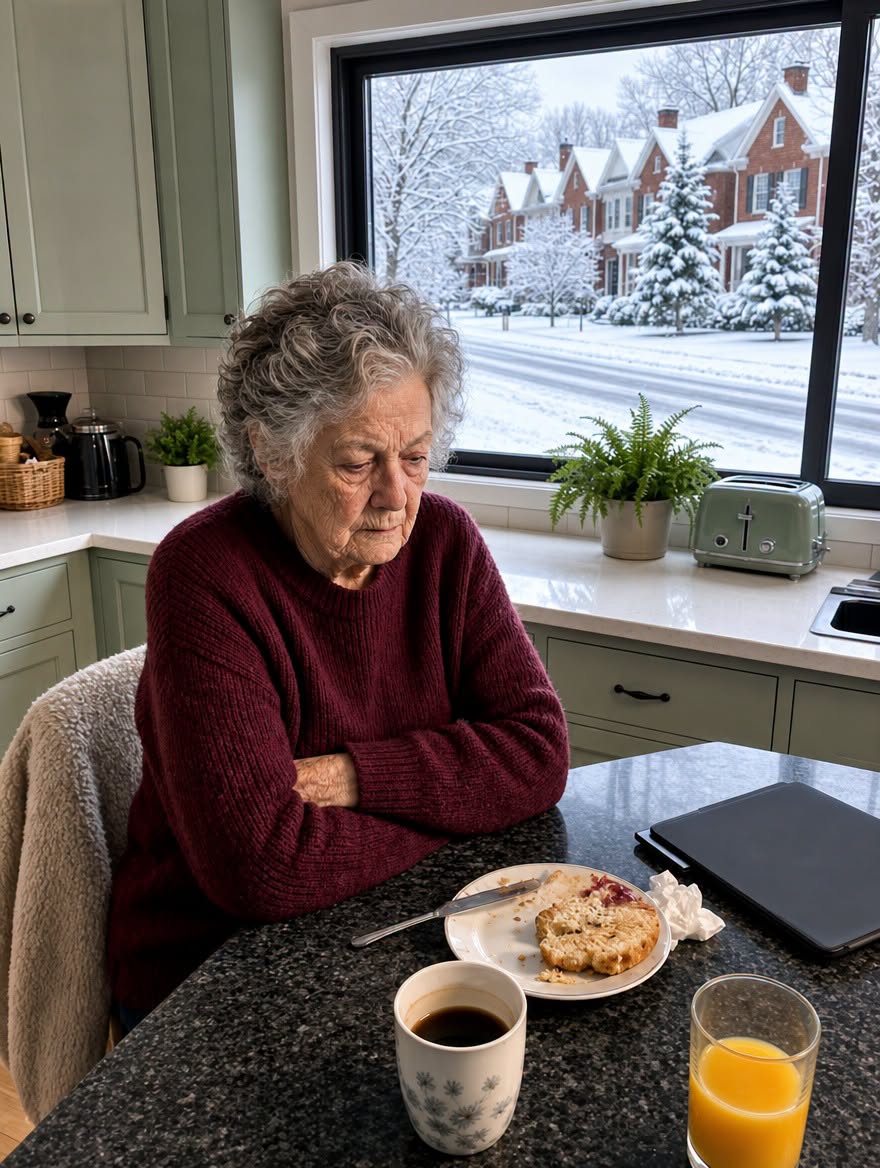
The air in the house always smelled of cinnamon and floor wax during the holidays, a comforting aroma that masked a bitter truth I had spent decades refusing to see. Returning home from a quiet, windswept trip to Oregon—clutching my late husband’s woolen scarf tightly around my shoulders—I finally sat down at the kitchen table to do something I should have done years ago: I tallied the numbers. I calculated precisely how much capital I had poured into subsidizing my son Preston, his partner Bianca, and their increasingly entitled lifestyle.
The totals sprawled across the ledger were staggering, a harsh cold splash of reality. For nearly three unrelenting years, Preston had lived under my roof completely rent-free. But that was merely the baseline. Month after month, I had absorbed the full weight of the household overhead—the soaring electricity bills, the high-speed internet required for their endless devices, the overflowing grocery carts filled with specialty items, school fees, temporary emergency costs, and, most glaringly, a luxury twenty-four-thousand-dollar family lodge trip that I had paid for entirely out of my own retirement savings.
My paperwork made the situation undeniable. There was no room for argument or gaslighting. The property deed sat in my hands, bearing only my name, a solitary testament to who actually owned the roof over their heads. Resting directly on top of my financial calculations was page one of a legal thirty-day notice, demanding that Preston and Bianca vacate the premises.
When I handed them the notice, the chaos began precisely as I expected. Preston immediately shifted into theatrical victimhood, trying to portray my boundary as a cruel, heartless punishment directed at his innocent children. But I looked him straight in the eye and dismantled his narrative piece by piece. I explained, in a voice entirely devoid of the trembling hesitation of my past, that the children were always welcome to visit their grandmother anytime they pleased. The notice was strictly for the two adults orchestrating a cruel family plan behind my back.
Bianca, never one to miss an opportunity to deflect blame, immediately stepped in with a grievance of her own. She argued loudly that her parents had suffered financial losses because the luxury lodge trip had been canceled due to mounting tensions. Without missing a beat, I slid the cancellation record across the table. The document proved indisputably that I alone had paid for every cent of the vacation, and that Bianca’s parents had not invested a single penny of their own money. Therefore, they had lost nothing. Their frantic complaint about finances did not expose an injustice; it exposed how deeply and shamelessly dependent they had become on my ongoing generosity.
True to the legal timeline, Preston and Bianca packed their bags and left within the mandated thirty days. Preston rented a modest apartment nearby, while Bianca vanished from my life entirely, retreating into the background like a shadow that had finally lifted. I didn’t feel a sudden rush of triumphant euphoria. What I felt was infinitely better: a profound, steady peace. For the first time in years, I had absolute control over my home, my space, and my finances.
The ripples of my decision, however, were only beginning to spread through the wider family tree. A screenshot of a family group chat soon leaked and circulated among my relatives, exposing a sickening truth. It revealed that many of my extended family members had actively discussed abandoning me in my old age—treating me as an aging convenience—while simultaneously continuing to use my money, my home, and my resources as their personal bank.
The moment my financial support vanished from the equation, a deafening silence fell over them. Many of those relatives stopped calling, stopped visiting, and stopped sending polite holiday texts, finally realizing that the woman they had taken completely for granted was no longer willing to fund their misbehavior or finance their lives. The transactional nature of their affection was laid bare for all to see.
Months later, amid the quiet rhythm of my restructured life, an unexpected piece of mail arrived in my mailbox. It was a genuine, four-page handwritten letter from Preston. There were no demands, no excuses, and no attempts to manipulate me. Instead, it was an unvarnished confession. He admitted that he had actively approved the family plan to marginalize and abandon me. He confessed that he had spent years confusing a mother’s unconditional love with an absolute entitlement to financial rescue. Crucially, unlike every other letter or phone call in the past, he did not ask me for a single dime.
That letter marked the slow, fragile beginning of a new chapter. Our relationship did not heal overnight, but it began to mend through small, deliberate actions. We started meeting for neutral coffee dates in town, and Preston consistently brought the children along, allowing us to rebuild our bond away from the toxic influence of the past. When he came to my house, a noticeable shift had occurred. He entered politely through the front door, waiting to be invited in, rather than swaggering around as though the entire property belonged to him by right. I noticed with a quiet sense of validation that he had finally stopped treating my generosity as an automatic inheritance.
As for myself, I kept my late husband’s scarf draped over my chair, and I continued traveling—only now, my journeys were entirely my own. I no longer packed my bags to escape family drama or to chase after people who treated me like an afterthought. I traveled according to my own deep desires, mapping out routes that brought me joy rather than obligation.
Looking back, I understood the painful anatomy of what had happened. My family had gradually, systematically transformed my open-handed generosity into a hard expectation, gambling that my fear of confrontation and my desire to keep the peace would prevent me from ever setting boundaries. They had relied on my embarrassment to keep me silent.
But I learned a vital, late-in-life lesson through the wreckage: being needed by people has never once guaranteed that you are actually loved by them. By cutting the financial cords and tearing down the illusions, I finally chose dignity, independence, and absolute control over the remainder of my life. The house was quiet, the bills were manageable, and my heart was finally my own.