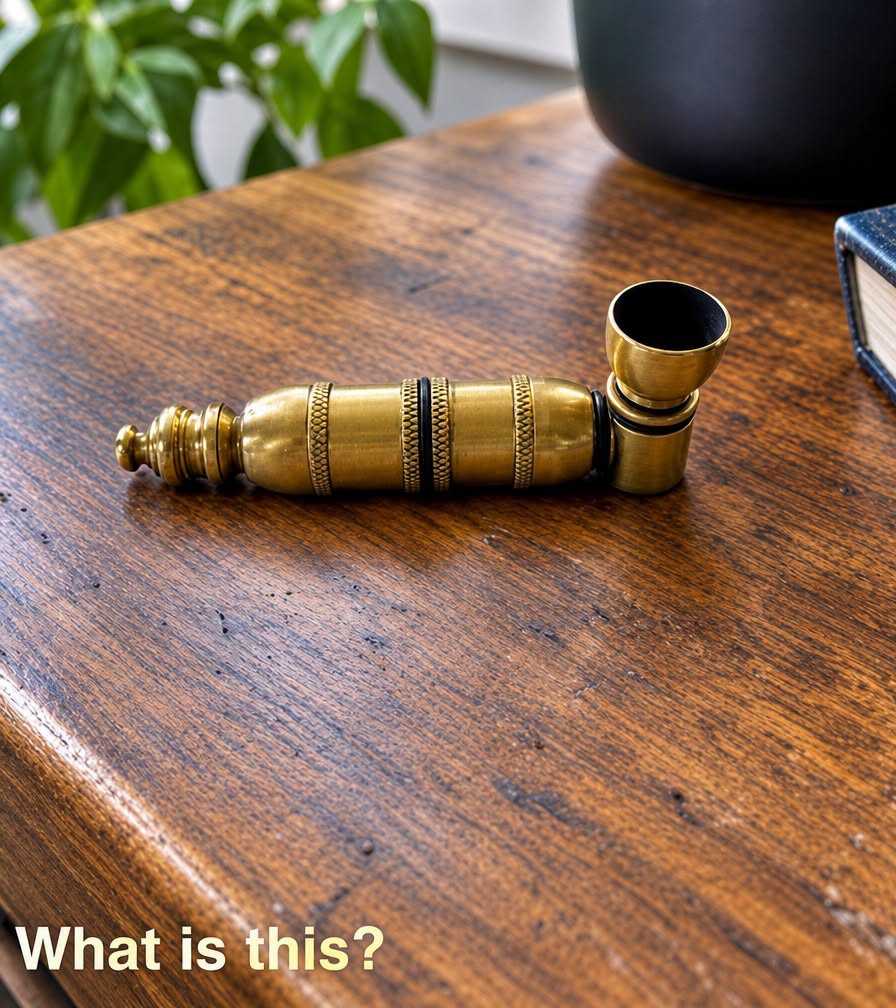
Sometimes, the most captivating discoveries are not unearthed in museums, antique shops, or high-priced collections. They sit hidden in everyday spaces, waiting quietly for someone to pay attention. An overlooked box, an old wooden cabinet, or a dusty drawer can hold an object that prompts far more questions than answers.
That is precisely what occurred when I stumbled upon a small brass object among my grandfather’s belongings.
My grandfather was an enthusiastic collector who delighted in saving unusual items. Over the years, he had gathered pieces of varying shapes, sizes, and materials. Some served a decorative purpose, others appeared practical, and a few were so unique that their original function was not immediately clear.
His collection reflected a lifelong curiosity about bygone eras. He seemed to value items that other people might easily overlook, particularly objects that carried the character of another time.
While searching through one of his old drawers, I caught sight of something small resting amidst the accumulated dust. At first glance, it did not look especially remarkable. It was merely a tiny brass piece, partially concealed among other forgotten items.
Yet, as soon as I picked it up and examined it more closely, I began to wonder what it could actually be.
A Small Object With an Unusual Appearance
The first aspect that caught my attention was its material. The object bore the warm, muted tone characteristic of aged brass. Its surface displayed subtle signs of wear, indicating that it had been handled or stored for a considerable length of time.
However, its exact age was impossible to determine based purely on its appearance.
What made it particularly intriguing was the sheer amount of detail packed into such a tiny piece. Its shape and decorative accents gave it a distinctive look, unlike the ordinary metal items we encounter every day.
I turned it gently between my fingers, observing it from various angles.
There were tiny details that proved easy to overlook initially. Certain areas appeared more pronounced than others, and the overall design seemed to have been crafted with real care.
Was it an item used around the house? Could it have been part of a larger instrument or device? Perhaps it was a decorative fitting, a component from an older tool, or something created for a purpose that is no longer familiar today.
Without clearer photographs, exact measurements, and a thorough look at how it was constructed, none of these possibilities could be verified.
Even so, that very uncertainty made finding it all the more enjoyable.
Why Old Brass Objects Can Be So Intriguing
Brass has served a wide range of functions throughout history. Because it can be shaped, worked, and finished in so many ways, it has been used for decorative accents, household fittings, instruments, tools, and countless other goods.
Its warm color also gives it a distinct visual charm, particularly when an object forms a natural patina through age and exposure.
Still, the material alone cannot tell us precisely when a piece was manufactured.
Many modern items are crafted from brass, and older objects may have been cleaned, polished, restored, or modified over time. Surface wear and discoloration offer clues about an item’s condition, but they are not definitive proof of a specific date or origin.
That is why the small object in my grandfather’s drawer remained such a mystery.
Its material offered a starting point, but its overall form and construction would play a much larger role in uncovering what it actually was.
A specialist would likely evaluate its dimensions, weight, maker’s marks, joints, moving parts, and any symbols or inscriptions that might help clarify its function.
Even an obscure feature on the underside could yield a valuable clue.
Until those details are known, the best approach is to remain curious without jumping to conclusions.
The Stories Hidden in a Collector’s Drawer
One of the most fascinating aspects of discovering an old item is imagining how it made its way to its final resting spot.
Was it bought at an antique market? Did it belong to a relative? Was it picked up during a trip, recovered from the contents of an old home, or kept simply because its owner saw something special in it?
In this instance, the piece was discovered among the possessions of someone who truly enjoyed collecting unusual things.
That background makes the discovery feel much more personal.
Collectors frequently keep objects for reasons that might not be obvious to anyone else. An item might carry historical interest, practical utility, sentimental value, or simply a look that captured the owner’s imagination.
While some collectors maintain thorough records of their acquisitions, others gather items across many years without documenting every single find.
If my grandfather kept notes on where this piece originated, those records could prove just as valuable as the item itself. A receipt, a handwritten tag, a photo, or an old catalog entry might help clear up its background.
Without that documentation, its story remains incomplete.
Yet an incomplete story is by no means an uninteresting one.
At times, the search for an answer becomes just as satisfying as the answer itself.
Could It Have Had a Practical Purpose?
The object’s small size and detailed crafting naturally prompt questions about how it might have been utilized.
Many older tools and mechanical parts were designed for very specific tasks. Some were built as components of larger devices, whereas others were meant to be handled on their own.
A tiny brass piece might have fulfilled a decorative role, helped secure another component, or served as part of a tool used in a specific trade.
It could just as easily have been created for personal use, perhaps as an accessory or ornament.
These, however, remain broad possibilities. The exact design of the object would need to be cross-referenced with documented examples before making any reliable identification.
For that reason, it would be premature to label it with a specific name based only on its material or aged look.
A sensible next step would be to photograph the object from multiple angles—including the front, back, sides, and bottom. Placing it beside a ruler in a photo would help establish its size.
Any visible numbers, letters, symbols, screws, hinges, openings, or moving parts should also be carefully documented.
Details like these could assist collectors or experts in narrowing down the possibilities and distinguishing it from items that look similar at a glance.
How to Investigate a Mysterious Antique
Anyone who stumbles upon an unfamiliar piece in an old collection can follow a few practical steps to discover more about it.
-
First, document its appearance. Take clear photos in natural lighting. Avoid using filters that alter the object’s natural color or obscure surface textures.
-
Second, record its dimensions. Measuring the length, width, thickness, and weight will help differentiate it from similar items.
-
Third, inspect it carefully without causing damage. Search for maker’s marks, stamped letters, serial numbers, or unique design traits. Avoid scraping the surface or using harsh chemicals to uncover hidden marks.
-
Fourth, research similar examples. Reference books on antiques, museum collections, specialized catalogs, and trusted collector groups can offer valuable insight. Compare similar-looking items closely, as small variations can point to completely different uses.
-
Finally, seek out an expert opinion when appropriate. An antique dealer or certified appraiser familiar with that specific category can offer a far more informed assessment.
If the object seems delicate or potentially valuable, avoid polishing or altering it prior to getting expert advice. Cleaning can occasionally strip away evidence of an original finish or reduce its historical value.
While these steps cannot guarantee an answer, they turn an intriguing discovery into a structured investigation.
The Value of Curiosity
What I appreciated most about coming across the brass object was not the thought that it might carry monetary value.
It was the reminder that our everyday surroundings can hold pieces of history we haven’t yet learned to recognize.
A single small object can offer a glimpse into historical manufacturing techniques, aesthetic tastes, practical needs, or the habits of those who once held it. Even something with little financial worth can be well worth preserving because it links us to a person, a family, or a specific period in time.
My grandfather’s collection provided endless opportunities to ask questions. Some objects were easy to identify right away, while others invited further investigation.
This particular piece clearly fell into the second group.
Its warm brass hue, intricate design, and forgotten placement in a dusty drawer made it a captivating mystery. Yet the primary question remains open: what was it originally designed to do?
Without proper identification or extra evidence, it would be misleading to call it rare, historically significant, or worth a specific price.
For now, it remains an unusual piece with a story waiting to be uncovered.
Perhaps a closer look will reveal a hidden mark that provides the answer. Perhaps another collector will recognize its unique shape. Or perhaps it will stay an open question until further information comes to light.
That uncertainty is half the charm.
What do you think this tiny brass object might be? Have you ever stumbled upon an unfamiliar item in an old family collection and spent hours trying to figure out what it was? Share your thoughts and stories in the comments. If you happen to have a similar item, clear photos and details about its dimensions or markings might help others compare them.