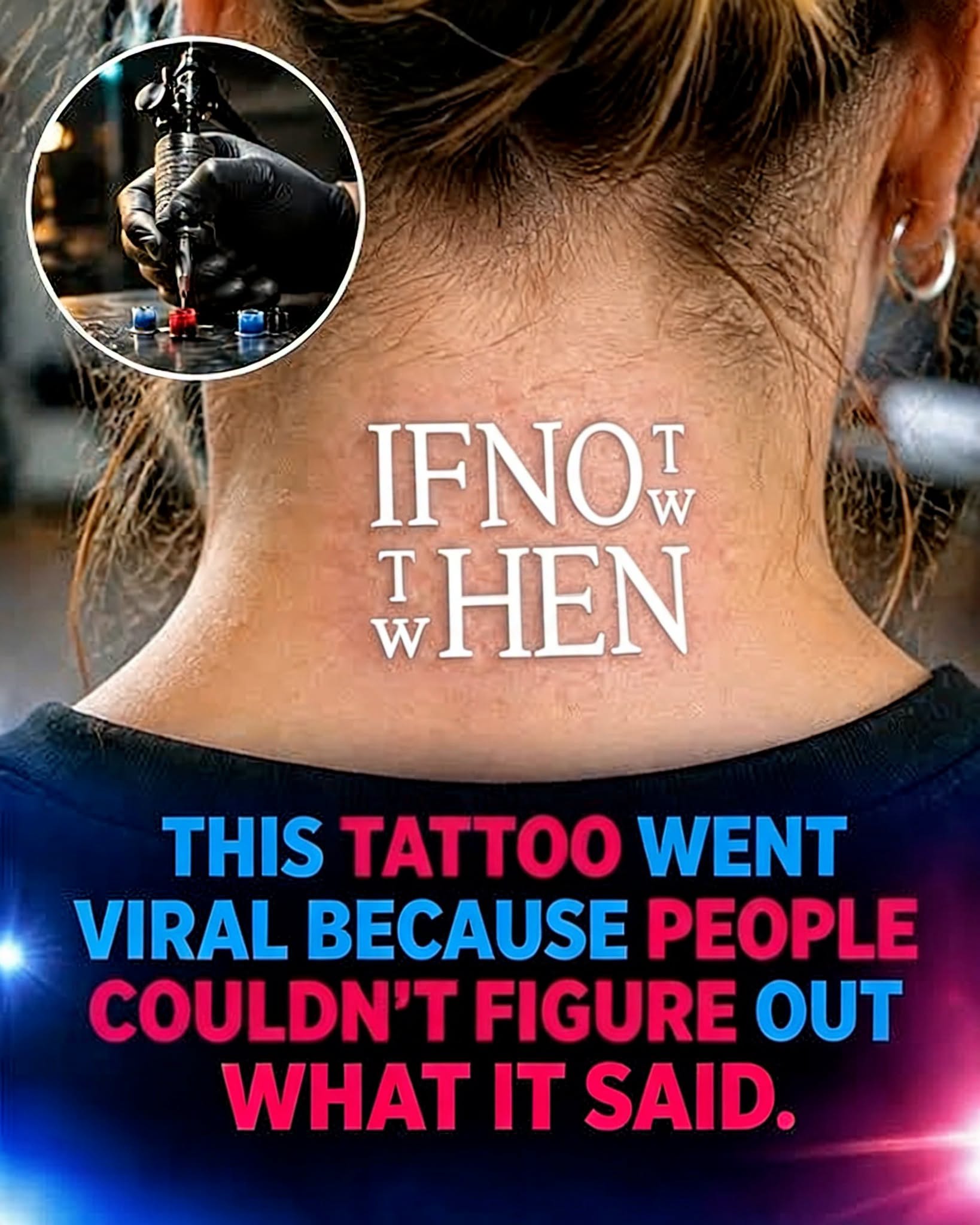
Sometimes, a picture can capture people’s attention without showing anything particularly complicated. A simple design, an unusual arrangement of letters, or a detail that is difficult to understand at first glance can be enough to make someone stop scrolling and take a closer look.
That is exactly the kind of curiosity created by an unusual tattoo that attracted attention online. At first, the design appeared to be nothing more than a collection of random words arranged across someone’s skin. The letters seemed confusing, and there was no immediately obvious way to read the message.
However, the more people examined the design, the more interesting it became.
Some viewers believed they understood the message almost immediately, while others needed to study the lettering several times before recognizing the possible meaning. The unusual arrangement encouraged people to zoom in, change their viewing angle, and compare different interpretations.
What made the tattoo interesting was not simply the presence of words. It was the way those words had been arranged to create a visual challenge.
The design offers an interesting example of how typography, creativity, and human perception can work together. It also demonstrates why optical illusions and visual puzzles continue to attract attention across social media platforms.
Why the Unusual Tattoo Caught People’s Attention
Most tattoos are designed to communicate something through recognizable images, symbols, words, or patterns.
Some people choose flowers, animals, meaningful dates, or family names. Others prefer short quotations, inspirational messages, or artistic designs that represent important experiences in their lives.
The unusual tattoo discussed here takes a different approach.
Rather than presenting its message in a straightforward line of text, the lettering appears to be arranged in a way that makes it difficult to understand immediately.
This creates a small puzzle for anyone looking at it.
At first glance, the viewer may recognize individual letters or words without understanding how they fit together. The brain attempts to organize the information, but the unusual arrangement makes the reading process less automatic.
That moment of uncertainty is what encourages people to look again.
When someone finally recognizes a possible message, the experience can feel surprisingly satisfying. A design that initially seemed confusing may suddenly appear much easier to understand.
This is one reason visual puzzles are so effective at attracting attention.
They invite participation rather than simply asking people to look at an image.
The Psychology Behind Hidden Messages and Optical Illusions
The human brain processes visual information constantly.
Every time we look at an object, read a sentence, or recognize someone’s face, our brains organize information and compare it with patterns we have encountered before.
Under normal circumstances, this process happens very quickly.
For example, reading a familiar word does not usually require examining every individual letter. We recognize common letter combinations and use the surrounding information to understand the meaning.
However, unusual typography can interrupt this familiar process.
When letters are placed in unexpected positions, arranged vertically, reversed, or combined with unusual spacing, the brain may need additional time to interpret them.
This creates an experience similar to solving a visual puzzle.
The viewer is no longer simply reading a sentence. They are trying to discover the correct way to interpret the arrangement.
This process is closely connected to visual perception, which describes how people organize and understand information received through their eyes.
Different people may approach the same design in different ways. Some notice the larger pattern first, while others focus on individual letters and gradually work out the overall message.
The experience can also depend on viewing conditions, image quality, lighting, and familiarity with the style of lettering.
A design that seems obvious to one person may remain confusing to another.
How Typography Can Turn Ordinary Words Into a Puzzle
Typography is the art and technique of arranging letters and text.
It plays an important role in everything from book covers and advertisements to websites, posters, logos, and artistic projects.
Although typography is often associated with readability, designers sometimes use lettering in creative ways that deliberately challenge conventional reading habits.
For example, words can be arranged in circular patterns, mirrored across a central point, placed vertically, or positioned so that different letters appear to overlap.
These techniques can produce interesting visual effects.
A phrase may look like a decorative pattern until the viewer discovers how the letters are supposed to be read.
This type of design can be particularly effective in tattoos because the human body provides a different surface from ordinary paper or a computer screen.
The artist must consider the shape of the body, the available space, the natural curves of the skin, and how the design will appear from different viewing angles.
A lettering design placed on an arm may look different when the arm is straightened, bent, or rotated.
Likewise, a design placed along the shoulder, wrist, or back may require a particular viewing position to make its arrangement easier to understand.
These considerations make unusual text-based tattoos an interesting combination of graphic design and personal expression.
Why Visual Puzzles Spread So Easily on Social Media
Social media platforms are filled with photographs, short videos, quizzes, and visual challenges.
Among the most engaging posts are those that encourage viewers to participate.
A photograph of a beautiful landscape may be enjoyable to look at, but a picture containing a hidden detail can create a different kind of response.
People want to solve the mystery.
They may zoom in, share their interpretation, compare answers with friends, or return to the image after someone suggests another way of looking at it.
This participation can help a visual puzzle generate discussion.
Optical illusions are particularly suitable for this type of interaction because they create different experiences for different viewers.
Some people may notice a hidden shape immediately. Others might need an explanation before understanding what the image is intended to show.
The same principle can apply to unusual lettering.
When viewers believe they have discovered a hidden message, they may want to share their discovery with others.
The resulting discussion can help a simple image travel beyond its original audience.
However, online popularity does not necessarily mean that every viewer has interpreted an image correctly. Without the original artist’s explanation or a clear view of the complete design, different interpretations should be treated with caution.
Tattoos as a Form of Personal Expression
Although the unusual lettering has attracted attention because of its visual appearance, tattoos have a much broader significance.
For many people, body art is a personal form of expression.
A tattoo may represent a family relationship, an important life experience, a personal belief, or a memory that someone wants to preserve.
Others choose tattoos because they appreciate the artistic qualities of a particular design.
There is no single reason why people decide to get tattooed.
Some prefer small and subtle designs, while others enjoy larger pieces that incorporate several visual elements.
Text-based tattoos are especially interesting because they can communicate ideas directly.
A person’s chosen words might come from a favorite book, a meaningful conversation, a personal motto, or a phrase associated with an important memory.
However, not every lettering tattoo needs to be immediately understandable to everyone who sees it.
Some designs are intentionally personal, allowing the wearer to decide how much meaning they want to share with others.
In that sense, an unusual tattoo can serve two purposes. It can be an artistic design that attracts attention while also carrying a private meaning for the person wearing it.
Why Choosing the Right Lettering Matters in Tattoo Design
Anyone considering a text-based tattoo should think carefully about the design before making a final decision.
Unlike writing on paper, a tattoo becomes part of the skin and requires long-term consideration.
The style of lettering is particularly important.
A highly decorative font may look attractive in a digital design but become difficult to read when reproduced at a smaller size.
Similarly, letters that are positioned too close together may become less distinct over time.
Tattoo artists generally need to consider several practical factors when creating lettering designs:
-
- Readability: The letters should be clear enough to communicate the intended message.
-
- Placement: The design should complement the natural shape of the body.
-
- Size: The lettering should be appropriate for the amount of text being used.
-
- Spacing: Individual letters and words need enough separation to remain recognizable.
-
- Style: The typography should match the overall artistic intention.
-
- Long-term appearance: The design should be planned with the natural aging of tattoos in mind.
For unusual optical designs, these considerations become even more important.
A tattoo that relies on precise letter positioning may need additional planning to ensure that the visual effect works properly on the chosen part of the body.
Discussing the concept with an experienced tattoo artist can help identify potential problems before the design is applied.
The Importance of Understanding a Tattoo Before Getting One
Creative tattoo designs can be exciting, particularly when they contain hidden words or unusual visual arrangements.
However, anyone considering a similar tattoo should take time to understand exactly what the design communicates.
This is especially important when the wording comes from another language or uses unfamiliar symbols.
A phrase that looks attractive may have a different meaning than expected. Likewise, an unusual arrangement may create confusion if the letters are not positioned correctly.
Before choosing a permanent design, it is sensible to:
-
- Confirm the exact wording and spelling.
-
- Check the intended meaning with a reliable source.
-
- Ask an experienced artist to prepare a clear design.
-
- Examine how the lettering looks from different angles.
-
- Consider whether the design will remain meaningful over time.
These simple steps can help people make informed decisions about body art.
A tattoo should be something the wearer feels comfortable with, rather than a choice made simply because a design is attracting attention online.
What Makes a Hidden-Message Tattoo Memorable?
There are many reasons why a tattoo might stand out.
Some designs attract attention because of their size or color. Others are memorable because they contain detailed artwork or represent an important personal story.
A hidden-message design introduces another element: discovery.
Instead of understanding the entire tattoo immediately, viewers are encouraged to spend time examining it.
This creates a small interaction between the artwork and the person looking at it.
The viewer notices something unusual, attempts to understand the arrangement, and gradually develops an interpretation.
That process can make the design more memorable than an ordinary piece of lettering.
It also creates an opportunity for conversation.
People may discuss how the words are positioned, whether the design is easy to read, and what techniques could have been used to create the effect.
Even when viewers disagree about the intended message, the design has succeeded in encouraging them to engage with the artwork.
Final Thoughts: Sometimes, Looking Again Makes All the Difference
The unusual tattoo that attracted attention online is a reminder that creativity does not always depend on complicated materials or elaborate artwork.
Sometimes, a simple arrangement of letters can be enough to create something interesting.
By presenting familiar words in an unexpected way, an artist can turn ordinary typography into a visual challenge that encourages people to look more closely.
The appeal comes from the combination of curiosity, visual perception, and the satisfaction of recognizing a pattern.
Tattoos already have a special place in personal expression, allowing people to preserve meaningful words, memories, and artistic ideas.
When creative lettering is added to the equation, the result can become even more distinctive.
Whether someone appreciates the tattoo for its artistic design, its unusual arrangement, or the challenge of understanding its message, the experience demonstrates how a small visual detail can capture attention.
And perhaps that is the most interesting lesson behind the design: sometimes, the things we understand least at first glance are the ones that encourage us to take a second look.