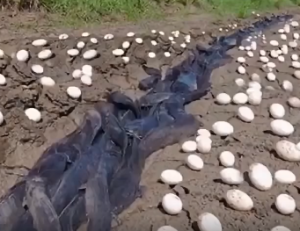
An ordinary day on a family farm reportedly took an unexpected turn when a farmer named Jack came across hundreds of unusual eggs scattered throughout his cornfield. What initially seemed like an inconvenience quickly developed into a mystery that attracted the attention of his entire family.
Jack had been working among his crops when he noticed several groups of eggs in different sections of the field. Their unexpected presence immediately raised questions. What kind of animal had left them there? Were they from wild creatures or domestic birds? More importantly, how could the family protect them without interfering with the regular activities of the farm?
At first, Jack considered removing the eggs so he could continue his work without interruption. Maintaining a farm requires constant attention, and unexpected obstacles can create practical problems, particularly in fields where tractors, harvesting equipment, and other machinery are regularly operated.
However, his daughters, Mary and Gisele, encouraged him to investigate the discovery before making any decisions. Their curiosity and concern for whatever might be developing inside the eggs eventually influenced how the entire family approached the situation.
An Unexpected Discovery Among the Crops
For Jack, the unusual discovery presented a difficult situation. He wanted to keep his farmland productive, but he also understood that the eggs might belong to animals living in the surrounding environment.
Mary and Gisele were especially interested in discovering what was inside them. Rather than viewing the eggs as an inconvenience interfering with their father’s agricultural work, they wondered whether developing animals might be inside and whether those creatures needed protection.
Their mother, Bonnie, also became involved in the discussion. She encouraged her daughters’ curiosity while recognizing that the family needed to handle the situation responsibly.
Without identifying the eggs, nobody could determine which species they belonged to or what conditions might be necessary for their survival.
The family therefore had several possibilities to consider. The eggs might have belonged to birds, reptiles, or another animal entirely. Their appearance alone could not provide a dependable identification.
Although the account presents the discovery as extraordinary, its details have not been independently verified. Nevertheless, it raises an interesting question about how people should respond when they encounter unfamiliar eggs or possible wildlife nests on agricultural property.
Why Unidentified Eggs Should Be Left Undisturbed
Discovering eggs outdoors can be an exciting experience, particularly for children who enjoy observing animals and learning about nature. However, touching, relocating, or disturbing unidentified eggs can create serious difficulties for the developing animals.
Different species produce eggs with varying shapes, sizes, colors, and textures. Although these characteristics can sometimes offer useful clues, they are not always sufficient to determine exactly which animal laid them.
The surrounding environment can also provide important information. Certain birds construct nests in trees, bushes, or other protected locations, while some reptiles deposit their eggs in soil, sand, or sheltered ground.
Because these behaviors differ considerably between species, making assumptions based solely on an egg’s appearance or location can lead to incorrect conclusions.
Agricultural properties introduce additional complications because planting, irrigation, harvesting, and machinery regularly disturb the land. When eggs are discovered in an active field, continuing normal operations without examining the surrounding area could accidentally damage a nest or interfere with developing wildlife.
A sensible first response is to keep people and equipment away from the immediate location until the situation has been assessed.
Wildlife professionals, agricultural specialists, or relevant local authorities may be able to identify the eggs and recommend an appropriate course of action.
Some species and their nests are protected by local wildlife regulations. Moving eggs without proper authorization or sufficient knowledge could harm the animals and potentially create legal complications.
A Family Decision to Show Compassion
According to the account, Mary and Gisele convinced their father to reconsider his original intention.
They wanted to give the eggs an opportunity to develop rather than immediately removing them from the field.
Jack listened to his daughters and began considering whether there was a way to protect the discovery while continuing the family’s regular farming responsibilities.
Bonnie supported their interest, although she also understood that nobody yet knew what kind of animals might eventually emerge.
The family reportedly prepared a sheltered space inside their barn, placing straw in an effort to create a protected environment for the eggs.
Although this detail adds an emotional element to the story, relocating unidentified eggs into a barn would not necessarily be the correct decision in a real-life situation.
Different species require particular conditions to develop successfully. Temperature, humidity, positioning, and environmental stability can all influence whether eggs survive and hatch.
Changing those conditions without understanding the species involved could damage the eggs.
A more appropriate approach would be to consult a qualified specialist before moving them. If the eggs belong to domestic poultry, an experienced poultry keeper might provide useful guidance. If they belong to wild animals, a wildlife professional can help determine whether they should remain in their original location.
The family’s willingness to stop and reconsider their initial response offers an important lesson: compassion matters, but responsible decisions also require accurate information.
Waiting for the Mystery to Be Solved
The days following the discovery reportedly brought a mixture of excitement and uncertainty to the household.
Mary and Gisele remained fascinated by the eggs and continued wondering what kind of creatures might eventually emerge.
Their enthusiasm reflected the curiosity children often experience when they encounter something unfamiliar in nature.
For Jack and Bonnie, however, there were practical concerns to consider.
A working farm has limited space and resources, and caring for newly hatched animals can involve responsibilities that extend well beyond the excitement of seeing them emerge.
If the eggs produced healthy young animals, the family would need to identify their species and understand their specific needs.
They would also have to determine whether their property could provide adequate shelter, food, protection, and long-term care.
These considerations are important whenever people become involved in caring for unexpected wildlife.
Successfully hatching eggs does not automatically mean that the resulting animals can be kept as household pets or farm animals. Their natural behavior, welfare requirements, and any applicable regulations must also be taken into account.
According to the account, the family remained interested in the outcome and continued waiting for answers.
The Reported Arrival of Young Peafowl
The story describes an eventual hatching that reportedly revealed young peafowl, commonly known as peachicks.
For the family, watching the young birds emerge would have been an unforgettable experience after several days of uncertainty.
Jack was reportedly emotional about the discovery, while Bonnie, Mary, and Gisele shared in the excitement.
However, the reported discovery and hatching have not been independently confirmed. The account should therefore be understood as an unverified story rather than an established wildlife event.
There is also an important distinction in the terminology used to describe these birds.
Young peafowl are called peachicks. Adult males are commonly known as peacocks, while adult females are called peahens. Peafowl is the general term for the species.
If hundreds of peafowl eggs were discovered in an agricultural field, determining their origin would be an important part of understanding the situation.
Peafowl are raised on farms and private properties in various locations, meaning their presence could have several possible explanations.
A qualified specialist could help determine whether the eggs belonged to a nearby flock, came from managed birds, or had another origin.
Understanding the Needs of Peafowl
Peafowl are large birds recognized for their distinctive appearance and colorful plumage.
Adult males of many varieties develop impressive ornamental trains with eye-like markings, while females generally have shorter tails and less elaborate coloring.
Despite their attractive appearance, peafowl require suitable living conditions and attentive care.
They need sufficient space, access to clean drinking water, appropriate nutrition, and protection from predators and extreme weather.
Their behavior can also surprise people unfamiliar with the species. Peafowl are capable of producing loud calls, particularly during breeding periods or when responding to disturbances.
They may also wander beyond their immediate surroundings, and some are capable of flying short distances.
Young peachicks have additional requirements because they are still developing.
They need appropriate starter feed, suitable environmental temperatures, clean water, and regular monitoring as they grow.
Anyone considering raising these birds should understand their dietary, housing, and health requirements beforehand. Guidance from experienced keepers or an avian veterinarian can help ensure that their needs are properly met.
Why the Family Could Not Keep Every Bird
According to the story, the family eventually encountered another challenge.
Although they had become emotionally interested in the young birds, their farm did not have sufficient space to accommodate all of them.
Jack and his family reportedly decided to keep two peachicks while arranging for the remaining birds to be transferred to a sanctuary.
This part of the account highlights an important responsibility that often arises when people become involved in caring for animals.
It is natural to become attached to young creatures, particularly after watching them hatch and develop. However, responsible animal ownership requires considerably more than affection.
People must consider available space, appropriate shelter, food requirements, veterinary expenses, and the time needed to provide daily care.
Taking responsibility for more animals than a property can reasonably accommodate may eventually create difficulties for both the animals and their owners.
Finding a suitable sanctuary or qualified animal-care facility may be a better alternative when a family cannot provide appropriate long-term care.
Any transfer should be arranged with people who understand the species and have the resources necessary to look after the animals.
The family’s reported decision demonstrates an attempt to balance their emotional attachment with the practical responsibilities involved in caring for a large group of birds.
What This Story Can Teach Children About Wildlife
One of the most meaningful aspects of the account is the curiosity displayed by Mary and Gisele.
Children often develop an interest in nature through direct experiences. Discovering eggs in a field, observing birds, or encountering unfamiliar animals can encourage them to ask questions and learn about the environment.
Parents can use these opportunities to explain why wildlife deserves respect and why unfamiliar animals should not automatically be touched or moved.
Not every discovery requires immediate intervention. Sometimes, the most responsible decision is to observe from a safe distance and ask someone with appropriate knowledge for assistance.
These experiences can also introduce children to broader subjects, including animal development, natural habitats, biodiversity, and the responsibilities involved in caring for living creatures.
The most important lesson is not simply that unusual eggs might eventually hatch.
It is that curiosity should always be accompanied by patience, respect, and an understanding of animal welfare.
Balancing Farm Responsibilities With Wildlife Protection
Farmers regularly work on land that also provides habitats for birds, insects, small mammals, and other wildlife.
These encounters can occasionally create challenges, particularly when animals establish nests in locations regularly used for agricultural activities.
Protecting wildlife does not necessarily mean that farming operations must stop whenever an animal is discovered.
Instead, recognizing the situation early can help farmers make informed decisions and avoid unnecessary damage.
Depending on the circumstances and the species involved, possible measures might include temporarily avoiding a small section of land, adjusting the timing of certain agricultural activities, or contacting wildlife specialists for recommendations.
Planning and communication can help reduce conflicts between agricultural operations and the natural environment.
Farmers who understand the wildlife living around their properties may also become better equipped to recognize unusual activity and respond appropriately.
A Reminder About Compassion and Responsibility
The account of Jack, Bonnie, Mary, and Gisele describes an unexpected family experience that reportedly began with a discovery in a cornfield and developed into an opportunity to learn about animal care.
Although the specific events have not been independently verified, the broader message remains meaningful.
Unidentified eggs and unfamiliar wildlife should never be handled carelessly. Decisions involving their protection, relocation, or care should be guided by reliable information and appropriate expertise.
The family’s reported choice to keep only two birds while arranging another home for the others also highlights an important principle: responsible animal care involves recognizing personal limitations and placing the animals’ welfare first.
Sometimes, an ordinary day on a farm can introduce an entire family to something they never expected to encounter.
Whether the discovery involves birds, reptiles, or another species, patience, informed decisions, and respect for wildlife can transform an unexpected situation into a valuable learning experience.
Part 2: What Happened After the Family Discovered the Young Birds?
The discovery reportedly changed the way Jack and his family looked at their farmland.
Before that day, the cornfield had simply been another part of their property, a place where they planted crops, operated machinery, and worked through the changing seasons.
Now, it had become a place associated with an unexpected discovery and a series of questions they had never imagined asking.
Mary and Gisele were especially interested in learning more about the birds.
They began asking their parents questions about where peafowl normally lived, what they ate, how quickly they grew, and whether the young birds would eventually develop the colorful feathers they had seen in photographs.
Jack realized that his daughters were no longer simply fascinated by the eggs. They wanted to understand the animals and what it meant to care for them.
Bonnie encouraged their interest.
She believed the experience could become an opportunity for the girls to learn something that could not easily be taught through books or classroom lessons.
However, she also reminded them that caring for animals involved responsibilities that could not be ignored once the initial excitement disappeared.
One evening, while the family was sitting together at the kitchen table, Mary asked a question that made everyone stop.
“Dad, what happens if the birds don’t have anywhere else to go?”
Jack looked at his daughter.
“What do you mean?”
“What if nobody wants them?”
Gisele immediately joined the conversation.
“We can’t just leave them somewhere.”
Bonnie smiled gently.
“Nobody is suggesting that. But we have to find out what is best for them.”
Jack nodded.
He had been thinking about the same problem.
The farm was already home to several animals, and the family had limited space available. Keeping a large number of additional birds would require more than simply building another enclosure.
They would need proper facilities, suitable food, veterinary assistance, and someone capable of monitoring the birds as they developed.
He explained this to his daughters.
Mary looked disappointed.
“But we found them.”
“I know,” Jack replied. “And that’s exactly why we need to make sure they receive the right care.”
The conversation stayed with the girls.
The following morning, Bonnie suggested contacting an experienced bird keeper who could explain what the family should do.
They also discussed having the reported discovery assessed by a qualified wildlife professional to establish the birds’ origin and whether any special requirements applied.
Jack agreed.
He understood that making decisions based entirely on excitement could create problems later.
A few days afterward, the family began looking into suitable animal-care facilities.
They wanted somewhere that could provide enough space and appropriate conditions for the birds.
Mary and Gisele helped their mother gather information, comparing different facilities and learning about the responsibilities involved in keeping peafowl.
The experience gradually became more educational than they had originally expected.
They learned that animals could not always be cared for in the same way. A young bird required different attention from an adult, and a species raised in captivity might have different needs from one living in the wild.
They also discovered that moving animals from one location to another could create additional stress if it was not handled properly.
This made them understand why expert advice was important.
Meanwhile, Jack began reviewing the areas of the farm where wildlife regularly appeared.
He realized that agricultural properties could provide habitats for many creatures, even when their owners were primarily focused on producing crops.
Some animals visited temporarily, while others established nests and remained for extended periods.
He started thinking about whether there were ways to make the farm more accommodating to wildlife without interfering with its agricultural purpose.
Bonnie supported the idea.
She suggested identifying certain areas where wildlife could remain undisturbed whenever possible.
Mary immediately liked the suggestion.
“Could we make a place where birds can live without getting near the tractors?”
Jack smiled.
“Perhaps. But we’d need to plan it properly.”
Over the following weeks, the family discussed several possibilities.
They considered planting additional vegetation near the edges of the property, maintaining suitable sheltered areas, and being more attentive to wildlife activity before beginning major agricultural work.
They also discussed how important it was to avoid feeding unfamiliar wild animals without understanding their dietary requirements.
The experience had changed their perspective.
Previously, they had mostly thought about the farm in terms of crops, machinery, weather, and daily responsibilities.
Now, they were beginning to recognize that the surrounding environment was also home to creatures whose needs deserved consideration.
For Mary and Gisele, that was perhaps the most important lesson.
They had initially wanted their father to protect the eggs because they were curious about what might emerge.
But as they learned more, they began understanding that protecting animals meant making decisions based on what those animals actually needed.
One afternoon, Mary was helping Bonnie organize supplies when she asked another question.
“Do you think we’ll remember this when we’re older?”
Bonnie looked at her daughter.
“I think you will.”
“Even if the birds aren’t here anymore?”
“Especially then.”
Mary smiled.
She had begun to understand that an experience did not have to last forever to become meaningful.
The family eventually continued with its normal farm responsibilities, but they approached unexpected wildlife discoveries with greater awareness.
They also understood that keeping animals was not always the best way to help them.
Sometimes, providing a safe environment, contacting the right specialists, and allowing experienced people to take responsibility was the more compassionate decision.
Jack later reflected on how differently he might have handled the discovery if his daughters had not encouraged him to stop and reconsider.
He had initially seen the eggs as an obstacle to his work.
His daughters had seen something else.
They had seen the possibility of life.
And although the reported details of the discovery remain unverified, that difference in perspective is what makes the story meaningful.
A family does not need to become wildlife experts to show consideration for the natural world.
It only needs to recognize that its actions can affect other living creatures.
For Jack, the experience became a reminder that farming and wildlife protection do not always have to work against each other.
For Bonnie, it was an opportunity to teach her children that compassion must be accompanied by responsibility.
And for Mary and Gisele, it became a lesson they could carry into adulthood.
Sometimes, the most valuable discovery in a field isn’t what is hidden beneath the soil or growing among the crops. It is the opportunity to teach the next generation to care about something beyond themselves.