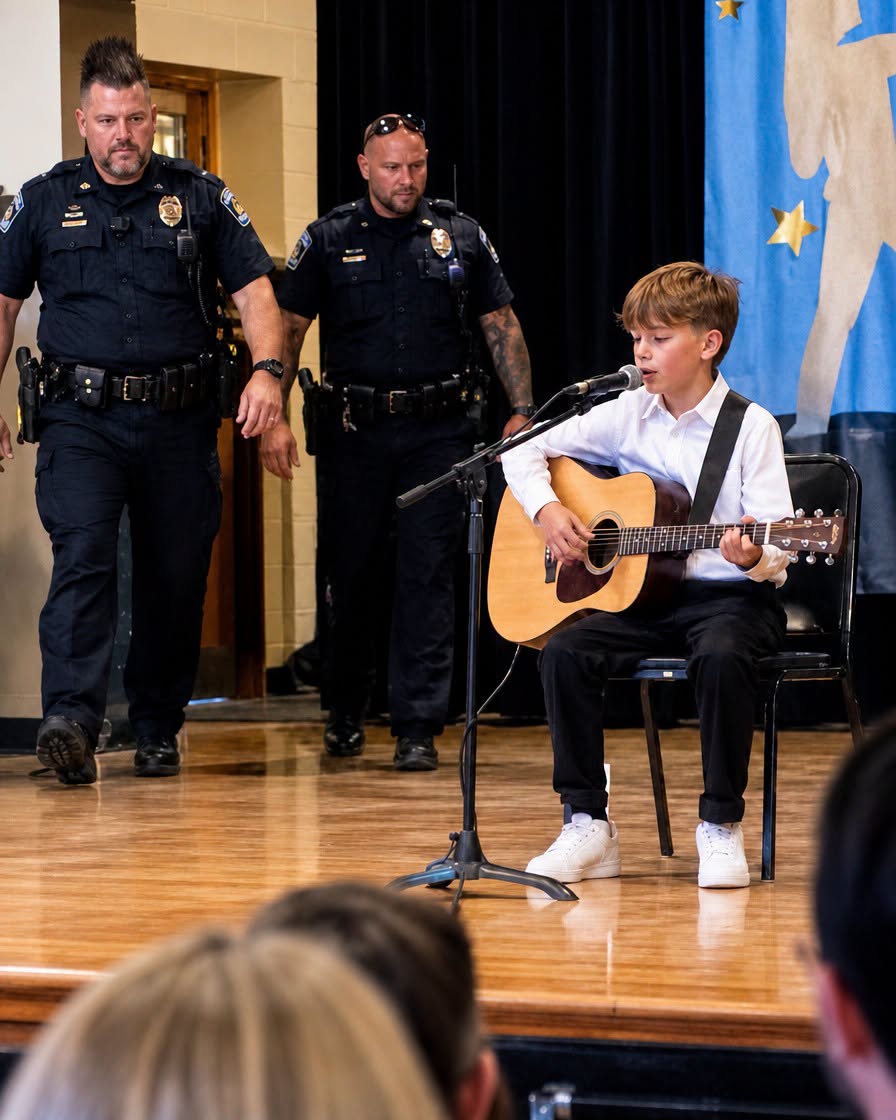
Caleb had barely touched his father’s old guitar since David passed away. So when my twelve-year-old son carried that guitar onto the stage during his school’s Father’s Day celebration, I knew something special was happening.
What I didn’t know was that two police officers would soon enter the school gym and reveal something about my late husband that would change our lives.
My name is Jennifer, and three years ago, I lost my husband after a long illness.
David had spent months receiving medical treatment. There were hospital visits, difficult days, and occasional moments when we allowed ourselves to hope that things might improve.
Our son Caleb was only nine when his father died.
At first, I believed he was coping well. He attended the funeral, returned to school, and rarely complained.
But as time passed, I noticed changes.
He stopped inviting friends over. He became quieter in class and gradually withdrew from activities he once enjoyed.
Whenever I mentioned his father, he usually changed the subject.
I tried asking whether he wanted to talk about his feelings.
His answer was almost always the same.
“I’m fine, Mom.”
But I knew he wasn’t.
Chapter 1: An Unexpected Decision
A week before Father’s Day, Caleb’s school announced a special assembly.
Students were invited to sing songs, share memories, read poems, or perform something meaningful in honor of their fathers and other important father figures.
When I read the announcement, I worried that the event might be difficult for Caleb.
That evening, I carefully brought it up.
“You know, you don’t have to participate if it makes you uncomfortable.”
He looked at me.
“Why wouldn’t I go?”
“I just thought it might bring back some difficult memories.”
He shook his head.
“I want to attend.”
I didn’t push him for an explanation.
The following morning, something unexpected happened.
Caleb came downstairs carrying his father’s old acoustic guitar.
I hadn’t seen him play it in months.
David had taught him his first chords when he was seven. They used to sit together on the living room couch, with David patiently helping him position his fingers.
Sometimes Caleb complained that his fingertips hurt.
David would laugh and tell him that learning something new required patience.
Those memories came rushing back when I saw the guitar.
“What are you planning to do with that?” I asked.
“I’m taking it to school.”
“For the assembly?”
He nodded.
“I’m going to play something for Dad.”
I felt tears gathering in my eyes, but I smiled.
“Your father would have loved that.”
Caleb adjusted the guitar strap.
“I hope so.”
Chapter 2: The Performance That Changed Everything
The school gym was decorated with handmade Father’s Day cards, colorful posters, and paper decorations.
Parents and relatives filled the folding chairs.
Some children performed songs with their fathers. Others shared stories about grandfathers, uncles, and people who had supported them.
I found a seat near the middle of the room.
Caleb sat with his classmates close to the stage.
When his name was announced, my hands became cold.
He walked onto the platform carrying David’s guitar.
The microphone was slightly too high, so his music teacher adjusted it.
Caleb looked around the room until he spotted me.
Then he took a breath.
“This song is for my dad,” he said.
He began playing.
I recognized the melody immediately.
It was one of David’s favorite songs. He used to sing it while preparing breakfast on Saturday mornings.
He wasn’t particularly interested in singing quietly. If there wasn’t music playing, he would create his own entertainment.
Sometimes he deliberately changed the lyrics just to make Caleb laugh.
Hearing the familiar melody again brought back memories I hadn’t thought about in months.
Caleb’s voice trembled during the opening lines, but he continued.
Soon, his singing became steadier.
Several parents began wiping their eyes.
His teacher watched from the side of the stage, smiling through her tears.
Then, just as Caleb reached the next part of the song, the gym doors opened.
Two police officers entered.
I immediately wondered whether something had happened.
They spoke briefly with a teacher before looking toward the stage.
Suddenly, both officers stopped.
The older officer appeared to recognize something.
He whispered to his colleague, and they remained near the back of the gym, listening to Caleb’s performance.
My son continued playing.
When the final chord faded, the room became completely quiet.
Then everyone stood and applauded.
Caleb looked overwhelmed.
His eyes filled with tears, and his shoulders began to shake.
I quickly made my way toward the stage.
The two officers were approaching too.
I couldn’t understand why they wanted to speak with my son, but I remained beside him.
Once we stepped outside the gym, the older officer introduced himself.
“My name is Officer Marcus, and this is Officer Alvarez.”
He looked at Caleb.
“What’s your name, son?”
“Caleb.”
Marcus glanced at the guitar.
“And your father’s name?”
“David.”
The officer’s expression immediately changed.
He looked at his colleague.
“I knew it,” he said quietly.
My heart began beating faster.
“You knew my husband?”
Marcus removed his cap.
“Yes, ma’am. We knew David through the community youth center.”
I was surprised.
David had worked in information technology for a regional insurance company. I knew he occasionally volunteered, but I hadn’t realized how involved he had been with the youth center.
Officer Alvarez smiled.
“Your husband was a wonderful volunteer. He helped young people understand online safety and responsible internet use.”
Caleb looked confused.
“My dad did that?”
Marcus nodded.
“He did much more than that.”
Chapter 3: The Story We Had Never Heard
The officers explained that David had volunteered at the center for several years.
He helped teenagers understand how to protect their personal information online, recognize suspicious messages, and respond when someone behaved inappropriately on social media.
He also spoke with parents about keeping children safe in an increasingly connected world.
“He was especially good at making young people feel comfortable talking about difficult subjects,” Marcus explained.
Officer Alvarez added that David sometimes brought his guitar and played music for the teenagers after their sessions.
Caleb tightened his grip on the instrument.
“He never told me about all that.”
Marcus smiled.
“Your father wasn’t someone who volunteered to receive recognition. He simply wanted to help.”
I felt both surprised and proud.
David had never presented himself as someone particularly important. He simply believed that helping others was something people should do whenever possible.
Then Marcus reached into his pocket and took out his phone.
“I think I have a photograph you might like to see.”
After scrolling through several pictures, he turned the screen toward us.
It showed David sitting in a chair at the youth center, holding his guitar.
Around him were several teenagers.
He was laughing, looking relaxed and genuinely happy.
Caleb immediately moved closer.
“Mom, look!”
I recognized my husband instantly.
For a moment, it felt as though we had been transported back to a time before his illness.
He looked healthy, energetic, and completely at ease.
Marcus sent me a copy of the photograph.
Then he invited us to visit the youth center whenever we felt comfortable.
“There are quite a few people there who remember your husband,” he said.
Caleb didn’t respond immediately.
But I could tell he was interested.
That evening, he spent nearly an hour looking at the photograph.
He zoomed in on the faces and studied the people sitting beside his father.
Finally, he asked a question that stayed with me.
“Why didn’t Dad tell us he helped so many people?”
I sat beside him.
“I think he was simply doing something he believed was worthwhile. He probably didn’t think he needed to talk about it.”
Caleb looked at the picture again.
“I thought I knew everything about him.”
I gently placed my hand on his shoulder.
“We can spend our whole lives learning new things about the people we love.”
He nodded.
Chapter 4: Meeting the People His Father Had Helped
The following Saturday, Caleb and I visited the community youth center.
He almost changed his mind when we arrived.
We sat in the car for several minutes.
“We can go home if you want,” I told him.
He looked at the entrance.
“Let’s go inside.”
Officer Marcus welcomed us.
He had told several former volunteers and young people that David’s family might visit.
We were greeted by a small group of people who remembered my husband.
One of the first was a young woman named Tasha.
She smiled when she saw Caleb.
“You’re David’s son, aren’t you?”
He nodded.
“Your dad was a wonderful person,” she said. “Although he could be pretty stubborn.”
Caleb looked surprised.
I laughed.
“That sounds familiar.”
Tasha explained that when she was younger, she frequently shared personal information online without thinking about the possible consequences.
David had patiently explained why she needed to be more careful.
At first, she ignored his advice.
Later, when someone she didn’t know began sending her uncomfortable messages, she remembered what David had taught her.
He helped her speak with her mother and report the situation.
“He never made me feel embarrassed,” Tasha explained. “He just wanted me to be safe.”
Another young man, Jordan, shared a different memory.
When he was in school, several classmates had created a fake social media account to make fun of him.
He became embarrassed and considered avoiding school.
David noticed that something was wrong.
Instead of dismissing the situation, he listened.
He encouraged Jordan to speak with his family and school staff and reminded him that someone else’s unkind behavior did not determine his worth.
“He kept checking on me,” Jordan said. “He made me feel like somebody cared.”
Caleb listened closely.
He had never known these stories.
One person after another shared similar experiences.
David had helped teenagers understand online privacy, digital responsibility, and the importance of treating others respectfully.
He also encouraged them to speak openly about loneliness, confidence, and the pressures young people sometimes experience.
I stood quietly, taking it all in.
My husband had been helping people in ways I had never fully understood.
Then Marcus brought out an old guitar.
“Your father sometimes used this during the program,” he told Caleb.
A teenager nearby joked that David only knew a handful of songs.
Everyone laughed.
Caleb laughed too.
It was one of the first genuine, carefree laughs I had heard from him in a very long time.
Chapter 5: A Small Change That Meant Everything
On the drive home, Caleb was unusually quiet.
After several minutes, he finally spoke.
“Do you think Dad knew those people would remember him?”
“I think he hoped he could make a difference.”
Caleb looked out of the window.
“I didn’t know he helped so many people.”
I thought carefully before answering.
“Sometimes the things people do for others become important long after they have forgotten doing them.”
That evening, Caleb came downstairs for dinner instead of taking his food to his bedroom.
A few days later, I received an encouraging message from his teacher.
She explained that Caleb had volunteered to lead part of a classroom project.
It was a small development, but it made me smile.
He also began spending more time with friends.
He joined a weekend soccer group and occasionally helped me prepare dinner.
His personality gradually began to shine again.
Of course, grief didn’t disappear.
There were still difficult days.
Sometimes a familiar song brought tears to his eyes. Other times, Father’s Day reminders made him unusually quiet.
I learned that healing didn’t mean forgetting someone.
It meant finding ways to remember them without allowing sadness to take over every moment.
One evening, Caleb and I were preparing dinner when he mentioned how his father used to burn onions while cooking.
“He always said they were supposed to look like that,” Caleb joked.
I laughed.
“Your father had an explanation for everything.”
Caleb laughed so hard that he had to put down the spoon.
For me, that moment was priceless.
It reminded me that memories could bring happiness as well as sadness.
Chapter 6: A Song That Brought Everyone Together
Several months later, the youth center organized a community fundraising event.
Officer Marcus contacted us and asked whether Caleb might consider performing.
At first, Caleb wasn’t interested.
But after thinking about it for a couple of weeks, he changed his mind.
On the evening of the event, I stood near the back of the room.
Caleb walked toward the small stage carrying his father’s guitar.
He looked nervous.
Marcus stood beside me.
“Think he’ll be okay?” he whispered.
I smiled.
“I hope so.”
Caleb adjusted the microphone and looked around.
Then he spotted me.
This time, instead of looking toward the ceiling, he smiled.
He faced the audience.
“This was one of my dad’s favorite songs,” he said.
He paused before continuing.
“For a long time, I thought hearing it would only make me sad because he wasn’t here anymore.”
The room became quiet.
“But now I think it reminds me that he was here, and that he made a difference.”
Then he began playing.
His fingers moved carefully across the strings.
His voice was steady.
When he reached the chorus, a few people quietly joined him.
I watched my son standing beneath the lights, playing the instrument his father had once taught him to use.
And I cried.
But this time, the tears felt different.
They weren’t only about losing David.
They were also about seeing Caleb rediscover something he loved.
When the song ended, the room filled with applause.
Marcus placed a hand on my shoulder.
“David would be proud.”
I nodded.
“I think so too.”
Caleb stepped away from the microphone and looked toward me.
His smile told me everything.
He had finally found a way to carry his father’s memory without feeling overwhelmed by the sadness of losing him.
Conclusion: The Love That Continues Through Memories
Losing David changed our family forever.
For a long time, I worried that Caleb would never feel like himself again.
I wanted to help him, but I didn’t always know how.
Meeting the two police officers opened a door we hadn’t known existed.
Through them, we discovered another side of David’s life.
We learned about the teenagers he had supported, the lessons he had shared, and the friendships he had built through his volunteer work.
Most importantly, Caleb discovered that his father’s influence had reached far beyond our home.
He began to understand that a person’s life is remembered not only through family photographs or personal belongings, but also through the kindness they show others.
Today, Caleb still has difficult moments.
He still misses his father.
But he also plays guitar, spends time with friends, and enjoys activities he once avoided.
The old guitar is no longer something he leaves untouched in a corner.
It has become a connection to the memories he wants to preserve.
I sometimes think about that school assembly and the moment two officers stopped at the back of the gym.
They entered the building for an ordinary community meeting.
Instead, they recognized a familiar song and discovered an opportunity to reconnect a family with memories of someone they had loved.
That unexpected encounter reminded us of something important.
We may never know how deeply our actions affect other people.
A small act of kindness, a few hours of volunteering, or a conversation with someone who needs encouragement can leave a lasting impression.
And sometimes, the people who benefit from those actions carry the memory forward for years.
David may no longer be sitting beside us on Saturday mornings, but the lessons he shared and the people he helped continue to be part of our lives.
Whenever Caleb picks up that guitar, I am reminded that love doesn’t disappear simply because someone is no longer physically present.
Sometimes, it continues through the memories we share, the kindness we pass along, and the lives we touch along the way.