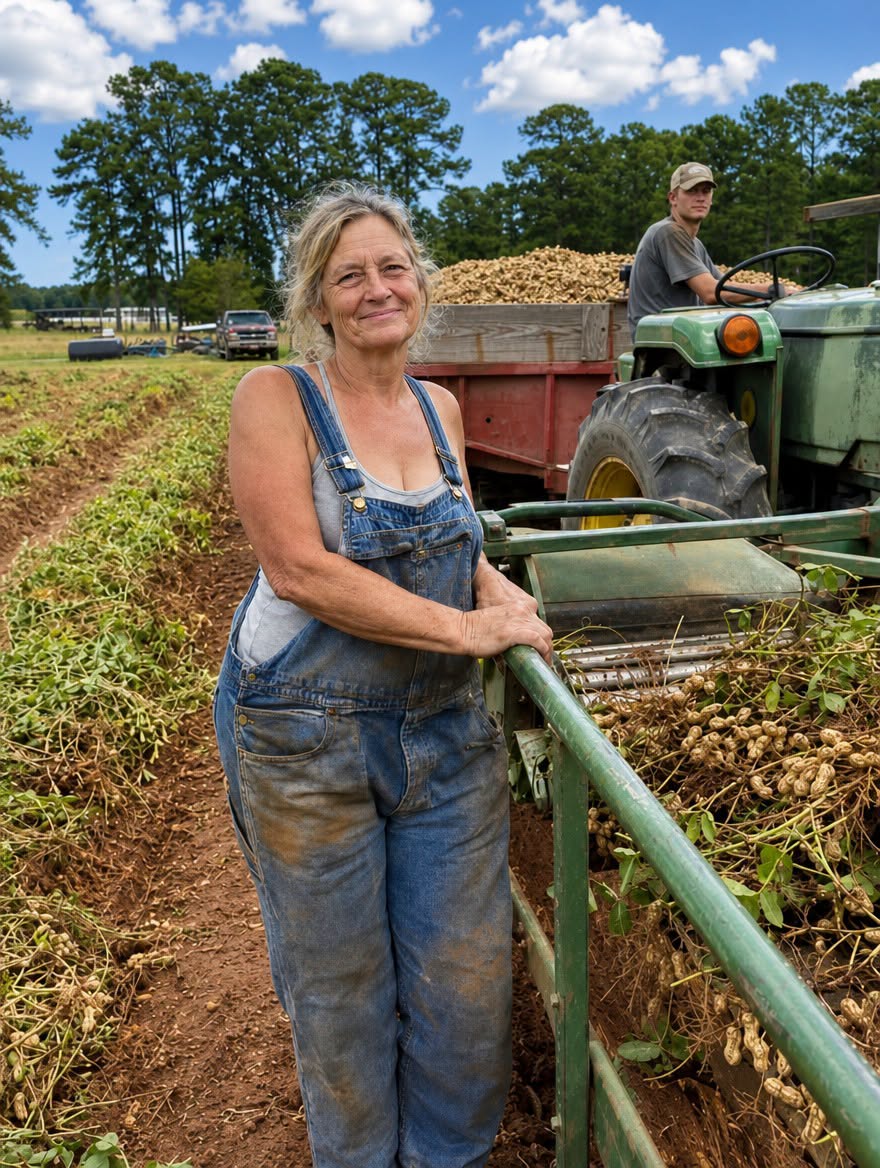
My husband’s uncle had one responsibility: harvest our peanuts.
For fifteen years, we had trusted him to do the job. Hoyt handled the digging, and his uncle Lamar operated the picker. The arrangement was simple: fifty dollars per acre for our 180 acres, totaling $9,000.
It had always worked without problems.
But this year, Lamar asked for the money in advance.
“I have a few things to take care of,” he explained. “I’d appreciate it, son.”
Hoyt trusted him and wrote the check.
Lamar slipped it into his shirt pocket.
“Friday morning, around ten,” he promised. “I’ll be there as soon as the dew dries.”
We believed him.
By Friday, our peanut plants had been pulled from the ground and arranged in long rows across the fields. They were drying in the sunshine, ready for harvesting.
Everything was perfectly timed.
At nine-thirty, I prepared sandwiches and sweet tea for the workers. At nine-fifty, Hoyt stood outside with his coffee, watching the road.
Then ten o’clock arrived.
We heard the familiar roar of Lamar’s combine.
But instead of turning into our driveway, the machine started working in the field across the road.
Lamar was harvesting his own peanuts.
Hoyt watched for several minutes before getting into his truck and driving over.
I stayed on the porch, waiting for him to return.
Later, he told me exactly what happened.
“Uncle Lamar, you were supposed to be here this morning.”
“I know, son.”
“Our peanuts are ready.”
“So are mine.”
Hoyt reminded him that the check had already been written and that they had agreed on Friday.
Lamar looked ahead and answered, “I’ll get to yours when I get to yours.”
Then he closed the cab door and continued working.
Hoyt returned home quietly.
“He’s doing his field first,” he said.
I looked at my husband. At fifty-one, he had spent most of his life farming the same land. He was hardworking, dependable, and rarely complained.
But that morning, he looked deeply disappointed.
“How long will it take him to finish?” I asked.
“Four or five days, assuming nothing goes wrong.”
I checked the weather forecast.
A tropical storm named Pilar was approaching the Gulf Coast. According to the forecast, heavy rain could reach our part of Georgia by Monday afternoon.
That was terrible news.
Once peanuts have been dug and placed in rows to dry, heavy rainfall can cause serious damage. Water can knock the pods loose, increase moisture, encourage mold, and reduce the value of the harvest.
Our entire year’s work was sitting outside.
We had 180 acres of peanuts, representing nearly $200,000 in potential income.
And we had very little time.
The Sixty Acres That Meant Everything
Of those 180 acres, sixty belonged to Hoyt’s mother, Inez.
She was eighty-one years old and lived in a small white house at the end of our road.
Her husband, Wendell, had passed away many years earlier. He left her the land, the house, and an old pickup truck.
Every year, Hoyt farmed her sixty acres along with our own. After the harvest, he gave her the proceeds in a cashier’s check.
That money paid for her groceries, electricity, medication, and medical appointments.
Without the peanut income, she would face a difficult year.
We couldn’t afford to lose the harvest.
Someone suggested hiring another farmer, but everyone in the surrounding counties was already busy. The Daniels brothers were booked through Tuesday, and another farmer’s equipment was being repaired.
There simply wasn’t another available combine.
Our sons, Beau and Clayton, tried thinking of alternatives.
Beau was twenty-two and had recently graduated from Abraham Baldwin Agricultural College. Clayton was eighteen and still in high school.
Both understood how much was at stake.
“What are we going to do?” Beau asked.
Nobody had an answer.
Then I remembered something.
“My daddy’s picker.”
Everyone turned toward me.
A Forgotten Machine in My Father’s Shed
My father, Earl Bledsoe, had been a farmer for more than fifty years.
He grew peanuts, cotton, and corn. He was a hardworking man who believed in maintaining his equipment and helping his neighbors.
After he passed away six years earlier, we sold most of his farming equipment.
But I kept one machine.
It was his 1985 two-row peanut picker.
Unlike modern harvesting equipment, it was slow and required more hands-on attention. Still, it had served my father faithfully for many years.
The machine had been sitting beneath a tarp in his old shed.
“It’s been sitting there for six years,” Hoyt reminded me.
“Then perhaps it’s time we see whether it still works,” I replied.
Hoyt wasn’t convinced. A two-row picker was much slower than Lamar’s modern combine.
But we had no other choice.
We walked to the shed and pulled away the tarp.
Dust filled the air.
The old machine looked tired. One tire was flat, the belts were deteriorated, and several picking fingers needed replacing.
Hoyt inspected it carefully.
“The belts need replacing. Several parts need attention. We’ll have to grease every bearing.”
“But can it work?”
He looked at it again.
“Possibly.”
That was enough for me.
Hoyt drove to several equipment dealers and salvage yards looking for parts.
At one salvage yard, a man named Dewey recognized the machine.
“Is that Earl Bledsoe’s old picker?” he asked.
Hoyt nodded.
Dewey disappeared into his workshop and returned with several replacement parts. He even gave Hoyt a used tire at no charge.
“Your father helped me when I needed it,” he explained. “I’d like to return the favor.”
Back home, the family got to work.
Beau cleaned the machine, Clayton greased the fittings, and Hoyt replaced the belts and damaged parts.
I found my father’s old grease gun hanging on the shed wall.
His initials, E.B., were scratched into its side.
Holding it brought back memories of my childhood. I remembered standing beside him in the early morning, holding a flashlight while he maintained the equipment.
He would always tell me where to point the light.
“Move it a little to the left, Della Mae. That’s my girl.”
I hadn’t thought about those mornings in years.
Clayton noticed me standing there.
He gently took the grease gun from my hands.
“I’ll take care of this one, Mama,” he said.
Then he returned to work.
By midafternoon, the picker was ready for its first test.
Hoyt connected it to our tractor and engaged the power take-off.
At first, the machine shook and rattled.
Then the belts caught, the internal mechanism started turning, and the old picker came to life.
We all cheered.
My father’s machine still had some work left in it.
Four Days to Save 180 Acres
We began harvesting at three that afternoon.
Clayton operated the tractor, while I rode on the machine’s small platform to monitor the vines and make sure everything fed properly.
Hoyt and Beau transported the harvested peanuts to the buying point in Donalsonville.
It was slow, dusty work.
We could only harvest when the plants were dry. Morning dew delayed the start, and evening moisture eventually forced us to stop.
On our first afternoon, we completed twenty-two acres.
That night, Hoyt calculated our progress.
Even if we worked long hours, finishing all 180 acres before Monday’s storm would be difficult.
We needed help.
The following morning, Inez arrived before sunrise.
Despite her painful hip, she came to prepare breakfast.
She made biscuits, eggs, bacon, grits, sandwiches, and sweet tea.
She insisted that everyone eat properly before heading into the fields.
Later that afternoon, she walked out to bring us cold tea.
“Inez, you shouldn’t be walking all the way out here,” I told her.
“My hip has been bothering me for years,” she replied. “I’d rather spend the day helping than sitting inside.”
She looked across the field.
“Sixty acres of this belongs to me. I’m not going to sit at home while everyone works to save it.”
Her determination encouraged all of us.
Saturday was exhausting.
We harvested forty-one acres, bringing our total to sixty-three.
But the machine had experienced a couple of problems, and the transportation trips took longer than expected.
At that rate, we might not finish in time.
Sunday morning brought an unexpected blessing.
Brother Toby, our local pastor, arrived in his truck.
He had heard about our situation and wanted to help.
Before becoming a pastor, he had worked as a farmer.
“Tell me where you need me,” he said.
Hoyt asked whether he could drive a truck.
Brother Toby smiled.
“I think I can manage that.”
He joined Beau in transporting trailers.
A little later, two more trucks arrived.
They belonged to Ronnie and Gene Pruitt, brothers who had already finished harvesting their own crops.
They had heard about our situation and came without being asked.
With additional trucks available, the picker no longer had to wait for trailers to return.
We harvested forty-eight acres that Sunday.
By evening, we had completed 111 acres.
There were still sixty-nine acres remaining.
And the storm was getting closer.
The Race Against Pilar
Monday morning arrived with heavy clouds and unusually still air.
The weather forecast had changed. Rain was expected earlier than originally predicted.
We started harvesting as soon as the vines were dry enough.
Everyone worked together.
Clayton stayed behind the wheel of the tractor. I monitored the picker. Hoyt, Beau, Brother Toby, and the Pruitt brothers kept the trucks moving.
Inez continued preparing food and watching from the porch.
By early afternoon, the wind began changing direction.
The sky grew darker.
At two-thirty, we had twenty-six acres left.
At three-fifteen, eighteen remained.
Then Hoyt drove alongside the picker.
“The weather report says the first rain band is getting close!” he shouted.
I looked across the field.
We still had twelve acres to harvest.
The old machine was working harder than it had in years.
Clayton concentrated on keeping the tractor moving, while I watched the rows disappear behind us.
The wind grew stronger.
Soon, the first raindrops began falling.
We continued.
Four acres remained.
Then three.
Then two.
The rain was approaching from the far end of the property.
Finally, the pickup reel gathered the last remaining vines.
The final peanuts were lifted into the machine.
We had finished.
Moments later, the rain arrived in earnest.
Clayton switched off the tractor.
The machinery became silent.
I climbed down from the platform, exhausted. My legs were trembling, and my clothes were soaked.
Then Hoyt’s truck came bouncing across the field.
He jumped out and hurried toward me.
“We did it, Della! We got everything!”
Beau climbed onto the tractor and embraced his younger brother.
Clayton was crying from exhaustion and relief.
I looked toward the house.
Inez was standing on the porch, holding her cane. One hand covered her mouth.
She had watched every acre come in.
Her sixty acres were safe.
The Harvest Results Surprised Everyone
The storm continued throughout the night.
It damaged part of our shed, knocked down two pecan trees, and caused a power outage.
But our peanuts had already been harvested.
The following morning, I delivered the final trailer to the buying point.
Farmers throughout the county were discussing their losses. Some had lost entire sections of their crops because they couldn’t finish harvesting before the rain.
When our turn came, the workers weighed the trailer and collected samples for grading.
I waited inside the scale house.
Ardith Coker, who had been grading our peanuts for decades, returned with my results.
She looked at the paper twice.
Then she approached me.
“Della, this is an excellent grade.”
The report showed 76 percent sound mature kernels, less than one percent damage, and moisture within the desired range.
She explained that it was the best grade she had recorded that season.
I was proud, but I was also exhausted.
Then the door opened.
Lamar walked inside.
He looked older than I remembered. His clothes were muddy, and he held his familiar cap in both hands.
He saw me standing at the counter.
For several moments, neither of us spoke.
Then he approached.
The Check He Had Never Cashed
Lamar reached into his shirt pocket.
He pulled out a folded check.
It was the same $9,000 check Hoyt had written before harvest.
I stared at it.
“You told us you had cashed it,” I said.
Lamar lowered his eyes.
“I know. But I never deposited it.”
He explained that he had carried the check around for several days, hoping it would somehow force him to honor his promise.
He had become frightened about losing his own final harvest. With his wife Bonnie gone and retirement approaching, he had been struggling with the thought of leaving farming behind.
Instead of keeping his promise, he had chosen to harvest his own fields first.
He had put his family’s future ahead of ours.
During the storm, his combine had suffered a serious mechanical failure.
Forty-one acres remained unharvested.
Much of that crop had been damaged by the rain.
Lamar looked at me.
“I should have come to your place Friday morning,” he said. “I made the wrong decision.”
He spoke about his late wife, Bonnie, and how difficult life had become since losing her.
He admitted that he had been thinking only about himself.
Then he said something that stayed with me.
“Wendell would have been ashamed of me.”
Wendell was Hoyt’s father and Lamar’s older brother.
After Wendell died in a tractor accident, Lamar had helped Hoyt learn how to manage the farm.
For an entire year, he had arrived at our house at five every morning to teach him.
Hoyt had never forgotten that kindness.
I looked at the check in Lamar’s hands.
Then I thought about everything that had happened over the previous four days.
I thought about my father’s old picker, our sons working through the heat, Inez preparing meals despite her painful hip, and the neighbors who had arrived to help.
Finally, I handed the check back to Lamar.
“You may need that money for something else,” I told him.
He looked confused.
Then I explained that his remaining forty-one acres might still have a chance.
Some of the higher ground could have dried enough to salvage a portion of the crop.
His combine was broken, but our old two-row picker was still available.
“We can try to help you,” I said.
Lamar covered his face with his cap.
For the first time that morning, he began to cry.
Our Family Made Another Decision
When I returned home, Hoyt was waiting on the porch.
I handed him the grading report.
He was delighted.
“Seventy-six percent? That’s incredible!”
Then I told him about Lamar.
I explained that the check had never been deposited and that his uncle had lost part of his own crop.
I also told him what I had promised.
Hoyt was quiet for a long time.
“You told him we’d help harvest what’s left?”
“Yes.”
He looked across the road toward Lamar’s field.
“After what he did?”
I understood his frustration.
“I know you’re angry,” I said. “I’m angry too. But remember what he did for you after your father died.”
Hoyt remembered those early mornings.
He remembered Lamar teaching him everything he needed to know about farming.
Finally, he nodded.
“I still don’t like what happened.”
“You don’t have to like it,” I replied. “But we can still choose to help.”
Later that afternoon, Inez came over.
She had already heard the news.
She was upset about Lamar’s decision, especially because her sixty acres had been at risk.
“He took my livelihood and put it behind his own,” she said.
Then she became quiet.
She remembered how Lamar had stood beside her at Wendell’s funeral and how he had helped the family through a difficult period.
After a while, she announced:
“I’ll make the biscuits.”
That was her way of saying she would help.
A Second Chance for Lamar
By Thursday afternoon, the higher ground in Lamar’s field had dried enough to attempt harvesting.
We brought out my father’s old two-row picker.
Clayton operated the tractor, and I rode on the platform.
Hoyt and the others arrived with trucks and trailers.
Even Mr. Sumner, a farmer who had lost his own entire crop during the storm, came to lend a hand.
Inez arrived with a basket of biscuits in her pickup.
Lamar was waiting when we reached his field.
He looked at the faded green picker and recognized it immediately.
“Earl’s old machine,” he said quietly.
Clayton nodded.
“Yes, sir.”
Lamar placed his hand against the side of the picker.
He stood there for a moment, remembering the man who had once owned it.
Then everyone got to work.
We managed to salvage nineteen acres.
The remaining twenty-two acres were too damaged to recover.
The quality wasn’t particularly good, and the financial return would be limited.
But those nineteen acres were better than nothing.
When we finished, Lamar stood in the field looking at everyone who had come to help.
He wanted to say something, but Hoyt gently stopped him.
“Not tonight, Uncle Lamar.”
Lamar nodded.
He reached into his pocket and handed Hoyt the original check.
Hoyt looked at it, then tore it into several pieces.
The wind carried them across the empty field.
It was the end of an agreement that had gone badly wrong, but it was also the beginning of a different kind of understanding.
The Two Grease Guns
A few months later, Lamar prepared to move to Albany.
He had sold his land and equipment and was ready to begin a quieter life near his sister.
Before leaving, he came to our house one morning around five.
He stood outside looking at my father’s shed.
He remembered the mornings when he used to arrive at that same hour to help Hoyt after Wendell’s death.
“I thought I was doing him a favor back then,” Lamar told me. “But those mornings helped me too. After my brother died, I needed something to give me a reason to get out of bed.”
He explained that helping Hoyt had given him a sense of purpose during one of the hardest periods of his life.
Then he reached into his truck and handed me something wrapped in an old feed sack.
Inside was another grease gun.
It belonged to Wendell.
His initials, W.H., were scratched into the metal.
Lamar explained that he had kept it after his brother’s accident but had never found the right moment to return it.
“I figured it belonged next to Earl’s,” he said.
I carried it into the shed.
Now the two grease guns hang side by side.
One belonged to my father, Earl Bledsoe.
The other belonged to Hoyt’s father, Wendell Harrell.
Two men who had spent their lives working the land and helping the people around them.
A Family Legacy That Continues
Our family continued farming.
Beau began working with the local extension service, helping other farmers with soil testing and agricultural problems.
Clayton graduated from high school and enrolled at Abraham Baldwin Agricultural College in Tifton.
It was the same college Hoyt had once planned to attend before his father’s death changed everything.
Clayton wanted to study agriculture and eventually return home to farm.
At his graduation celebration, Inez gave him a special gift.
It was a small brass plate engraved with the following words:
EARL BLEDSOE’S PICKER — 1985
180 ACRES IN 4 DAYS
CLAYTON HARRELL, DRIVER
Clayton attached it to the machine near the hitch.
He promised to keep the picker in working condition.
Inez also underwent her long-needed hip replacement and began recovering.
The income from her peanut harvest helped cover her expenses.
One afternoon, she and I visited Spring Creek Cemetery.
We stood beside Wendell’s grave. Bonnie was buried nearby.
Inez told me that Lamar occasionally drove down from Albany to visit his wife’s grave and spend a little time beside his brother’s.
He had called her recently to ask about Clayton’s graduation and the old picker.
“He wants to see it again someday,” she said.
I asked whether she had invited him.
She smiled.
“I told him he’d have to ask Hoyt.”
What We Learned That Harvest Season
People sometimes ask why we didn’t take Lamar to court.
The answer is complicated.
He disappointed us. He broke his promise, and his decision placed our family’s financial future at risk.
We had every reason to be upset.
But a lawsuit wouldn’t have saved those peanuts before the storm arrived.
What saved our harvest was hard work, an old machine, and a community that refused to let us face the problem alone.
Our neighbors brought trucks. Our pastor helped transport the crop. Inez cooked for everyone. Our sons worked tirelessly, and Hoyt never gave up.
My father’s old picker had been sitting unused for six years.
Yet when we needed it most, it started working again.
The two grease guns hanging in the shed remind me of something important.
The best things we inherit aren’t always money or property.
Sometimes they’re the skills people teach us, the kindness they show us, and the example they leave behind.
And sometimes, when life gets difficult, those lessons are exactly what help us keep going.