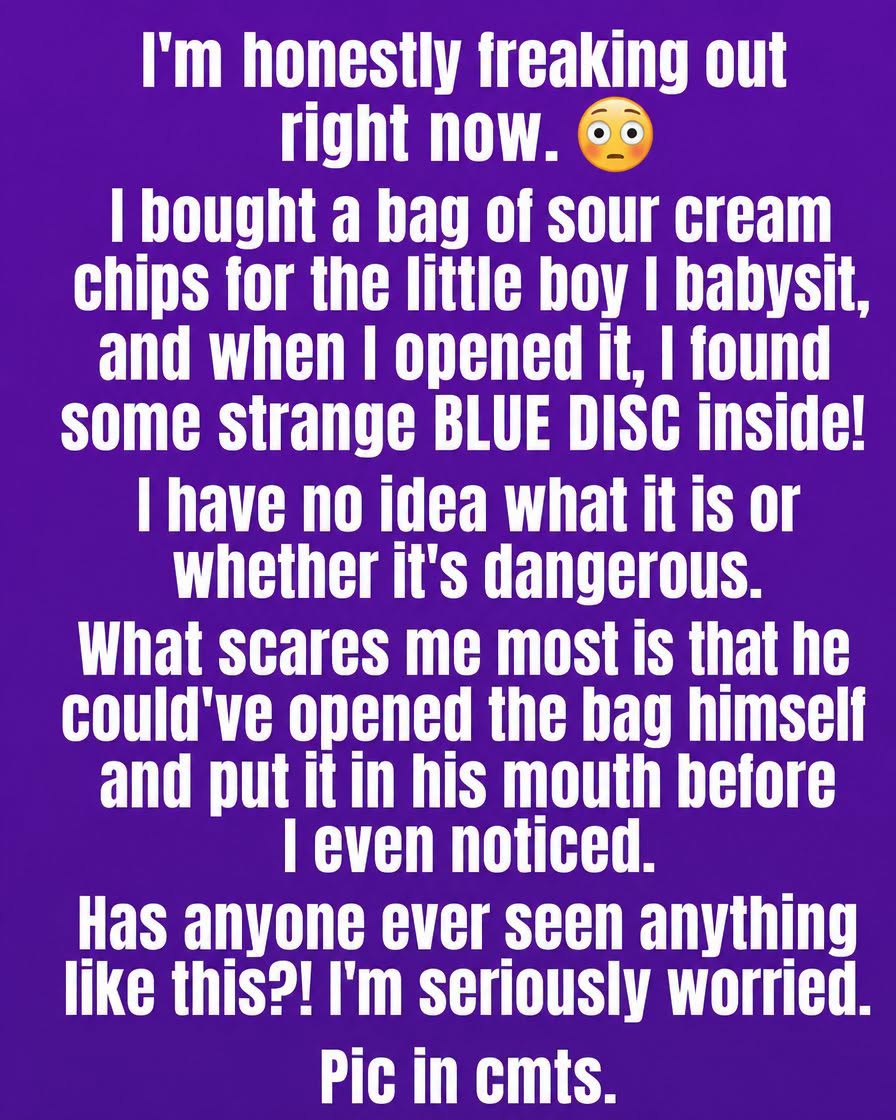
Have you ever opened a packet of sour cream crisps, reached inside for a handful, and noticed a small blue disc sitting among the chips? At first glance, it might look like a strange plastic object, a piece of packaging, or even something that accidentally fell into the packet during manufacturing.
Finding an unfamiliar object inside food packaging can naturally cause concern. After all, nobody expects to discover a small disc hidden among their favorite snacks. Its unusual appearance may leave you wondering what it is, why it is there, and whether it is safe to touch.
Fortunately, there is usually a simple explanation. The object may be an oxygen absorber or another type of food-grade packaging insert designed to help protect the contents from deterioration. Some packaging inserts contain iron-based materials that help reduce oxygen inside sealed packages, while others are designed to absorb moisture.
These small components can play an important role in maintaining food quality, helping preserve flavor, texture, and freshness during storage and transportation.
However, it is important not to assume that every blue disc found inside a crisp packet serves the same purpose. The exact function depends on its design and labeling. It may be a specialized oxygen absorber, moisture-control component, or another packaging-related insert.
Whatever its intended function, it is not part of the snack and should never be eaten.
Let’s explore what this mysterious blue disc might be, why manufacturers use packaging inserts, and what you should do if you discover one inside your crisps.
1. What Exactly Is the Blue Disc Inside the Crisp Packet?
The small blue disc found inside some food packages is often associated with protective packaging technology.
Certain food products contain small sachets, pads, or specially designed inserts that help control conditions inside sealed packaging.
One common example is an oxygen absorber.
Oxygen absorbers are designed to reduce the amount of oxygen inside a sealed package. Many contain iron-based materials that react with oxygen, helping limit the chemical processes responsible for food deterioration.
However, not every packaging insert is an oxygen absorber. Some are moisture absorbers, which help control humidity and prevent products from becoming damp.
The appearance of these inserts can vary considerably. They may be small packets, flat discs, or specially shaped components enclosed in food-safe materials.
A blue color may be used to make a particular component easier to recognize, but color alone cannot confirm its purpose or composition.
This is why examining the packaging and any printed warnings is important.
If the object is unfamiliar, do not open it, cut it, or attempt to identify its contents by taste or smell.
2. Why Do Crisp Manufacturers Put These Discs Inside Packets?
Crisps are particularly sensitive to changes in their surrounding environment.
Although they may appear simple, their freshness depends on maintaining the right balance of moisture, oxygen, and protective packaging.
Once crisps are exposed to unsuitable storage conditions, their quality can deteriorate.
They may lose their characteristic crunch, develop unpleasant flavors, or become less enjoyable to eat.
Manufacturers therefore use several packaging techniques to help protect snacks throughout their journey from the factory to supermarket shelves.
These techniques may include:
- Protective packaging materials that limit exposure to air.
- Nitrogen flushing to replace much of the oxygen inside the packet.
- Moisture-control systems designed to maintain suitable humidity.
- Oxygen absorbers that help reduce residual oxygen.
- Packaging seals that prevent outside air and moisture from entering.
A small insert can therefore be part of a larger system designed to protect the product.
Its purpose is not to add flavor or improve the crisps directly. Instead, it helps maintain the conditions that allow the snack to retain its intended quality.
3. How Do Iron-Based Oxygen Absorbers Work?
Iron-based oxygen absorbers are a widely used food-packaging technology.
Their operation is based on a chemical reaction between iron and oxygen.
When iron is exposed to oxygen under suitable conditions, it undergoes oxidation. This is the same general process responsible for rust forming on exposed iron surfaces.
In an oxygen absorber, the reaction is used deliberately to remove oxygen from the surrounding package environment.
The absorber contains specially prepared materials that react with oxygen and gradually reduce its concentration inside the sealed packaging.
This can help slow certain deterioration processes, particularly oxidation.
For example, oxygen can react with fats and oils found in food, contributing to rancid flavors and unpleasant odors.
Reducing the amount of available oxygen can help limit these reactions and preserve food quality.
It is important to understand that oxygen absorbers do not work like ordinary sponges. They do not simply collect air inside a container.
Instead, they use a chemical process that binds or reacts with oxygen.
The insert must also be designed specifically for food packaging. Its contents are not intended for direct consumption.
4. Why Are Crisps So Sensitive to Oxygen and Moisture?
Crisps are made from ingredients that can deteriorate when exposed to air and humidity.
Their distinctive taste and texture depend on the condition of the oils, starches, seasonings, and other ingredients used during production.
Two major factors affect their quality: oxygen and moisture.
Oxygen exposure
Many crisps contain oils that can react with oxygen over time.
This process, known as oxidation, can cause fats to develop unpleasant flavors and odors.
Even when the packet remains sealed, some oxygen may be present inside the package. Protective packaging methods help reduce this exposure.
Moisture exposure
Crisps are valued for their dry, crunchy texture.
When they absorb moisture from the surrounding air, their structure changes. Instead of breaking cleanly when bitten, they may become soft, chewy, or stale.
Moisture can also affect seasoning and other ingredients.
This is why food manufacturers pay close attention to packaging materials and storage conditions.
A well-designed package helps maintain a suitable environment, protecting the snack from the conditions that would otherwise reduce its quality.
5. Is the Blue Disc Edible?
No. Any unidentified packaging insert found inside a crisp packet should be treated as non-edible.
Even if it looks like a harmless plastic disc or appears to be part of the packaging, it should never be eaten.
Oxygen absorbers and moisture-control inserts contain materials intended for a specific packaging function, not human consumption.
Some oxygen absorbers contain iron-based mixtures, while moisture-control products may contain other substances designed to absorb or regulate humidity.
Their contents can vary depending on the manufacturer and intended application.
For this reason, you should never assume that an insert is harmless simply because it is small or looks clean.
Do not:
- Eat the disc.
- Open or cut it to inspect the contents.
- Chew it or allow children to play with it.
- Place it in food or drink.
- Reuse it for another purpose.
- Assume that its blue color indicates a particular chemical composition.
If you find an unfamiliar insert, remove it carefully and keep it away from children and pets.
If anyone accidentally swallows it, seek advice from a medical professional or local poison control service, particularly if the packaging identifies it as an oxygen absorber or moisture-control product.
6. What Is the Difference Between an Oxygen Absorber and a Moisture Absorber?
Although oxygen absorbers and moisture absorbers may look similar, they perform different functions.
Understanding the distinction helps explain why manufacturers use different protective components in food packaging.
Oxygen absorbers
These are designed to reduce oxygen levels inside sealed packaging.
They are particularly useful for products that may deteriorate through oxidation.
Common applications include certain dried foods, packaged snacks, nuts, and other products containing fats or oils.
Iron-based oxygen absorbers work through a chemical reaction with oxygen.
Moisture absorbers
These are designed to control humidity by absorbing water vapor or moisture.
Depending on the product, they may contain materials such as silica gel or other moisture-control substances.
Their purpose is to help prevent dampness, clumping, and texture changes.
For example, silica gel packets are frequently found in packaging for electronics, footwear, and certain food products.
Although both types of inserts help protect packaged products, they are not interchangeable.
An oxygen absorber cannot necessarily control moisture, and a moisture absorber does not necessarily remove oxygen.
The packaging manufacturer selects the appropriate system according to the food’s characteristics and storage requirements.
7. Why Is the Disc Sometimes Blue?
One of the most curious aspects of these packaging inserts is their color.
Many people expect food-protection components to be white, transparent, or beige. Discovering a bright blue disc among pale-colored crisps can therefore seem particularly unusual.
There are several possible reasons for colored packaging components.
Manufacturers may use different colors to distinguish particular products, designs, or packaging components.
Color can also make an insert easier to recognize during inspection and handling.
However, the color itself does not establish whether the disc contains iron, silica gel, or another material.
Some moisture-control products also use indicators that change color when their condition changes.
These indicators can help communicate whether the product has absorbed moisture or reached a particular stage of use.
Nevertheless, not every blue packaging component contains an indicator, and not every blue disc is a moisture absorber.
Without identifying the exact product and manufacturer, it would be misleading to claim that the blue disc has one specific chemical composition.
The safest approach is to check the packaging information or contact the manufacturer for confirmation.
8. Why Don’t Manufacturers Simply Remove All the Air From Crisp Packets?
You may wonder why manufacturers need special packaging inserts when crisp packets are already sealed.
The answer is that sealing a packet does not automatically eliminate oxygen.
Air may remain inside the package unless specific techniques are used to reduce or replace it.
Many crisp manufacturers use nitrogen flushing during packaging.
Nitrogen is an inert gas under ordinary food-packaging conditions, meaning it does not readily react with the ingredients in the crisps.
The gas replaces much of the oxygen inside the packet and helps protect the product.
It also helps maintain the packet’s shape and provides cushioning that reduces the likelihood of crisps breaking during transportation.
However, nitrogen flushing does not necessarily remove every trace of oxygen.
Small amounts may remain inside the package or become trapped in the food itself.
Depending on the product and packaging design, additional protective technologies may be used.
An oxygen absorber can help reduce residual oxygen, while suitable packaging materials prevent unwanted air and moisture from entering.
Together, these methods help manufacturers maintain product quality over time.
9. What Should You Do If You Find a Blue Disc in Your Crisps?
Discovering an unfamiliar object inside a food packet can be concerning, particularly if you have already eaten some of the crisps.
The first step is to stop eating from that packet until you understand what the object is.
Then follow these simple precautions.
Step 1: Remove the object carefully.
Use clean hands or a utensil to remove the disc without opening or damaging it.
Avoid touching any exposed contents if the component appears damaged.
Step 2: Check the packaging.
Look for any information explaining the presence of an oxygen absorber, moisture-control insert, or other protective component.
Some products include clear warnings stating that packaging inserts should not be eaten.
Step 3: Keep the insert intact.
Do not cut, crush, puncture, or dismantle it.
Keeping it intact makes it easier for the manufacturer to identify the component.
Step 4: Contact the manufacturer if necessary.
If the disc is unexpected, unlabeled, damaged, or appears unusual, contact the snack manufacturer.
Provide the product name, batch number, and any photographs that may help identify it.
Step 5: Keep it away from children and pets.
Even small packaging inserts can present risks if swallowed or damaged.
If you are unsure what the object contains, dispose of it according to the manufacturer’s instructions.
10. Should You Be Worried If You Have Already Eaten Crisps From the Packet?
Finding an unexpected object after eating some crisps can naturally create concern.
However, discovering an intact packaging insert does not automatically mean that the food is contaminated or unsafe.
The important consideration is whether the insert is intact and whether its contents have come into contact with the food.
If the disc appears undamaged and the crisps otherwise look and smell normal, the situation may simply involve an unexpected packaging component.
Nevertheless, you should stop eating from the packet until the manufacturer confirms what it is.
If the insert is broken, leaking, or appears to have released its contents, avoid consuming the remaining crisps.
Keep the packaging and contact the manufacturer for guidance.
If someone has swallowed part of the insert or its contents, seek advice from a healthcare professional or poison control service rather than waiting for symptoms to appear.
Children and pets require particular attention because they may accidentally swallow small objects.
It is always better to obtain reliable advice than to guess about the safety of an unidentified substance.
11. Do These Packaging Inserts Affect the Taste of Crisps?
When used correctly, food-packaging inserts are designed to protect the quality of the product rather than change its flavor.
Oxygen absorbers remain inside their designated packaging material and are not intended to come into direct contact with the food.
Moisture-control inserts are similarly designed for their specific packaging application.
Their purpose is to maintain the conditions needed to preserve the original taste and texture.
In fact, protective packaging technologies help explain why crisps can remain enjoyable for weeks or months after manufacturing, provided they are stored correctly and remain within their recommended shelf life.
However, if a packaging insert becomes damaged or its contents escape, the product should not be treated as normal.
Do not taste the contents or attempt to determine whether they have affected the food.
Contact the manufacturer and follow its safety guidance.
12. Why Is Food Packaging Technology So Important?
Modern food packaging does much more than simply hold products together.
It plays an important role in protecting food from environmental conditions that can affect its safety, quality, and shelf life.
Manufacturers must consider several factors when designing packaging, including:
- Exposure to oxygen.
- Changes in moisture levels.
- Temperature fluctuations.
- Light exposure.
- Physical damage during transportation.
- Contamination from external sources.
For snacks such as crisps, maintaining a dry environment and limiting oxidation are particularly important.
Packaging inserts, protective films, sealed containers, and controlled-atmosphere techniques can all contribute to preserving food quality.
These technologies allow products to travel long distances, remain on supermarket shelves, and reach consumers in a condition that is close to how they were intended to be enjoyed.
Although some components may look unusual, they are often part of carefully designed packaging systems.
Final Thoughts: A Small Disc With an Important Job
The mysterious blue disc found inside a packet of sour cream crisps may look like an accidental object, but it could be a specialized food-packaging component designed to help preserve freshness.
Iron-based oxygen absorbers are one example of this technology. They work by reacting with oxygen inside sealed packaging, helping reduce oxidation and protect food quality.
Other packaging inserts are designed to control moisture and prevent snacks from becoming stale or losing their characteristic crunch.
However, appearance alone cannot confirm what a particular blue disc contains or what function it performs.
The important thing to remember is that these inserts are not part of the snack. They should never be eaten, opened, crushed, or treated as ordinary packaging material.
If you discover one inside your crisps, remove it carefully, check the product information, and contact the manufacturer if its purpose is unclear.
It may be a small and unusual discovery, but it highlights something interesting about modern food production: keeping a simple packet of crisps fresh and crunchy involves more technology than most people realize.
So, the next time you open a packet of sour cream crisps, remember that the familiar crunch you enjoy may depend on a carefully controlled packaging environment working quietly behind the scenes.