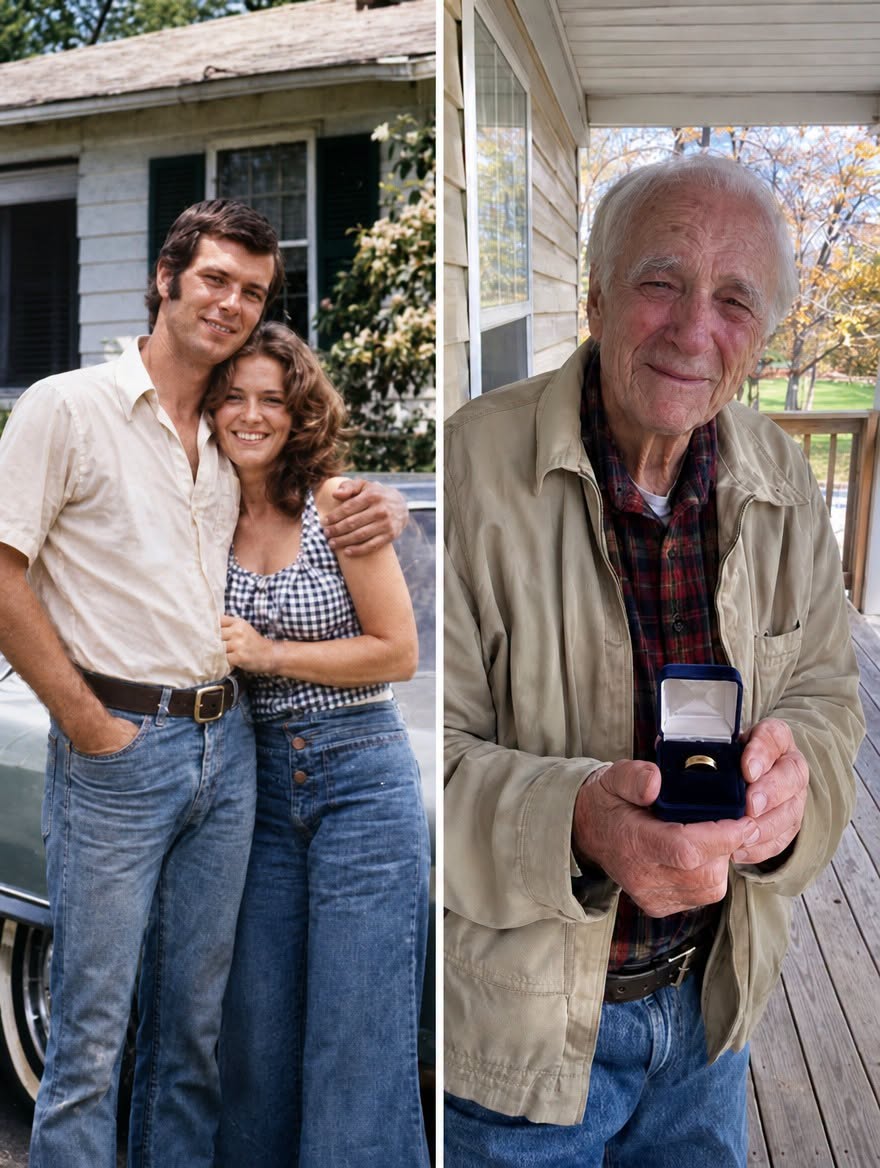
I’m eighty years old, and I’ve never been married. Not because I never had the chance, and not because I didn’t believe in love. I simply never stopped loving the one man I thought I would spend the rest of my life with.
His name was Benjamin.
He was the only man I ever imagined growing old beside. But he disappeared during the Vietnam War, and for more than sixty years, I believed I would never know what happened to him.
Then, last Tuesday, something happened that changed everything I thought I knew about my past.
A stranger approached me outside a little café. He had Benjamin’s blue eyes, his familiar crooked smile, and even the tiny dimple on his chin.
He placed a small blue box in my hands.
And before I could ask who he was, he told me something that made my knees almost give way.
But perhaps I should start at the beginning.
I celebrated my eightieth birthday this spring.
Over the years, people have asked me the same questions countless times.
“Didn’t you ever want to get married?”
“Weren’t you lonely growing up without children?”
“Don’t you wish you had someone to share your old age with?”
I usually smile politely and change the subject. It’s difficult to explain a lifetime of love to someone who believes happiness must look the same for everyone.
I did want a family. I wanted a husband, children, grandchildren, and a house filled with laughter.
I wanted all those things with Benjamin.
We met during our final year of high school. He was the kind of boy who could make an ordinary afternoon feel like the most wonderful day in the world.
He had bright blue eyes, a mischievous smile, and a habit of making promises he always tried his best to keep.
We spent nearly every afternoon together.
Sometimes we walked along the country road behind our school. Other times, we sat beneath an enormous willow tree, sharing sandwiches and talking about our future.
We dreamed about buying a little farmhouse with a white fence.
Benjamin wanted a vegetable garden, a dog, and enough land for our children to run around.
I wanted a kitchen with yellow curtains and a porch where we could sit together during summer storms.
We were young, and we believed life would unfold exactly as we imagined.
Then the Vietnam War changed everything.
Benjamin received his draft notice shortly after graduation.
I still remember the afternoon he showed it to me. He tried to smile, but I could see the fear in his eyes.
Neither of us knew what to say.
The night before he left, we returned to our favorite willow tree.
We sat there until the sky began turning pink.
He held both my hands and looked directly into my eyes.
“Listen to me,” he whispered. “No matter how long it takes, I’m coming home to you.”
I wanted to believe him more than anything.
I promised I would wait.
And I did.
At first, his letters arrived regularly. He wrote about the people he met, the places he saw, and how much he missed home.
He always ended his letters with the same words.
“Save me a place beside you.”
I kept every letter in a wooden box beneath my bed.
Whenever I missed him, I would take them out and read them again.
Then, one morning, everything changed.
Benjamin’s mother came to my house crying.
An Army officer had visited her that morning. Benjamin had been reported missing in action during a military operation.
There were no clear details.
No confirmation.
No body.
Just uncertainty.
For months, I refused to believe he was gone.
I continued writing letters, even though I had no address to send them to.
I wrote about the changing seasons, the little things happening in town, and how much I missed him.
I told him the willow tree was still standing.
I told him I was still waiting.
Eventually, another official letter arrived.
Benjamin had been presumed dead.
Those words destroyed something inside me.
There was no funeral with a body to bury. No final goodbye. No place where I could go and know that the boy I loved was resting there.
I attended a memorial service, but a part of me remained trapped in the last afternoon we had spent together.
Life continued moving forward, even when I felt as though mine had stopped.
Friends married. They bought homes, raised children, and celebrated anniversaries.
Some encouraged me to start dating.
A kind man named Robert once asked me to marry him. He was patient, thoughtful, and genuinely cared about me.
But when he asked, I realized I couldn’t promise him a heart that still belonged to someone else.
I never married.
Instead, I built a different kind of life.
I worked at a local library for many years. I volunteered at a children’s hospital, helped struggling families, and spent Thursday afternoons reading stories to children receiving hospice care.
I discovered that love could take many forms.
It could be holding a frightened child’s hand, helping a tired mother carry groceries, or sitting quietly beside someone who needed company.
I never had children of my own, but I was fortunate enough to become an important part of many children’s lives.
And every year, on Benjamin’s birthday, I bought red carnations and walked to the old willow tree.
I did this for nearly six decades.
Some years I cried.
Other years, I simply sat beneath the branches and remembered the boy who promised to come home.
Last Tuesday was Benjamin’s eightieth birthday.
I woke up early, bought my usual carnations, and put on the blue cardigan I had owned for years.
On my way to the tree, I stopped outside a small café.
Through the window, I noticed a little girl laughing as she struggled to eat an enormous ice cream cone.
Her mother was trying to wipe the melted ice cream from her cheeks.
I smiled.
It reminded me of the family Benjamin and I had once imagined.
For a moment, I stood there watching them.
Then I noticed a reflection in the glass.
There was a man standing behind me.
I turned around.
My heart began beating so quickly that I had to place one hand against the café window.
The stranger looked to be in his fifties.
But his eyes were unmistakable.
Bright blue.
His smile tilted slightly to one side.
And there, on his chin, was the same little dimple I had remembered for more than sixty years.
It was almost frightening.
For one impossible moment, I felt as though I was looking at Benjamin himself, only older.
The stranger noticed my expression.
He slowly approached me.
“Are you Eleanor?” he asked.
I nodded, barely able to speak.
“My name is Daniel,” he said. “I’ve been trying to find you for a very long time.”
I stared at him.
“Why?”
His eyes filled with tears.
“Because my father made me promise that I would find you.”
I felt my legs weaken.
“Your father?”
Daniel nodded.
Then he reached into his coat and removed a small blue box.
He placed it carefully in my trembling hands.
“He told me that if I ever found you, I had to give you this. He said you would understand.”
My fingers shook as I tried to open it.
Inside was a small silver locket.
I recognized it immediately.
Benjamin had bought it for me shortly before he left for Vietnam.
I had lost it during one of our last walks together, and I remembered how disappointed he had been that we couldn’t find it.
But there was something else inside the box.
A folded piece of yellowed paper.
My name was written across the front in handwriting I would have recognized anywhere.
My dearest Eleanor.
I couldn’t hold back my tears.
“Where did you get this?” I whispered.
Daniel pulled a chair away from the café table and helped me sit down.
Then he began telling me a story I had waited sixty years to hear.
“My father survived Vietnam,” he said quietly.
I looked at him.
For a moment, I couldn’t understand the words.
“What did you say?”
“He survived. He was captured after his unit was separated during an operation. He spent years in captivity before finally being released.”
I covered my mouth.
Daniel continued.
“When he came home, he wasn’t the same person. He had suffered terrible injuries and struggled with memories of what happened. He spent a long time recovering.”
I could hardly breathe.
“Then why didn’t he come looking for me?”
Daniel lowered his eyes.
“He tried.”
He explained that his father had returned home several years after the war, only to discover that many things had changed.
His mother had moved away. Some family members had passed on, and the address Benjamin remembered for me was no longer current.
He had asked around, written letters, and tried contacting people from our hometown.
But somehow, every attempt led nowhere.
“Eventually, he found out that you had never married,” Daniel said. “He wanted to contact you, but he was afraid.”
“Afraid of what?”
“That too much time had passed. That you had moved on. That seeing him again would reopen wounds you had spent years trying to heal.”
I shook my head, tears falling onto my cardigan.
“All those years,” I whispered. “I waited all those years.”
Daniel reached across the table and gently touched my hand.
“My father knew. He never forgot you. Not for a single day.”
Then he told me something that made me hold the little blue box even tighter.
His father had married later in life. He had tried to build a family, and Daniel was his only child.
But throughout his childhood, there had been one name his father mentioned more often than any other.
Eleanor.
“He kept a photograph of you beside his bed,” Daniel said. “He told me about the willow tree, the farmhouse you dreamed of, and the promise he made before leaving for the war.”
I closed my eyes.
I could almost hear Benjamin’s voice again.
No matter how long it takes, I’m coming home to you.
Daniel unfolded another piece of paper.
“This is the last letter he wrote for you.”
I carefully opened it.
The handwriting was shaky, but unmistakably his.
It read:
My dearest Eleanor,
If this letter has finally reached your hands, then my son has kept the promise I asked him to make.
I have spent most of my life wondering what happened to the girl who sat beneath the willow tree and promised to wait for me.
I wanted to come home. I tried harder than you could ever imagine.
There were years when I believed I would never see my family again. When I finally returned, I thought I would have the chance to find you. But life had changed, and I was afraid you had found happiness somewhere else.
I hope you did.
I hope you laughed often, met kind people, and had beautiful moments worth remembering.
I never wanted my absence to become a prison for you.
But I need you to know something.
I never forgot you.
I kept the little photograph you gave me. I carried it through the darkest days, and whenever I thought I might not make it, I remembered the girl beneath the willow tree.
I am sorry it took me so long to find my way home.
If there is one thing I wish I could tell you, it is that you were loved. You were loved more deeply than I ever managed to explain.
Forever yours,
Benjamin.
By the time I reached the final words, I was crying so hard that Daniel had to take the letter from my hands.
I looked at him.
“Is your father alive?”
Daniel was silent for several seconds.
Then he gently shook his head.
“No, Eleanor. I’m sorry. He passed away three months ago.”
The room seemed to grow quiet around me.
I looked down at the silver locket.
I had spent sixty years wondering whether Benjamin had survived, whether he had remembered me, and whether he had ever thought about the promises we made.
Now I knew.
But I had arrived too late to see him again.
Daniel took a deep breath.
“There’s something else he wanted me to tell you.”
I looked up.
“Before he died, he asked me to visit the town where he grew up. He wanted me to find the old willow tree and see if it was still there.”
I nodded slowly.
“It’s still standing.”
Daniel smiled sadly.
“He would have loved to know that.”
Then he reached into his pocket and showed me another photograph.
It was an old picture of Benjamin sitting beside a woman and a little boy.
The boy was Daniel.
Benjamin looked older, his hair thinner, and his face more weathered.
But his smile was exactly the same.
I touched the photograph.
“He looks happy,” I whispered.
“He was,” Daniel replied. “But every year on his birthday, he would sit alone for a while and take out your photograph.”
I couldn’t speak.
Daniel then asked whether I would accompany him to the willow tree.
Of course, I said yes.
We walked slowly through the familiar streets.
When we reached the tree, I placed my red carnations against its trunk.
Daniel stood quietly beside me.
For several minutes, neither of us said anything.
Then he looked at the flowers.
“These were his favorite, weren’t they?”
I smiled through my tears.
“Yes. I used to bring them every year.”
Daniel looked surprised.
“My father did too. Every year, he bought red carnations on his birthday. He never told me why.”
I stared at him.
For sixty years, we had both been visiting the same memory from different places.
Two people living separate lives, still carrying the same promise.
Daniel reached into his jacket and removed one final envelope.
“My father asked me to give you this only after we reached the tree.”
Inside was a small photograph of Benjamin and me beneath the willow tree on the night before he left for Vietnam.
I had completely forgotten that photograph existed.
On the back, he had written:
We were young when we made our promises. But what we felt was real. Never believe that the years took that away.
I held the photograph against my chest.
For the first time in sixty years, I didn’t feel like a woman waiting for someone who might never return.
I felt like someone who had finally received an answer.
Before Daniel left, I asked him one question.
“Did your father ever regret not finding me?”
Daniel thought for a moment.
“He regretted the years you lost together. But he never regretted loving you. He always said that meeting you was one of the greatest gifts of his life.”
I watched him walk toward his car.
Then I called his name.
He turned around.
“Would you come back next Thursday?”
He smiled.
“Why Thursday?”
I laughed softly.
“Because I used to read stories to children every Thursday. I suppose I’m getting too old to keep doing it alone. Perhaps you’d like to help me sort through some old books.”
Daniel laughed.
“I’d like that.”
And just like that, something unexpected happened.
I didn’t get Benjamin back.
I couldn’t change the war, recover the lost years, or rewrite the ending we had once imagined.
But I gained a connection to the man who had loved me for so long, and I discovered that a beautiful part of our story could continue through someone who carried his memories.
Daniel began visiting every Thursday.
Sometimes we talked about Benjamin. Sometimes we looked through old photographs. Other times, we simply drank tea and laughed about ordinary things.
A few months later, Daniel brought his young daughter to visit.
She sat beside me with a picture book in her lap and asked whether I would read to her.
I looked at her little face and smiled.
For a moment, I remembered the girl in the café whose laughter had first caught my attention.
Life has a strange way of bringing things full circle.
I still visit the willow tree every year on Benjamin’s birthday.
But I no longer go there only to mourn the life we never had.
I go there to remember the love we did have.
And I keep the little blue box on my bedside table, beside the photograph of two teenagers who once believed the world was theirs.
I’m eighty years old.
I never became a wife or a mother, and my life didn’t turn out the way I imagined when I was seventeen.
But I have learned something important.
Sometimes, love doesn’t disappear when people are separated by time, distance, or circumstances.
Sometimes it lives in old photographs, handwritten letters, forgotten promises, and the stories passed from one generation to another.
And sometimes, after more than sixty years, a small blue box can bring a piece of your heart home.
I spent most of my life believing Benjamin had forgotten me. Now I know he never did.
And if I could speak to that young boy beneath the willow tree one more time, I would tell him something I never got the chance to say:
“You kept your promise, Benjamin. You found your way back to me, even if it took a lifetime.”