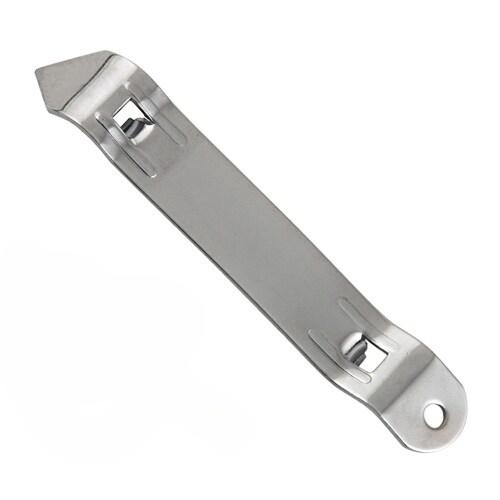
For decades, this little opener did its job without complaint. It punched cans, popped bottles, and sat quietly in a kitchen drawer until someone needed it again. No cords, no batteries, no complicated buttons, and certainly no instructions. It was simple, dependable, and built to last. Yet, as modern kitchen gadgets replaced old habits, the humble church key gradually became a forgotten household tool. Today, finding one tucked away in an old drawer can trigger a rush of memories, taking people back to family dinners, crowded kitchens, summer picnics, and a time when even the smallest household objects carried a surprising amount of comfort.
The church key may not look like much, but it once played an important role in everyday life. Usually made of sturdy metal, this simple handheld opener was designed with a pointed end for punching holes in cans and a curved end for removing bottle caps. Before pull-tab cans and convenient twist-off lids became common, opening certain food and drink containers required a little more effort. The church key was the answer, and nearly every household seemed to have one.
Its name has an interesting history, although its exact origins are not entirely clear. One popular explanation connects the name to the tool’s shape, which some people thought resembled an old-fashioned key used to open church doors. Others associate the name with its long history in bars and taverns, where bartenders relied on similar openers to serve bottled beverages. Whatever its origins, the name stuck, and generations grew up knowing exactly what someone meant when they asked for the church key.
For many families, the tool was more than just something used to open cans and bottles. It was part of the rhythm of everyday kitchen life. It might hang from a hook near the stove, sit in a drawer with measuring spoons and vegetable peelers, or rest inside a kitchen utensil container. Nobody thought much about it. It was simply there, ready whenever it was needed.
Older generations will likely remember the familiar sound of a church key punching through a metal can. Opening certain canned foods meant making two or more holes near the top to allow the contents to pour out smoothly. The process required a steady hand and a little pressure, but most people learned how to do it without thinking twice. It was one of those small skills that became second nature through repetition.
The tool also found its place during family gatherings and celebrations. Someone preparing dinner might reach for it to open a can of tomato juice, evaporated milk, or another pantry staple. During backyard cookouts, it could be used to open bottled sodas and other refreshments. At holiday gatherings, it was often just another familiar object being passed from one person to another as everyone helped prepare the meal.
These memories are part of what makes the church key so nostalgic today. It represents a period when kitchens were filled with practical tools that rarely needed replacing. Many were made from metal, had very few moving parts, and could last for decades with ordinary care. They were not designed to be fashionable or impressive. Their only purpose was to work, and they generally did that job extremely well.
Of course, kitchen technology eventually changed. Manufacturers introduced cans with pull tabs, followed by stay-on tabs that made opening beverages easier and safer for many consumers. Bottle caps became easier to remove with improved packaging and convenient twist-off designs. Electric can openers also became popular in many homes, offering an alternative to the manual tools people had relied on for years.
As these changes took place, the church key slowly lost its place in the everyday kitchen. Younger generations grew up without needing to punch holes into cans, and many never learned how to use one. What was once an essential household item became something people occasionally discovered in a grandparent’s kitchen drawer, an old toolbox, or a box of miscellaneous household belongings.
Still, the church key never disappeared completely. It remains useful for certain cans and bottles, and its simple design continues to appeal to people who appreciate practical, durable tools. Vintage examples are also collected by enthusiasts interested in kitchen history, advertising memorabilia, and everyday objects from earlier decades. Some feature company names, beverage advertisements, or distinctive designs that reflect the period in which they were made.
There is something refreshing about holding an object that has survived generations without needing an upgrade. In a world filled with rechargeable appliances, touchscreens, and disposable gadgets, the church key reminds us that good design does not always have to be complicated. A piece of shaped metal, carefully designed to perform a simple task, can remain useful long after newer products have come and gone.
Perhaps that is why finding one can feel unexpectedly emotional. It may bring back memories of a parent or grandparent preparing dinner, the sound of dishes being arranged on a kitchen table, or the excitement of helping with a family picnic. The tool itself might be ordinary, but the memories attached to it are anything but ordinary.
Sometimes, the strongest connections to the past are not found in expensive antiques or treasured family heirlooms. They are hidden in everyday objects that once seemed too ordinary to notice. A worn church key, with its scratches, faded finish, and familiar shape, can tell a quiet story about the people who used it and the homes where it belonged.
The next time you come across one in an old kitchen drawer, take a moment to appreciate it. What looks like a simple bottle opener and can puncher is also a small reminder of how much everyday life has changed. More importantly, it is a reminder that the objects we use every day can become meaningful pieces of our personal history.
The church key may no longer be a kitchen essential, but it still holds something valuable: a connection to simpler routines, shared family moments, and the comfort of home. And sometimes, that is worth far more than the job a little metal tool was originally designed to do.