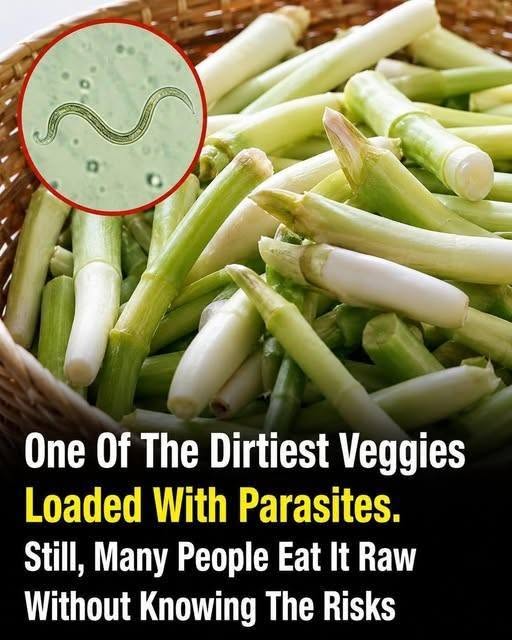
At first glance, the vegetable shown in the image looks like an ordinary ingredient found in countless Asian kitchens. Its long, pale-green stems and fresh appearance make it a familiar sight at markets, in vegetable baskets, and on family dinner tables.
The vegetable appears to be water spinach, also known as kangkong, water morning glory, or Ipomoea aquatica. It is widely eaten across Southeast Asia and is especially popular in stir-fries, soups, and traditional home-cooked meals.
Water spinach is appreciated for its tender stems, leafy texture, and ability to absorb the flavors of garlic, chili, and savory sauces. It is inexpensive, versatile, and easy to prepare, making it a regular part of many people’s diets.
Yet the headline accompanying the image raises an important question: could a vegetable that looks fresh and healthy carry parasites when eaten raw?
The answer requires a closer look at how aquatic vegetables grow and how foodborne infections can occur.
Water spinach is a semi-aquatic plant. Depending on the growing method, it may thrive in wet soil, shallow water, or other moist environments. Its long stems can grow along the surface of water, and its roots may develop in conditions that are very different from those used to cultivate ordinary land vegetables.
This growing environment is not automatically dangerous. Water spinach can be cultivated safely when farmers use clean water, appropriate agricultural practices, and proper handling procedures.
The risk arises when freshwater plants are exposed to water contaminated with human or animal waste, or when they are harvested, transported, or prepared under unsafe conditions.
Contamination may occur at several stages. Water used for irrigation may contain microorganisms or parasite stages. Plants may come into contact with contaminated soil or water during harvesting. Vegetables may also become contaminated after harvest if they are washed with unsafe water or handled with unclean equipment.
This means that a vegetable can look fresh while still carrying microscopic organisms that cannot be identified by sight.
The inset in the supplied image shows a worm-like illustration. However, the picture does not establish that the organism is a particular parasite or that the vegetables shown are contaminated. A magnified illustration is not laboratory evidence.
The real concern is supported by medical knowledge: certain parasites can be transmitted through raw or inadequately cooked freshwater plants.
One example is Fasciola, a type of liver fluke. Another is Fasciolopsis buski, an intestinal fluke that occurs in parts of South and Southeast Asia.
These parasites have complex life cycles involving freshwater environments and, in some cases, snails. Infective stages can attach to aquatic plants and may be swallowed when contaminated vegetables are eaten raw.
The danger is therefore not that water spinach is inherently dirty. The danger is that aquatic vegetables can become vehicles for infection when they are grown or handled in contaminated conditions.
For people who enjoy water spinach, this distinction is important.
There is no need to panic or assume that every bunch purchased at a market contains parasites. But it is sensible to treat raw aquatic vegetables with particular care.
A fresh appearance, pleasant smell, or clean-looking stem cannot guarantee that a vegetable is free from microscopic contamination.
The safest approach is to purchase produce from reliable sources, wash it with clean water, and cook aquatic vegetables thoroughly before eating.
These simple habits can help reduce foodborne risks while allowing people to continue enjoying a familiar and nutritious ingredient.
Chapter 2 — How Parasites Can Reach Freshwater Vegetables
The journey from a freshwater environment to a person’s dinner plate can involve several stages, and understanding this process helps explain why certain aquatic plants require careful preparation.
Some parasites that infect humans spend part of their life cycle in freshwater snails. The parasite develops inside the snail before releasing stages that can attach to aquatic vegetation.
When a person eats a contaminated plant without sufficient cooking, the infective stage may enter the digestive system.
This process is particularly relevant to infections caused by certain flukes.
The liver fluke connection
Fasciola hepatica and Fasciola gigantica are parasites commonly known as liver flukes.
They can infect animals such as cattle and sheep, and humans can become accidental hosts.
Infection may occur when someone eats raw watercress or another freshwater plant carrying infective larvae. Contaminated water can also be involved, including water used to wash or irrigate vegetables.
After entering the body, the parasites may pass through the intestinal wall and migrate toward the liver. They can cause inflammation and damage during this process.
The symptoms may include fever, abdominal discomfort, nausea, vomiting, and changes in liver-related blood tests.
In some cases, the infection can later affect the bile ducts and cause additional complications.
The symptoms are not always immediate. Depending on the parasite and stage of infection, a person may become unwell days, weeks, or even months after exposure.
This delay can make it difficult to connect an illness with a meal eaten long before symptoms appeared.
The intestinal fluke connection
Another parasite, Fasciolopsis buski, can cause an infection known as fasciolopsiasis.
This intestinal fluke is found in parts of South and Southeast Asia. Humans may become infected by eating raw or undercooked aquatic plants carrying the parasite.
Many infections cause few or no symptoms. However, some people may experience abdominal pain, diarrhea, nausea, or vomiting.
Heavy infections can lead to more serious intestinal complications.
The existence of these parasites does not mean that water spinach is always contaminated. It means that aquatic vegetables grown in areas where these parasites circulate may require special food-safety precautions.
Why contaminated water matters
Water quality is one of the most important factors in food safety.
If vegetables are grown in water contaminated by human or animal waste, they may be exposed to organisms that cause illness.
The same problem can occur when vegetables are washed with unsafe water after harvesting.
Even produce that appears clean may have been exposed to contamination earlier in the supply chain.
This is why washing vegetables with safe water is important, but why washing alone should not be considered a complete solution for every parasite risk.
Some infective stages may remain attached to plant surfaces despite ordinary rinsing.
For aquatic vegetables from uncertain sources, thorough cooking is a more reliable precaution.
The role of snails and the environment
Freshwater snails are important intermediate hosts for several foodborne parasites.
Their presence in an aquatic environment does not automatically mean that every plant in that environment is infected. The parasite must complete specific stages of its life cycle, and environmental conditions influence whether transmission occurs.
The risk is therefore concentrated in particular locations and agricultural conditions rather than distributed equally across every vegetable or every market.
Improving sanitation, protecting irrigation water, controlling animal waste, and maintaining safe agricultural practices can reduce the chance of contamination before vegetables ever reach consumers.
Food safety begins on the farm, continues through transport and storage, and ends with proper preparation in the kitchen.
Chapter 3 — What Happens If Someone Eats Contaminated Water Spinach?
Eating contaminated aquatic vegetables does not guarantee that a person will become ill. Infection depends on whether the plant carries an infective parasite, how much is swallowed, and whether the organism survives preparation and digestion.
However, when infection occurs, symptoms may vary depending on the parasite involved.
Abdominal pain and digestive discomfort
One of the most common symptoms of foodborne parasitic infections is abdominal discomfort.
A person may experience cramping, tenderness, bloating, nausea, or a general feeling of being unwell.
These symptoms can resemble ordinary digestive problems, making it difficult to identify the cause without medical testing.
Persistent abdominal pain after a possible exposure should not be ignored, particularly if it is accompanied by fever, diarrhea, or unexplained weakness.
Diarrhea and changes in bowel habits
Some intestinal parasites can cause diarrhea or changes in bowel habits.
The symptoms may be mild in some people but more severe in others.
A person may also experience nausea or vomiting, especially when the infection affects the digestive tract.
Not every case of diarrhea is caused by parasites. Viral infections, bacterial food poisoning, medication effects, and many other conditions can produce similar symptoms.
The important point is to seek medical advice when symptoms are severe, prolonged, or associated with signs of dehydration.
Fever and unusual fatigue
Fever may occur when the body responds to a parasitic infection.
Some people also experience fatigue, reduced appetite, or a general sense of weakness.