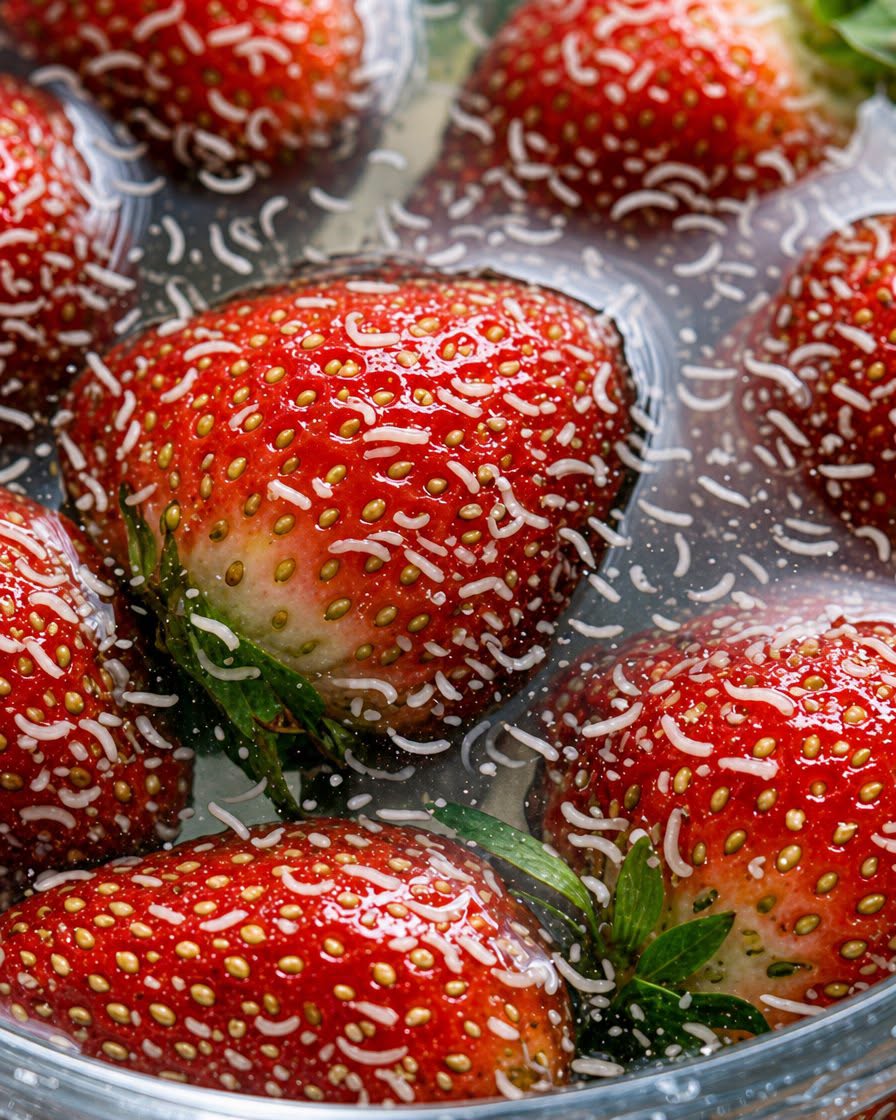
Finding tiny white larvae inside a fresh strawberry is enough to make even the most enthusiastic fruit lover put the entire container back in the refrigerator and reconsider every berry they’ve eaten that week.
At first glance, the discovery can be genuinely alarming. Strawberries are supposed to be bright red, juicy, and sweet—not home to tiny, nearly invisible creatures. If you’ve ever sliced into a berry and noticed something moving inside, your first reaction may have been some combination of disgust, confusion, and the immediate desire to throw away the entire package.
But while the discovery may be unpleasant, tiny larvae in fresh fruit are not necessarily a sign that the strawberries are rotten or dangerously contaminated.
In many cases, the larvae come from a small fruit fly known as the spotted wing drosophila. Unlike many familiar fruit flies, which tend to take advantage of fruit that is already damaged, bruised, or overripe, spotted wing drosophila can lay eggs in healthy, ripening fruit while it is still growing on the plant.
That means the tiny insects can sometimes be present long before the strawberries reach the grocery store.
The idea sounds unpleasant, but it is also a reminder of something important about fresh produce: fruits and vegetables are agricultural products that are grown outdoors, not manufactured in sterile environments.
And despite modern farming, harvesting, inspection, packaging, and refrigeration, it is impossible to guarantee that every piece of produce will be completely free of naturally occurring insects.
How Do Larvae Get Inside Strawberries?
The spotted wing drosophila is a small fly that belongs to the same general group as the fruit flies many people encounter around kitchens and overripe produce. However, its behavior is different in an important way.
The females have a specialized egg-laying structure that allows them to insert eggs into relatively firm, ripening fruit. Strawberries can be among the fruits affected, along with other soft-skinned fruits such as raspberries, blueberries, cherries, and similar crops.
Once eggs are deposited, they can hatch into extremely small larvae.
Because the larvae are so tiny and pale, they can be difficult to see. They may remain inside the fruit where they are protected from the outside environment. A strawberry can therefore look perfectly normal from the outside while containing larvae inside.
By the time the fruit is harvested and packaged, there may be no obvious indication that anything is unusual.
This is one reason people can be particularly surprised when they discover larvae at home. They may have carefully selected berries that looked fresh, firm, and healthy.
The problem wasn’t necessarily visible because it happened before the fruit ever reached the refrigerator.
Why Don’t You Notice Them?
The larvae are exceptionally small, especially during their earliest stages.
A strawberry is also a surprisingly effective hiding place. Its bright red flesh can make pale larvae difficult to spot, particularly when the fruit is being eaten quickly. Most people don’t carefully inspect the inside of every berry before taking a bite.
In addition, not every strawberry will contain larvae, and even when larvae are present, they may not be in an obvious location.
You might only notice them after cutting the fruit open.
Some people have also reported seeing tiny organisms emerge after berries are placed in water. This has contributed to viral videos and social media posts showing strawberries apparently releasing small white worms after soaking.
Those videos can be unsettling, but the phenomenon itself isn’t necessarily evidence that the fruit has suddenly become contaminated.
Instead, soaking or cutting the fruit can make organisms that were already present easier to see.
Does Finding a Larva Mean the Strawberry Is Unsafe?
For most healthy people, the presence of a tiny fruit-fly larva does not automatically mean that a strawberry is dangerous to eat.
That distinction is important.
Something can be unpleasant without being hazardous.
Fresh produce grown outdoors is naturally exposed to insects, soil, rain, wind, microorganisms, birds, and countless other environmental factors. Food safety systems are designed to reduce genuine risks, but they cannot make agricultural products completely free of every naturally occurring organism.
The presence of an occasional insect or insect larva is therefore not, by itself, proof that food is spoiled or unsafe.
Of course, that doesn’t mean you have to eat a strawberry containing a larva.
If you see one, throwing the berry away is perfectly reasonable. Most people aren’t going to feel particularly enthusiastic about eating around an insect they just discovered inside their lunch.
But there is a difference between saying, “I don’t want to eat this,” and saying, “This fruit is dangerously contaminated.”
The first is a matter of personal preference.
The second requires evidence of an actual food safety hazard.
What About Food Safety Standards?
Food production is subject to standards intended to protect consumers from dangerous contamination and other hazards.
At the same time, food safety regulations recognize the practical reality of agriculture. Because fruits and vegetables are grown in natural environments, it is not possible to eliminate every microscopic or naturally occurring trace of insects and other biological material.
Regulatory standards therefore focus on preventing meaningful health risks rather than requiring every piece of produce to be absolutely perfect.
This can be surprising to consumers.
People sometimes imagine that the food they purchase has been inspected so thoroughly that nothing remotely unusual could ever make it through the system. In reality, agricultural inspection and quality-control systems are designed around reducing risks and maintaining acceptable standards—not creating an entirely insect-free food supply.
Growers use a variety of strategies to manage pests, including monitoring crops, using appropriate pest-management techniques, removing damaged fruit, maintaining sanitation, and carefully handling harvested produce.
These practices can reduce the number of affected fruits, but they cannot guarantee that every individual berry will be completely free of insects.
Nature is simply too complicated for that.
Should You Throw Away the Whole Container?
Not necessarily.
If you discover a single strawberry containing a larva, you don’t automatically need to throw away an entire container of otherwise fresh fruit.
Inspect the berries and remove anything that looks damaged, moldy, excessively soft, or otherwise questionable. If multiple berries appear to have problems, you may decide that discarding the container is the most practical option.
But finding one tiny larva isn’t necessarily evidence that every strawberry in the package is affected.
This is similar to finding one bruised or moldy piece of produce. You assess the rest rather than automatically assuming the entire batch is dangerous.
When in doubt, however, use common sense. If berries smell fermented, show widespread mold, are slimy, or have deteriorated significantly, they should not be eaten.
The presence of a tiny larva and the presence of spoilage are two different issues.
Does Washing Strawberries Remove Them?
Washing fresh produce is a good practice, but it is important to understand what washing can and cannot accomplish.
The basic recommendation for strawberries is to rinse them thoroughly under cool, running water shortly before eating them.
This helps remove dirt, dust, surface debris, and some microorganisms from the outside of the fruit.
It can also remove insects or other material sitting on the surface.
However, washing cannot be expected to sterilize produce or guarantee that anything inside the fruit will be removed.
That’s particularly relevant for larvae that are already inside a strawberry.
You should also avoid using household soaps or detergents on produce. These substances aren’t intended to be consumed and can leave residues behind.
Plain running water is generally the straightforward choice for routine washing.
What About Salt Water?
Salt-water soaking has become popular online because people have discovered that small larvae may sometimes emerge from strawberries after the fruit is submerged.
For some people, this provides reassurance because they can see what, if anything, was inside their fruit.
Others find the process so unpleasant that they would rather never know.
Salt-water soaking isn’t generally necessary to make otherwise fresh strawberries safe to eat. It can help dislodge some insects and debris, but it shouldn’t be viewed as a magical decontamination process.
If you choose to soak berries, rinse them afterward with clean water.
And remember that discovering a larva during the process doesn’t necessarily mean the entire container is hazardous.
It simply means you’ve found something that was previously hidden.
What About Vinegar?
Some people soak berries in a diluted vinegar-and-water solution in an attempt to remove bacteria, debris, or insects.
This may help clean the surface, but it isn’t required for routine food safety, and it won’t guarantee that strawberries are completely free of microorganisms or larvae.
There is also an important practical consideration: strawberries are highly perishable.
The longer berries remain wet, the greater the opportunity for excess moisture to contribute to deterioration if they aren’t dried properly.
For everyday use, a thorough rinse under cool running water shortly before eating is a simple approach.
If you prefer another cleaning method, make sure you are using it appropriately and rinse the fruit afterward.
When Should You Wash Your Strawberries?
One surprisingly useful habit is to avoid washing all your strawberries immediately after bringing them home unless you plan to eat them soon.
Strawberries are delicate, and moisture can encourage mold and spoilage.
Instead, many people find it better to keep berries refrigerated and wash only the amount they plan to eat.
When you’re ready for a snack, rinse the berries under cool running water and gently dry them if necessary.
This approach can help preserve their quality and reduce unnecessary moisture during storage.
It’s also a good idea to inspect berries when you first bring them home. Remove any fruit that is visibly moldy or badly damaged so that problems don’t spread through the container.
Why Are Strawberries Particularly Vulnerable?
Strawberries have several characteristics that make them attractive to insects.
They are soft, sweet, and relatively delicate. As they ripen, they become increasingly appealing to a variety of insects and other organisms.
Their surface also has many small seeds and irregularities that can provide places for debris and tiny organisms to collect.
But the bigger issue is simply that strawberries are grown outdoors.
A strawberry plant exists in an ecosystem.
Insects interact with it. Birds interact with it. Rain falls on it. Wind blows across it. Soil surrounds it. Pollinators visit it. Predators and other organisms move through the same environment.
Modern agriculture works to manage those interactions, but it cannot completely eliminate them.
That is true not only for strawberries but for virtually every fresh fruit and vegetable we eat.
Are Tiny Larvae a Sign of Bad Farming?
Not necessarily.
It’s easy to assume that finding an insect means someone failed to properly grow, inspect, or package the fruit.
But pest pressure can vary enormously depending on weather, geography, crop conditions, and timing.
Even well-managed farms can encounter insects.
Farmers monitor crops and use integrated pest-management strategies to minimize damage. Those strategies can include crop monitoring, biological controls, cultural practices, physical controls, and carefully selected treatments when appropriate.
The objective is to manage pests effectively while producing healthy food—not to create an environment in which absolutely no insect could ever come into contact with a crop.
That distinction matters because the occasional discovery of an insect doesn’t automatically mean a farm ignored food safety.
Are Strawberries Still Healthy?
Absolutely.
The occasional possibility of finding a tiny insect doesn’t erase the nutritional benefits of strawberries.
Strawberries are a nutrient-rich fruit and provide vitamin C, fiber, and a variety of naturally occurring plant compounds. They can be an easy addition to breakfast, snacks, salads, smoothies, desserts, and countless other meals.
In other words, discovering that strawberries exist within an ecosystem doesn’t make them nutritionally undesirable.
It simply makes them agricultural products rather than perfectly manufactured objects.
That can be an uncomfortable realization, especially in an age when much of our food arrives in clean plastic containers and looks remarkably uniform.
But nature doesn’t operate according to supermarket aesthetics.
What Should You Do If You Find One?
If you cut open a strawberry and discover a tiny white larva, the simplest response is to stay calm.
You can discard the affected berry if you don’t want to eat it. Inspect the remaining fruit for obvious signs of spoilage or damage. Rinse the berries you plan to eat under cool running water.
If the fruit is fresh, firm, and otherwise normal, there is generally no reason to panic simply because you found an insect larva.
And if the sight of one has completely ruined your appetite for strawberries for the day, that’s understandable too.
Nobody is required to be emotionally prepared for surprise wildlife in their snack.
The important thing is not to let the discovery create unnecessary fear about fresh produce in general.
The Bigger Picture
Finding tiny white larvae inside fresh strawberries is certainly unpleasant, but it is also a reminder of how closely our food is connected to the natural world.
We often expect fruits and vegetables to arrive perfectly clean, perfectly shaped, and completely free of anything that once lived nearby. In reality, crops grow in fields, orchards, gardens, and greenhouses where they interact with insects and other organisms every day.
Farmers and food producers work hard to manage those risks. Washing and proper storage provide additional protection once the produce reaches consumers.
But no system can make a living agricultural environment completely sterile.
So the next time you discover a tiny white larva inside a strawberry, you don’t have to pretend it’s pleasant. It isn’t.
But you also don’t need to assume that your entire container of berries is dangerous.
Remove the affected fruit, wash the berries you intend to eat, store them properly, and use ordinary food-safety judgment.
The occasional insect is an unfortunate but natural part of eating food that was grown outdoors.
And when you consider the alternative—a world in which every strawberry had to be completely isolated from nature before it could reach your kitchen—the occasional surprise starts to seem a little less mysterious.
Strawberries are still strawberries: sweet, nutritious, and worth enjoying.
Just maybe inspect the next one before you take that first bite.