“She’s not your daughter. Don’t correct her.” Greg’s palm slammed down hard against my mahogany dining table. The crystal glassware rattled. My sister froze, her wineglass halfway to her mouth. Greg’s cousins suddenly found their dinner plates utterly fascinating. Even the grandfather clock in the hallway sounded deafeningly loud. Across from me, Sarah leaned back, arms crossed over her chest. She looked thoroughly pleased with herself. Only moments earlier, she had smiled across my table and remarked, “Honestly, the food is fine, Beth. A little old-fashioned, but fine.” I let that slide. Then she kept going. “It’s sort of like the boutique. If I hadn’t stepped in and modernized it, goodness knows how much longer it would’ve lasted.” My sister arched an eyebrow. Sarah offered an airy laugh. “Beth means well. She’s just a bit stuck in the past.” Then she delivered the line that changed everything. “She’s lucky Greg and I are here to look after her.”
Dead silence blanketed the dining room. I had cooked the meal. I owned the property. I paid for the groceries, the utilities, the roof over Sarah’s head, the vehicle she drove, and—most infuriatingly—the paycheck she collected every two weeks from my business. I placed my napkin neatly beside my plate. “Sarah,” I said evenly, “you will not speak to me that way in my house. And you will not pretend you built a enterprise I spent thirty years creating.” Her expression stiffened. Before she could retort, Greg exploded. “Mom, enough!” His hand struck the wood once more. “She’s not your daughter. Don’t correct her.”
Something deep inside me went completely still. I looked at my son. The boy I had nursed through childhood fevers. The teenager whose college tuition his father and I had scraped together. The adult man I had welcomed back when he claimed he just needed “six months to get back on his feet.” That had been three years ago. Now he stood before me, face flushed with anger, glaring at me as though I were the villain. I didn’t yell. I didn’t weep. I simply smiled. “Fine.” Then I stood up and walked upstairs. They assumed I had surrendered. They had no clue what that word was about to signify.
Following the death of my husband, Michael, four years prior, the quiet had been the hardest part of widowhood. His slippers remained by the bed for months, and I still caught myself listening for his keys in the lock. So when Greg asked if he and Sarah could stay temporarily, I felt a wave of relief. “Just until we save enough for a place of our own,” he had promised. I believed him. At first, running my shop, Willow & Hart, helped fill the void. But gradually, I began losing my space in my own home. Sarah rearranged my kitchen, threw out vintage anniversary dishes, swapped out my curtains, and removed Michael’s framed photograph because it allegedly felt “too sad.” Instead of putting my foot down, I swallowed the pain—and then made the catastrophic mistake of hiring her. Over thirty years, I had built Willow & Hart into a beloved downtown specialty store. When Sarah bounced between jobs, I offered her a management post. Within six months, she acted like she owned the place, alienating staff and running up personal expenses on company tabs. Whenever I questioned her, Greg intervened with, “Mom, you hired her to modernize things.” I hadn’t. But that became their convenient reality.
Then came the SUV. When Greg asked for financial help for a newer vehicle, I agreed on one condition: the loan stayed in my name, but Greg would make the payments. He made two. After that, I quietly covered the loan, insurance, and registration month after month while they paid zero rent, used my grocery cards, and lived off my generosity.
Sitting alone at my desk that night, the laughter drifting up from downstairs, Greg’s words echoed in my mind: She’s not your daughter. He was right. Sarah wasn’t my daughter. And if I had no right to correct her, I certainly had no obligation to fund their lifestyle. Opening my laptop, I audited the accounts. Business expenses, restaurant tabs, online shopping, the SUV loan—thousands vanished every month. They weren’t saving money; they were bleeding me dry. I stripped Sarah of company card access, froze spending, and changed every password. At 12:18 a.m., I called my oldest friend, Clara, who offered up her barn property. By 4:00 a.m., I had relocated the SUV. By sunrise, Tom the handyman was changing every lock at Willow & Hart, and Sarah’s personal items were boxed up inside.
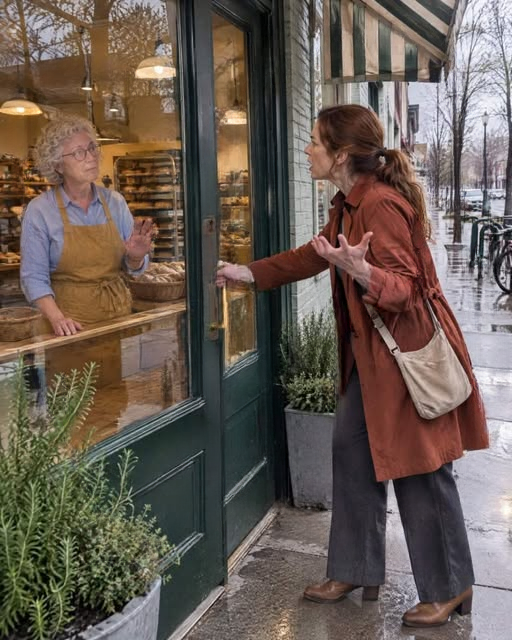
When Sarah and Greg arrived at the boutique later that morning, demanding entry and screaming about the car and the locks, I calmly presented the paperwork proving the vehicle, the business, and everything else belonged entirely to me. Greg marched in, furious, demanding to know what I was doing. That was when my accountant, Daniel, walked in with a thick folder. “A line of credit for two hundred and fifty thousand dollars,” Daniel said, sliding a document across the counter. Willow & Hart was listed as collateral. At the bottom was my signature—except I had never signed it. Greg had forged my name.
Worse still, Daniel produced a home appraisal from six weeks prior, along with a medical statement falsely describing me as suffering from “increasing memory impairment.” They weren’t just stealing; they were building a narrative to have me declared legally incompetent so they could seize everything.
Sarah stared at Greg in horror, realizing she had been as much a pawn in his lies as I was. She slapped him across the face and stormed out.
Before I could process the shock, my attorney, Margaret Wells, arrived with a sealed envelope bearing my late husband’s handwriting. Michael had left instructions to open it under one specific condition: if Greg ever attempted to borrow against, sell, or claim ownership of Willow & Hart. Inside was a letter detailing how Michael had caught Greg forging company checks years earlier. To protect him, Michael had given him a second chance, but quietly restructured his estate. Thanks to a protective family trust, Greg would inherit absolutely nothing from the business if I passed away while owning it; instead, the assets would go to loyal employees and a local entrepreneur foundation. Furthermore, the house was similarly protected, destined to go to whoever truly cared for me without expectation of financial gain.
The irony was absolute. Greg’s relentless greed and forgery had triggered the exact clauses that disqualified him from the fortune he expected.
In the weeks that followed, Greg faced the full legal consequences of his fraud. The fraudulent credit line was frozen, the bank notified, and he began facing debt repayment without my protection. Sarah filed for separation. I promoted Maria, who had stood by me for years, and slowly reclaimed my peace. Michael’s photograph returned to the living room, and my dining table was once again filled with people who respected me.
Months later, a thinner, humbled Greg showed up at my door with a receipt for his first debt repayment and an admission that he had read his father’s letter and failed to become a better man when given the chance. When he asked if I would ever forgive him, I gave him the hard truth: “Forgiveness isn’t the same as access, Greg. And love isn’t the same as financing someone’s destruction.”
He nodded quietly and walked away.
Visiting Michael’s grave on the anniversary of his passing, I clutched his final letter to my chest. He hadn’t left me alone; he had left me permission. Permission to stop destroying myself for the sake of motherhood, permission to love my son without sacrificing my dignity, and permission to understand that family never requires enduring cruelty.
My house was mine. My business was mine. My life was mine.
Free.