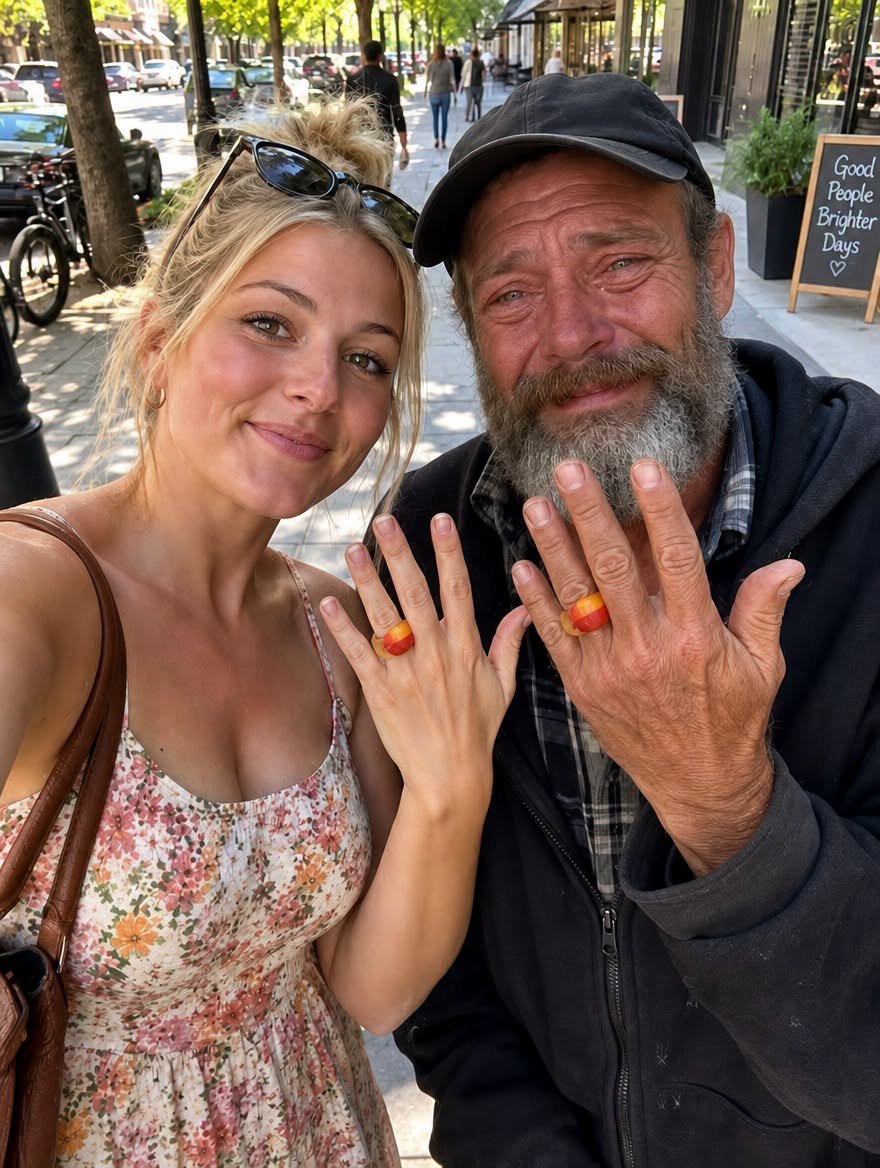
I never imagined that a simple act of kindness could turn my entire life upside down. I thought I was helping a lonely man find peace during the final days of his life. I had no idea that the decision would lead me to discover a secret he had carried for many years.
My name is Sarah, and for almost two years, I saw Larry every morning on my way to work.
He usually sat near the entrance of the subway station, wrapped in an old brown coat, with a small backpack beside him. He never shouted at passersby or demanded money. He simply sat quietly, occasionally greeting people who walked past.
Most people ignored him.
I was different.
The first time I spoke to Larry, it was a particularly cold morning. I had bought two cups of coffee because the weather was unbearable, and when I noticed him sitting outside the station, I offered him the extra one.
He thanked me with a smile that I still remember.
After that morning, bringing him coffee became part of my daily routine.
Sometimes we talked about the weather. Other times, he asked how my work was going or whether I had managed to get enough sleep. Our conversations were never particularly long because I was usually rushing to the office.
Still, those few minutes became something I looked forward to.
Larry was surprisingly well-spoken. He had a gentle manner and seemed to know a little about everything. Occasionally, he would mention books he had read or places he had visited when he was younger.
I once asked him how he had ended up living on the streets.
He smiled sadly.
“Life doesn’t always follow the plans we make, Sarah. Sometimes one unfortunate event leads to another, and before you know it, you’re somewhere you never imagined.”
I didn’t press him for details.
I understood that some people carried painful memories they weren’t ready to share.
Then came the Tuesday morning that changed everything.
The weather was freezing, and the streets were unusually quiet. As I approached the subway entrance, I noticed Larry holding a piece of cardboard.
At first, I thought he was asking for money.
But when I came closer, I stopped walking.
His sign read:
“MARRY ME. I HAVE ONLY ONE MONTH LEFT TO LIVE.”
I stared at the words, wondering whether I had misunderstood them.
Larry looked much weaker than usual. His face was pale, his clothes seemed too large for his thin frame, and his hands trembled as he held the cardboard.
I immediately crouched beside him.
“Larry, what is going on? Why would you write something like this?”
He looked at me, then lowered his eyes.
“The doctor says I don’t have much time left,” he answered quietly.
I felt my stomach tighten.
“What do you mean?”
“They found something seriously wrong with my liver. It’s failing. The clinic told me that I should prepare myself because I may only have a few weeks.”
I struggled to find the right words.
“I’m so sorry, Larry. Is there nobody who can help you? Do you have family?”
He shook his head.
“Not anymore. At least, not anyone I can call.”
I looked at the cardboard again.
“But why are you asking someone to marry you?”
He took a deep breath before answering.
“I don’t want to die as somebody nobody knows. I don’t want my body to be treated like an unidentified case. I want someone to know my name, someone who will collect my belongings and claim my ashes. I want to leave this world knowing that I mattered to at least one person.”
His eyes filled with tears.
For a moment, neither of us spoke.
I had always considered myself a compassionate person, but I had never faced a request like that before.
“Larry, marriage is a serious thing,” I finally said.
“I know. I’m not asking you to pretend to love me. I know you have your own life. I just want a little dignity before my time runs out.”
I returned to work that morning, but I couldn’t concentrate.
His words kept repeating in my mind.
I imagined how frightening it must be to face the end of your life without family, without a home, and without anyone waiting for you.
Two days later, I returned to the subway station with my usual coffee.
Larry was there.
I sat beside him and told him I had spent the previous evening thinking about his request.
“I’ll help you,” I said.
He looked at me in disbelief.
“Are you serious?”
“Yes. But I want us to understand exactly what we’re agreeing to. I don’t want either of us to make a decision without knowing the consequences.”
He nodded.
We discussed everything carefully, including the practical and legal responsibilities involved. I also encouraged him to speak with a legal adviser and the hospice team so that his wishes would be properly documented.
Two days later, after the necessary arrangements and paperwork were completed, we were legally married at the city courthouse.
There were no flowers, no wedding decorations, and no guests cheering for us.
It was just Larry and me, standing before an official and signing our names.
When everything was finished, Larry held my hand.
“Thank you, Sarah,” he whispered. “You have given me something I thought I would never have again.”
“What is that?” I asked.
He smiled.
“The feeling that I belong somewhere.”
I tried to smile, although my eyes were already becoming wet.
From that day onward, I visited Larry whenever my schedule allowed.
Eventually, his health became too weak for him to remain on the streets, and he was admitted to a hospice facility where he could receive professional care.
I visited him several times each week.
Sometimes we talked about ordinary things. Other times, we sat quietly while he watched the sunlight coming through the window.
One afternoon, he asked me about my childhood.
I told him about my parents, my education, and how I had always dreamed of having a family of my own.
He listened carefully.
“You are a good woman, Sarah,” he said.
I laughed softly.
“You don’t know everything about me.”
“Perhaps not. But I know enough.”
He then asked whether I had ever been married before.
I told him I hadn’t.
He looked toward the window.
“Don’t spend your entire life being afraid of people, Sarah. Not everyone who enters your life will stay forever, but that doesn’t mean every connection is meaningless.”
I remembered those words long after he stopped speaking.
During my final visit, Larry seemed unusually tired.
I sat beside his bed and held his hand.
“Do you need anything?” I asked.
He shook his head.
“I only want you to promise me something.”
“Anything.”
“If something happens to me, don’t throw away the old brown envelope in my backpack. Make sure you read what’s inside.”
I looked at him curiously.
“What’s in it?”
He gave a faint smile.
“An explanation. Something I should have told you a long time ago.”
Before I could ask another question, he closed his eyes.
I stayed for a little while longer before leaving.
Three days later, the hospice facility called.
Larry had passed away peacefully.
I was deeply saddened, even though I knew his condition had been serious. I had grown accustomed to seeing him, talking to him, and knowing that someone was waiting for my visits.
I arranged for his final wishes to be respected and made sure his funeral was handled with dignity.
There were very few people present.
I stood quietly as we said goodbye.
After the service, I returned home feeling emotionally exhausted.
The following afternoon, I checked my mailbox and discovered a thick envelope addressed to me.
The postmark showed that it had been sent the day before Larry died.
My name was written carefully across the front.
I recognized his handwriting immediately.
I carried it into the kitchen, placed it on the table, and opened it.
Inside were several handwritten pages and a smaller envelope containing an old photograph.
I expected a simple message thanking me for the kindness I had shown him.
But the first few sentences made my hands begin to shake.
The letter began:
“Dear Sarah,
If you are reading this, then I am probably no longer here. Before you become angry with me, please allow me to explain something I should have told you when we first became friends.
There is a reason I never told you much about my past.
I was not always the man you saw sitting outside the subway station.”
I stopped reading.
What did he mean?
I continued.
“Many years ago, I had a wife and a daughter. We lived comfortably, and I had a successful career. I believed I had everything a man could possibly need.
But I made a terrible mistake.
I allowed my work and personal ambitions to become more important than the people who loved me.
My wife repeatedly asked me to spend more time with our daughter. I always promised that things would change, but I never kept those promises.
Eventually, my marriage ended.
My daughter was still young when her mother moved away with her. I told myself I would find them and make things right, but I kept postponing it.
Years passed.
By the time I finally tried to contact them, my former wife had passed away, and my daughter had built a life of her own.
I discovered that she had changed her name after getting married.
I searched for her, but I never found the courage to approach her.
I was ashamed of the father I had become.”
I put the letter down.
I couldn’t understand why Larry was telling me this.
Then I opened the smaller envelope.
Inside was an old photograph of a little girl standing beside a man in a suit.
The man was Larry.
The little girl had a familiar smile.
I turned the photograph over.
On the back were the words:
“My daughter, Elizabeth. Her seventh birthday.”
I returned to the letter.
“Sarah, there is something else.
When you first began bringing me coffee, I noticed how naturally you treated people. You never looked at me as though I was less important because I had no home.
Your kindness reminded me of the daughter I had lost.
I later discovered that you knew someone who had once worked with my family. Through that connection, I learned something about you that made me believe you might be able to help me.”
I paused.
I had no idea what connection he was referring to.
Then I reached the next paragraph.
“Your mother, Margaret, was my wife’s closest friend. They worked together many years ago. I remember meeting her at our family gatherings.
I learned that she had a daughter named Sarah, but I never imagined that the young woman bringing me coffee every morning was that same child.”
My mouth fell open.
My mother?
I quickly searched my memory.
My mother had passed away several years earlier, but she had occasionally spoken about an old friend named Eleanor. I remembered hearing that Eleanor had been married to a man who had struggled with personal problems.
Could that have been Larry’s wife?
I continued reading.
“Your mother once told my wife that you were one of the kindest people she had ever known. I remembered that conversation because I had already lost so much through my own mistakes.
I did not approach you because I wanted money or sympathy. I simply found it difficult to believe that life had given me the opportunity to meet someone connected to the family I had lost.
When I became seriously ill, I made the decision to ask you for help.
I know my request was unusual. I also know that you may question why I chose marriage rather than simply asking you to help arrange my final wishes.
The truth is that I was afraid.
I wanted someone legally recognized as family to help carry out the arrangements I could no longer make for myself. I should have explained that more clearly, and I am sorry if my request placed an unexpected burden on you.”
I wiped my eyes.
Then came the final part of the letter.
“Sarah, I have one more thing to tell you.
Before my health deteriorated, I contacted a lawyer and arranged for the remaining money from the sale of my old family property to be placed in a trust.
It is not a fortune, but it is enough to make a difference.
I have left instructions for the money to support a community organization that provides temporary accommodation and practical assistance to people experiencing homelessness.
I also made a provision for you to receive a personal gift in recognition of the kindness you showed me. It is not payment for marrying me. Nothing could ever repay the dignity you gave me.
Please don’t feel obligated to accept anything. I simply want you to understand that your kindness mattered more than you know.
I spent years believing that my mistakes had made me unworthy of love.
You reminded me that people can still be treated with compassion, even when their lives have taken difficult turns.
Thank you for giving an old man a reason to smile during his final days.
And if you ever have the opportunity to reconnect with someone you love, don’t wait until it is too late.
With gratitude,
Larry.”
I sat motionless.
For several minutes, I couldn’t even put the letter down.
Larry had not been the person I thought he was. He had lived a complicated life, carried regrets, and kept a painful secret for many years.
But the biggest surprise was yet to come.
At the bottom of the envelope was a business card with the name and telephone number of his lawyer.
I called the following morning.
The lawyer confirmed that Larry had made arrangements before his death. He explained that the documents had been prepared legally and that I could come to his office to review them.
When I arrived, he placed a file on the desk.
Inside were copies of Larry’s final instructions, details about the charitable trust, and a small personal gift he had left for me.
There was also a letter addressed to Larry’s daughter, Elizabeth.
The lawyer explained that Larry had tried to locate her before his illness became serious. Unfortunately, he had not managed to speak with her directly.
He had asked that the letter be delivered if she could be found.
I looked at the lawyer.
“Did he ever find her?”
The lawyer shook his head.
“Not personally. But he left enough information for us to continue the search.”
I thought about the little girl in the photograph.
I wondered whether she knew her father was gone. I wondered whether she had spent years believing he had simply forgotten her.
I decided that I wanted to help.
Over the following weeks, the lawyer and I made several inquiries using the information Larry had left behind.
Eventually, we located Elizabeth.
She was living in another state and had a family of her own.
When I first contacted her, she was understandably cautious.
I introduced myself and explained that I had known her father during the final part of his life.
There was a long silence.
Then she asked a question that made my heart ache.
“Was he really still alive all those years?”
I didn’t know how to answer.
She explained that she had spent much of her childhood wondering why her father had disappeared from her life. Her mother had tried to protect her from the details of their separation, but as she grew older, she realized that the relationship between her parents had broken down.
She had occasionally searched for Larry, but eventually she stopped.
“I thought he didn’t want anything to do with me,” she whispered.
I told her about his final days, the conversations we shared, and the photograph he had kept.
I also offered to send her the letter he had written.
A few days later, she called me again.
She had read it.
She was crying.
“He remembered my birthday,” she said. “I thought he had forgotten everything about me.”
I could barely hold back my own tears.
“He remembered you, Elizabeth. He spoke about you with sadness, but he never spoke about you with anger.”
She eventually asked whether we could meet.
We arranged to have lunch at a small restaurant near her home.
When I arrived, I recognized her immediately from the photograph.
She looked older, of course, but she had the same gentle smile.
We spent hours talking about Larry.
She told me about her childhood, her mother, and the questions she had carried for years.
I told her about the man I had known outside the subway station.
Neither of us tried to pretend that Larry had been a perfect father or a perfect man.
He had made mistakes that caused real pain.
But before he died, he had finally acknowledged those mistakes and tried to make amends in the ways still available to him.
Elizabeth eventually agreed to visit his grave.
She placed flowers beside the headstone and stood quietly for a long time.
I watched from a short distance.
After a while, she turned toward me.
“Thank you for helping me find the truth,” she said.
I shook my head.
“Your father wanted you to know that he never forgot you.”
She nodded, wiping her eyes.
I never expected that marrying a homeless man would lead me to discover an entire chapter of his life. I had thought I was simply helping a stranger avoid being forgotten.
Instead, I became part of a story about family, regret, forgiveness, and the importance of making peace with the past.
Larry’s marriage proposal had initially seemed like an unusual request from a desperate man.
But the letter helped me understand that behind his worn clothes and quiet manner was someone who had once enjoyed a comfortable life, loved his family, made painful mistakes, and spent years wishing he could turn back time.
I also learned that kindness does not always come with immediate explanations or rewards.
Sometimes, we help people without knowing the full weight of what they carry.
I still think about Larry whenever I pass the subway station where we first met.
I no longer see that place as simply a busy entrance where people rush past one another.
I remember the quiet man who taught me that everyone has a story, even when we cannot see it.
And I remember the most important lesson his final letter left with me:
Never assume that someone has nothing simply because they have lost everything. And never wait until the end of your life to tell the people you love how much they matter.
Because sometimes, the greatest tragedy is not losing someone.
It is allowing years to pass without making an effort to find your way back to them.