Modern vehicles offer plenty of features designed to make everyday driving easier. From touchscreen entertainment systems and automatic parking assistance to keyless entry and push-button ignition, today’s cars are more technologically advanced than ever.
One feature many drivers particularly appreciate is the keyless entry system. Instead of searching through a pocket or handbag for a traditional car key, drivers can simply approach their vehicle, open the door, and start the engine while keeping the key fob nearby.
It is certainly convenient, but this technology also introduces security concerns that many vehicle owners may not be aware of.
One particular type of vehicle theft, commonly known as relay theft, has attracted attention from law enforcement agencies and automotive security experts. Criminals can use specialized electronic equipment to exploit the communication between certain keyless entry systems and vehicles.
The surprising part is that a simple household material may help reduce this risk.
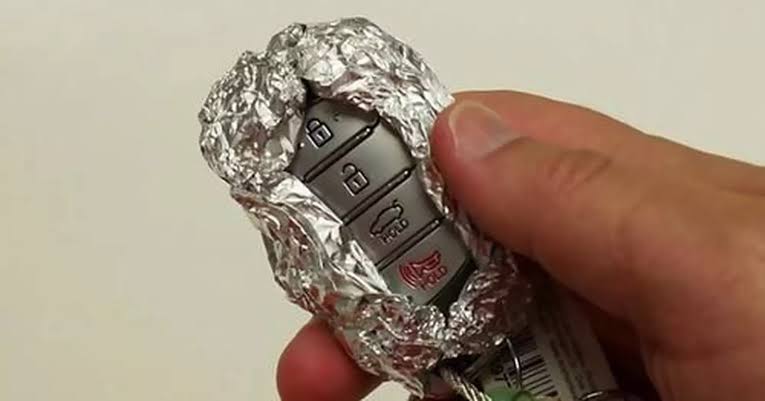
You may have heard the advice to wrap your car keys in aluminum foil when you’re at home. Although it might sound unusual, there is a scientific explanation behind the suggestion.
Here’s what drivers should understand about keyless car theft, how signal-blocking materials work, and what steps can help protect a vehicle.
Why Are Drivers Being Advised to Protect Their Car Keys?
Traditional car keys work differently from modern electronic key fobs.
With an older vehicle, the driver generally needs to insert a physical key into the door or ignition. Without that key, starting the vehicle is considerably more difficult.
Many newer vehicles, however, use wireless communication between the key fob and the car.
When the driver approaches the vehicle, the system checks for an authorized key. If the correct key is detected, the doors can unlock automatically.
Some vehicles also allow the driver to start the engine by pressing a button while the key fob remains inside the vehicle.
These systems are designed for convenience, but their wireless nature can create opportunities for criminals.
In certain circumstances, thieves may attempt to manipulate the communication between a vehicle and its key fob without physically possessing the original key.
This is one reason automotive security specialists encourage owners of keyless vehicles to take additional precautions.
What Is Relay Theft?
Relay theft is a method of vehicle theft that targets certain keyless entry systems.
Rather than breaking a window or stealing a physical key, criminals attempt to exploit the wireless signals used by the vehicle and its electronic key.
The general idea is that the vehicle needs to recognize an authorized key before allowing certain functions.
If criminals can interfere with or relay the relevant communication, they may be able to make the vehicle believe that its key is nearby when it is actually somewhere else.
This type of attack is particularly concerning when a car is parked outside a home and its key fob is stored indoors.
The important distinction is that relay theft does not necessarily involve stealing or copying the original physical key. Instead, it takes advantage of the vehicle’s wireless authentication process.
Not every keyless vehicle is equally vulnerable, and security protections differ between manufacturers and models.
Nevertheless, owners should understand that keeping a keyless fob near the front door or beside a window may not always provide the level of protection they assume.
How Can Thieves Target Keyless Car Systems?
Modern key fobs communicate with vehicles using radio-frequency technology.
Depending on the vehicle, these systems may use different communication methods and security features.
Relay attacks involve specialized electronic equipment that attempts to extend or manipulate communication between the key and the vehicle.
This can create a false impression that the authorized key is close enough to the car.
For vehicle owners, the concern is that a criminal may attempt to access a vehicle without having direct access to the original key.
These incidents have encouraged manufacturers to improve vehicle security and introduce additional protections.
Some newer systems include motion sensors, digital authentication improvements, and other features designed to reduce the risk of unauthorized access.
However, vehicle security is not identical across all models.
If you own a car with keyless entry, checking the manufacturer’s security recommendations is a sensible first step.
Why Does Wrapping Your Car Keys in Aluminum Foil Help?
The suggestion to wrap car keys in aluminum foil may sound like an internet trick, but it is based on a genuine scientific principle.
Aluminum is an electrically conductive material.
When used appropriately, conductive materials can help shield electronic devices from certain electromagnetic signals.
This principle is related to something known as a Faraday cage.
A Faraday cage is an enclosure made from conductive material that can reduce or block electromagnetic fields from reaching the space inside it.
The effectiveness depends on several factors, including the enclosure’s design, the material, and the frequencies involved.
When an electronic key fob is completely surrounded by a suitable conductive barrier, its wireless communication may be significantly reduced.
In practical terms, this can help prevent certain types of unauthorized wireless communication involving the key.
However, there is an important detail: aluminum foil is not a guaranteed security solution.
Small gaps, loose wrapping, tears, or incomplete coverage can reduce its effectiveness.
For this reason, drivers who want a more dependable option may prefer a purpose-designed signal-blocking pouch.
What Is a Faraday Pouch?
A Faraday pouch is a small protective container designed to block or reduce wireless signals.
These products are commonly marketed for protecting keyless car fobs.
They usually contain conductive shielding materials built into the fabric or lining.
When the key fob is placed inside a properly functioning pouch and the opening is closed correctly, the shielding can prevent the vehicle from detecting the key through certain wireless signals.
Faraday pouches are available in different sizes and designs.
Some resemble small wallets, while others look like compact fabric cases.
They are particularly useful for people who want a convenient place to store their electronic car keys at home.
Unlike improvised aluminum foil wrapping, a purpose-designed pouch can be easier to use consistently.
However, not every product performs equally well. Drivers should choose a reputable product and test it with their own vehicle.
How to Test Whether Your Faraday Pouch Works
Buying a signal-blocking pouch is only useful if it actually blocks the signals used by your car.
Fortunately, drivers can perform a simple everyday check without specialized equipment.
Follow these general steps:
- Place your key fob inside the pouch and close it completely.
- Leave the key inside the pouch and take it near your vehicle.
- Try using the vehicle’s keyless entry system.
- Check whether the vehicle recognizes the key.
- If the car still unlocks normally, the pouch may not be providing sufficient shielding.
Follow your vehicle manufacturer’s instructions when performing this check, since different keyless systems operate differently.
You should also test the pouch periodically, particularly if it becomes damaged or worn.
Remember that a signal-blocking pouch should only be considered one part of a broader vehicle security routine.
Other Ways to Protect Your Keyless Entry Vehicle
Although signal-blocking materials can help, drivers should not rely on a single security measure.
There are several additional precautions worth considering.
1. Keep Your Keys Away From Exterior Doors and Windows
When you arrive home, avoid leaving your electronic key fob immediately beside a front door, window, or exterior wall.
Choose a secure storage location inside your home.
Although distance alone does not guarantee protection against sophisticated relay attacks, keeping keys away from exterior access points is a sensible precaution.
2. Use a Properly Tested Signal-Blocking Pouch
A Faraday pouch can provide an additional layer of protection when you are not using your vehicle.
Make sure the key is completely enclosed and that the pouch is closed correctly.
It is also worth checking that the pouch continues to work over time.
3. Check Whether Your Vehicle Has a Key Fob Sleep Mode
Some manufacturers offer a feature that allows the key fob to enter a low-power or sleep state when it is not moving.
This can reduce certain forms of wireless activity.
The availability and operation of this feature vary by vehicle.
Consult your owner’s manual or contact the manufacturer to find out whether your model includes it.
4. Use Your Vehicle’s Additional Security Features
Many modern vehicles include security options beyond basic keyless entry.
Depending on the model, these may include:
- An alarm system.
- An immobilizer.
- Motion-sensitive key fobs.
- Smartphone security notifications.
- Vehicle tracking services.
- Additional authentication requirements.
Review your vehicle’s available security features and make sure they are activated where appropriate.
5. Park in a Secure Location
Whenever possible, park inside a locked garage or in a well-lit area.
If you park outside, consider using a steering wheel lock as an additional visible deterrent.
Although no single measure can prevent every theft attempt, combining several precautions can make a vehicle a less attractive target.
6. Keep Your Vehicle Software Updated
Vehicle manufacturers sometimes release software updates that improve security and address technical vulnerabilities.
Check whether your vehicle has outstanding updates or security recommendations.
Your dealership or manufacturer’s official website can provide information about updates relevant to your particular model.
Are All Keyless Cars Vulnerable to Relay Theft?
No. It would be misleading to suggest that every vehicle with keyless entry has the same level of vulnerability.
Automakers use different technologies, authentication systems, and security measures.
Some vehicles have additional protections designed to make relay attacks more difficult.
For example, certain key fobs include motion sensors that reduce wireless activity when the key has been stationary for a period of time.
Other manufacturers use newer digital security technologies to strengthen communication between the key and vehicle.
However, these protections vary, and no vehicle owner should assume that a keyless system is automatically immune to electronic theft.
The best approach is to understand the security features of your specific vehicle.
If you are uncertain, contact the manufacturer or an authorized dealership and ask whether your model has known keyless-entry security concerns.
Is Aluminum Foil Better Than a Faraday Bag?
Aluminum foil and Faraday pouches rely on the same general concept: conductive materials can shield against electromagnetic signals.
However, there are practical differences.
Aluminum foil is inexpensive and widely available, but it can tear, become loose, and leave gaps around the key fob.
A purpose-designed Faraday pouch is generally more convenient for regular use because its shielding material is incorporated into a reusable enclosure.
| Feature | Aluminum foil | Faraday pouch |
|---|---|---|
| Cost | Usually inexpensive | Varies by product |
| Convenience | Can be awkward | Designed for everyday use |
| Reusability | Limited by wear and handling | Generally reusable |
| Signal protection | Depends on complete coverage | Depends on shielding quality |
| Maintenance | Needs careful handling | Should be tested periodically |
Neither option should be assumed to provide perfect protection without testing.
For everyday use, a reputable and properly tested Faraday pouch is generally the more practical choice.
What Should You Do If You Suspect Your Car Has Been Targeted?
If you notice signs that someone has attempted to access your vehicle, take the situation seriously.
Check that your doors are locked, inspect the vehicle for unusual damage, and avoid leaving valuables inside.
If your car has been stolen, contact the police and your insurance provider as soon as possible.
You should also contact your vehicle manufacturer or dealership if you suspect that a keyless entry vulnerability may be involved.
If your vehicle offers a connected security application, review its alerts and available security information.
Taking action promptly can help with reporting, recovery, and any necessary security improvements.
Final Thoughts: Is Wrapping Your Car Keys in Aluminum Foil Worth It?
Modern keyless entry systems make driving more convenient, but their wireless technology also means that vehicle owners need to understand a few additional security considerations.
Relay theft is a real security concern involving certain keyless entry systems. Fortunately, there are practical steps drivers can take to reduce their exposure.
Aluminum foil may help block certain wireless signals when it completely surrounds a key fob, thanks to the shielding properties of conductive materials.
However, it is not a guaranteed security solution.
For regular use, a properly tested Faraday pouch offers a more convenient alternative. Keeping keys away from exterior doors, using available vehicle security features, and following manufacturer recommendations can provide additional protection.
The most important lesson is simple: convenience should not come at the expense of awareness.
Take a few minutes to understand how your vehicle’s keyless system works and what security measures are available.
A small change in how you store your keys could be a worthwhile addition to your overall vehicle security routine.