
There are certain kitchen tools that seem to belong to another era.
You find them tucked into the back of a drawer, sitting quietly beside gadgets you bought with much more enthusiasm. Their handles may be slightly worn, their metal may have lost some of its original shine, and their design can look almost comically simple compared with the sleek, multifunctional tools that fill modern kitchens.
For a long time, that’s exactly how I thought about one particular vintage kitchen tool: the old-fashioned portioning scoop.
It wasn’t something I considered particularly useful. In my mind, it was one of those specialty utensils that had a single purpose and probably wasn’t worth taking up valuable drawer space. I associated it mostly with making meatballs, and even then, I figured a pair of spoons or my hands could accomplish essentially the same thing.
Then one day, while preparing a large batch of food, I decided to give it another chance.
What happened next was surprisingly simple.
The trick wasn’t some complicated technique, special attachment, or clever modification. It was simply learning to use the tool as a consistent portioning device rather than thinking of it as a one-purpose gadget.
That small realization completely changed the way I approached batch cooking.
The Vintage Tool I Had Almost Written Off
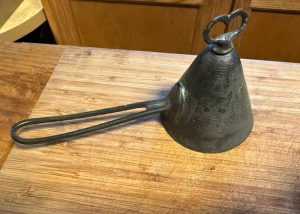
The tool itself isn’t particularly impressive at first glance.
Depending on the style, it can look like something you’d find in an old diner kitchen, a grandmother’s pantry, or a restaurant supply cabinet. There’s usually a rounded scoop attached to a handle, with a simple mechanism designed to release whatever you’ve placed inside.
Modern kitchens tend to celebrate tools that promise to do several things at once. We have food processors, immersion blenders, air fryers, silicone gadgets, adjustable measuring devices, and appliances that seem capable of replacing half a countertop.
Against all of that, a simple portioning scoop can look almost primitive.
That’s part of what made my discovery so unexpected.
I had initially judged the tool by how narrow its obvious purpose appeared to be. If it was mostly for portioning meatballs or similar foods, why bother keeping it around?
But I eventually realized that portioning is the real function—and portioning is something I do constantly.
Once I started looking at it that way, its usefulness became much more obvious.
The Surprisingly Simple Trick
The trick was consistency.
When you’re making a large batch of anything by hand, there’s an easy tendency to make each piece slightly different. One meatball gets a little more mixture than another. One falafel is noticeably larger. One cookie is small while the next is almost twice the size.
Individually, these differences don’t seem important.
But when you’re cooking a tray full of food, they can become surprisingly inconvenient.
Larger pieces may need more time to cook. Smaller ones can become dry before their neighbors are finished. A tray that should have cooked evenly suddenly requires monitoring, rearranging, or removing individual pieces at different times.
The portioning scoop solved much of that problem simply by giving me a repeatable motion.
Instead of grabbing an approximate amount of mixture with my hands, I could fill the scoop, release the portion, and repeat.
It wasn’t complicated.
That was precisely why it worked so well.
I wasn’t trying to make every piece mathematically identical. I was simply eliminating the guesswork that naturally happens when portioning dozens of pieces by hand.
And once I understood that, I started seeing applications everywhere.
From Meatballs to Almost Everything
The first obvious test was meatballs.
I prepared the mixture as usual, then used the scoop to portion it onto a tray. The difference was immediate. Instead of stopping repeatedly to judge whether each meatball looked roughly the same size, I could move through the batch in a steady rhythm.
Scoop.
Release.
Move.
Repeat.
The process became almost automatic.
More importantly, the finished meatballs looked uniform without requiring me to spend extra time shaping every individual one.
That got me wondering what else I could portion with the same method.
Falafel was one of the first experiments.
Falafel mixture can be particularly frustrating when you’re trying to create evenly sized pieces by hand. Some portions end up dense and large, while others are smaller and more delicate.
Using the scoop gave me a much more consistent starting point.
The same thing happened with arancini. Instead of estimating the amount of rice mixture for every ball, I could portion them quickly and then shape them as needed.
Vegetable patties worked, too.
So did certain kinds of fritters, croquettes, dessert bites, and cookie dough.
Suddenly, the tool I had mentally categorized as “the meatball gadget” had become something much broader: a batch-preparation tool.
Why Consistency Matters More Than I Realized
Before using the scoop regularly, I underestimated how much time I spent making tiny corrections.
Cooking is full of them.
You add a little more seasoning.
You adjust the size of something.
You reshape a piece that doesn’t look quite right.
You move one item because it’s cooking faster than another.
You check whether a particular piece is done.
None of these tasks takes very long individually, but together they create friction.
Batch cooking magnifies that friction because you’re repeating the same task over and over.
That’s where consistency becomes valuable.
When portions are approximately the same size, the cooking process becomes easier to predict. You have a better idea of how many pieces you’ll get from a mixture, how much space you’ll need on a tray, and how evenly they’ll cook.
The scoop doesn’t eliminate every variable, of course. Mixtures have different textures, ovens behave differently, and cooking times depend on the recipe.
But it removes one unnecessary variable: wildly inconsistent portions.
That alone made a noticeable difference.
The Unexpected Benefit: Less Mental Effort
The biggest surprise wasn’t actually speed.
It was how much less attention the process required.
When I portion food by hand, part of my brain is constantly evaluating each piece.
Is this enough?
Too much?
Should I add some?
Does this one match the others?
Do I have enough mixture left?
After repeating those decisions twenty, thirty, or fifty times, the task becomes tiring in a way that’s difficult to notice until you stop doing it.
The scoop turned the process into something much more mechanical.
Once I had a comfortable rhythm, I didn’t have to make a fresh decision about every portion.
That freed up attention for the things that actually mattered more: tasting the mixture, adjusting seasoning, preparing the next step, or simply enjoying the cooking process.
It sounds like a tiny distinction, but it changed the experience.
Cooking felt less like managing a production line and more like settling into a rhythm.
Batch Cooking Became More Enjoyable
There was another benefit I didn’t expect.
I began making larger batches more often.
Previously, I sometimes avoided recipes that required forming dozens of individual pieces because I knew how tedious the preparation could become.
The food itself might be delicious, but the thought of portioning and shaping everything was enough to make me reconsider.
Once I had a reliable way to portion the mixture, that hesitation disappeared.
Making a large batch of falafel no longer seemed like a chore.
Neither did preparing a tray of vegetable bites or a large quantity of cookie dough.
The process became predictable.
And predictable kitchen tasks are often much easier to tolerate than tasks that require constant judgment.
That realization made me think about how many kitchen frustrations come not from difficult recipes, but from repetitive little jobs.
Sometimes the best tool isn’t the one that performs a spectacular transformation.
It’s the one that makes a repetitive job feel effortless.
A Tool That Doesn’t Need an Instruction Manual
One of the things I appreciate most about this kind of vintage kitchen tool is its simplicity.
There’s no screen.
No settings.
No battery.
No charging cable.
No app.
There isn’t a complicated mechanism to understand before you can use it effectively.
You simply fill the scoop and release the portion.
That’s it.
Modern conveniences can be wonderful, but there’s something satisfying about a tool whose usefulness is immediately obvious.
The simplicity also makes it easy to clean and store. There are fewer components to worry about, and there isn’t a collection of accessories that needs to be kept together.
After years of accumulating kitchen gadgets, I’ve started to appreciate this more and more.
The tools that remain useful aren’t necessarily the most sophisticated ones.
They’re the ones that solve a real problem often enough to justify their space.
Why Vintage Tools Can Still Make Sense
There’s a tendency to assume that newer automatically means better.
Sometimes it does.
Materials improve. Designs become more ergonomic. Manufacturing becomes more precise. New tools can solve problems that older versions couldn’t.
But the opposite can also be true: a simple design that already solved a particular problem well doesn’t necessarily become obsolete just because newer gadgets exist.
That’s what I discovered with the portioning scoop.
Its basic purpose hasn’t changed.
Food still needs to be portioned.
Cookie dough still needs to be divided.
Meatballs still need to be made.
Falafel still benefits from reasonably consistent sizing.
A kitchen tool doesn’t need to be technologically advanced to remain useful.
In fact, its lack of complexity can sometimes be an advantage.
There is very little to troubleshoot.
The Difference Between a Gadget and a Keeper
My kitchen drawers are full of objects that seemed brilliant when I bought them.
Some were designed to perform an oddly specific task. Others promised to save time but ended up taking longer to clean than the task itself. A few were simply fun to own for a while.
Eventually, most of them disappeared into storage.
The portioning scoop was different.
Its usefulness wasn’t immediately obvious because I was thinking too narrowly about what it was designed to do.
Once I started using it for batch preparation, it became one of those tools I reached for without thinking.
That’s probably the clearest definition of a genuinely useful kitchen tool: you stop noticing that you’re using it.
It becomes part of the process.
You don’t admire it every time you open the drawer.
You just know where it is.
A Small Tool With a Surprisingly Large Impact
Looking back, the most interesting part of the whole experience is how little actually changed.
I didn’t buy a new appliance.
I didn’t reorganize my kitchen.
I didn’t learn a complicated cooking technique.
I simply reconsidered an old tool.
That was enough.
The scoop didn’t suddenly make cooking effortless. It didn’t eliminate preparation or guarantee perfectly cooked food. What it did was remove a small amount of unnecessary friction from a task I performed repeatedly.
And small improvements become significant when you repeat them often.
Saving a few seconds on one portion doesn’t seem important.
Saving those seconds across an entire batch feels different.
More importantly, avoiding dozens of tiny decisions makes the task feel easier.
That’s the part I hadn’t anticipated.
The Quiet Revolution in My Kitchen
What began as a nostalgic experiment turned into a quiet revolution in my kitchen.
The tool that once seemed destined for occasional meatball nights became the backbone of nearly every batch task I faced.
Falafel, arancini, cookie dough, vegetable patties, dessert bites—each mixture fell into line, portioned with a consistency my hands alone had never quite achieved.
Instead of hovering over trays and correcting each piece, I could trust the process and focus on flavor, seasoning, and timing.
That small shift changed how cooking felt.
Batch prep stopped being a slog of tiny corrections and became a calm, almost meditative rhythm.
Scoop.
Release.
Move.
Repeat.
There was something satisfying about the repetition. The tool did one thing, but it did that thing reliably, over and over again.
And because the portions started from the same basic measurement, the rest of the cooking process felt more organized.
Cleanup stayed simple. The mechanism never felt overcomplicated. Its sturdy construction made it feel less like a trendy accessory and more like a dependable piece of kitchen equipment.
Most importantly, I stopped thinking of it as old-fashioned.
I started thinking of it as proven.
Sometimes the Best Kitchen Upgrade Is Already in the Drawer
There’s a lesson in that.
We’re constantly encouraged to look for the next kitchen upgrade—the new appliance, the clever gadget, the tool that promises to save time and transform the way we cook.
But sometimes the solution is already sitting in a drawer.
The problem isn’t necessarily that the tool is outdated.
The problem may be that we haven’t discovered the right way to use it.
For me, that meant realizing that the humble portioning scoop wasn’t really about meatballs at all.
It was about consistency.
Once I understood that, its usefulness expanded dramatically.
Now, whenever I’m preparing a large batch of something, I find myself reaching for it almost automatically. What used to feel like a tedious series of tiny decisions has become a straightforward routine.
And perhaps that’s why the tool has earned its permanent place in my kitchen.
Not because it’s clever.
Not because it’s fashionable.
Not because it replaces a dozen other gadgets.
It simply works.
In a drawer crowded with forgotten inventions and short-lived kitchen trends, that unassuming little tool has proved something I increasingly value: true innovation doesn’t always look new.
Sometimes it looks like one well-made, utterly dependable motion repeated perfectly, again and again.