My morning routine shattered instantly. The cereal bowl I had just filled slipped right out of my hand, hitting the edge of the basin and cracking neatly into pieces as milk spilled across the stainless steel. Six grown men from the industrial plant where my late husband, Jonathan, had spent a decade working had suddenly shown up at the middle school gates, asking explicitly for my twelve-year-old daughter, Letty. The principal rushed to assure me that she was entirely safe, but the moment she heard her father’s name mentioned by strangers in the front office, she had locked up, panicked, and refused to leave the room.
My heart hammered against my ribs as I grabbed my car keys, drove with white-knuckled intensity across town, and burst through the double doors of the administration building.
When I finally stepped into Brennan’s office, the breath left my lungs entirely.
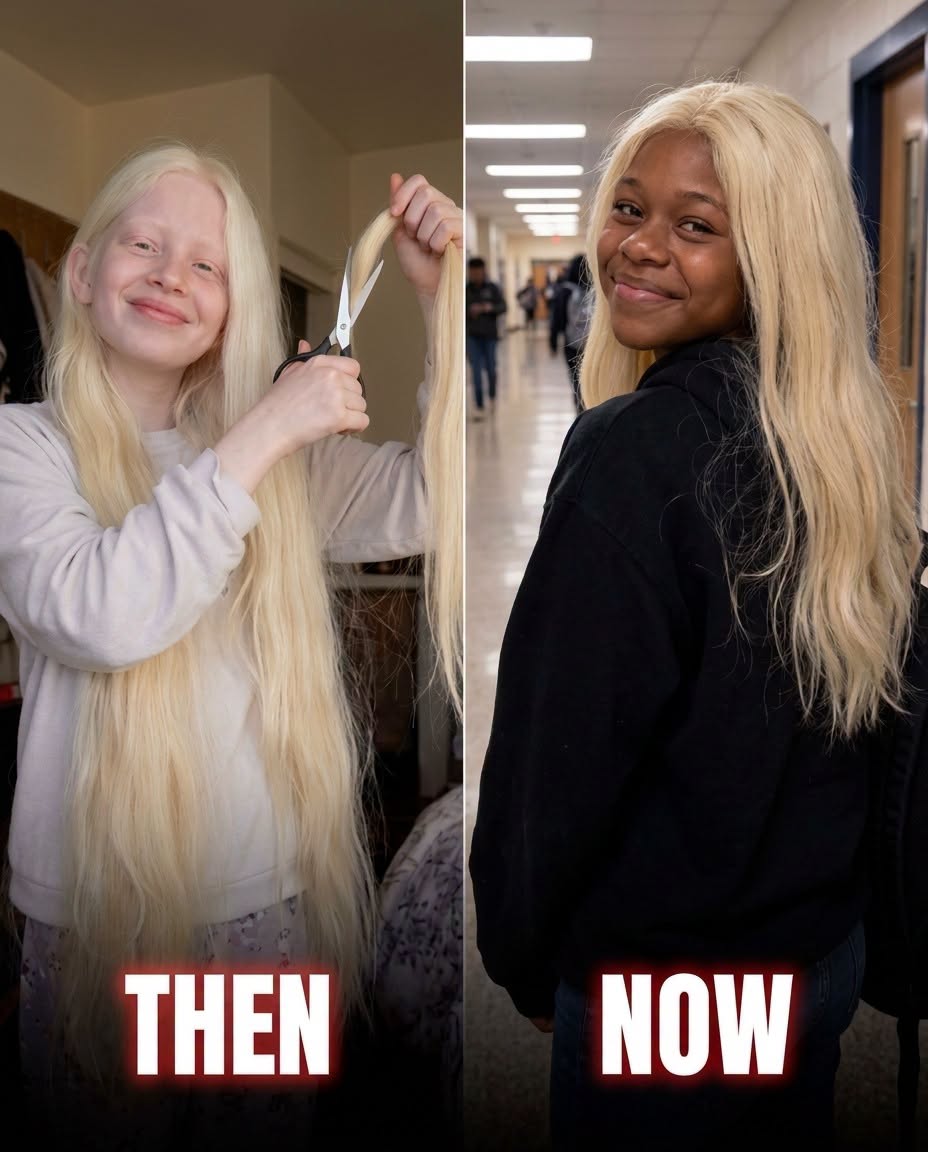
Letty stood near the window, her posture rigid, standing right beside her classmate Millie. Millie wore a brand-new, honey-blonde wig—a piece that looked remarkably familiar. Resting squarely in the center of Brennan’s cluttered mahogany desk was Jonathan’s battered old yellow hard hat, bearing the unmistakable, wonderfully absurd crooked purple star Letty had carefully glued onto the brim when she was just six years old. Panic slowly dissolved into utter confusion.
The events of the previous night flashed through my mind. I had stumbled down the hallway after midnight, finding Letty sitting barefoot on the cold bathroom tile, surrounded by clumps of dark hair and shaking scissors. Millie, who had only recently finished brutal cancer treatments and was officially in remission, had been quietly enduring vicious taunts from a group of boys because her hair had not yet grown back. Without consulting me, Letty decided that her own long hair could be used to craft a real wig to shield her classmate from the cruelty. Desperate to salvage the botched DIY haircut, I had rushed her early that morning to our stylist friend, Teresa, who managed to fix the uneven edges while prepping the healthy locks for an expedited donation.
What I hadn’t known was that Teresa’s husband, Luis, had stood shoulder-to-shoulder beside Jonathan on the plant floor for eight long years. When Luis heard what Letty had done from Teresa, the emotional weight hit him like a physical blow. He immediately called a handful of Jonathan’s closest former coworkers. Sitting quietly in Brennan’s office were those exact six men. Looking at Letty, they didn’t just see a schoolgirl acting on impulse; they saw the exact, quiet compassion Jonathan had exemplified every single day of his life. He had been the guy who voluntarily covered double shifts for exhausted parents, packed extra sandwiches for apprentices who forgot lunch, and stayed late to fix machinery when everyone else wanted to head home.
Marcus, Jonathan’s longtime supervisor and a man who rarely showed emotion, stepped forward and handed me a weathered white envelope. The handwriting scrawled across the front was unmistakably Jonathan’s. Back when he received his devastating diagnosis, Jonathan had quietly spearheaded an internal, employee-supported relief fund designed to assist working-class families overwhelmed by the crushing medical expenses of pediatric cancer. Even after his passing, the men at the plant had kept the contributions rolling in. Now, they intended to direct that support entirely toward Millie’s family to help lift their financial burden.
Principal Brennan cleared his throat, steering our attention back to the immediate crisis within the building. He explained that Millie’s harassment had been far more severe and systemic than the administration had initially realized. To escape the daily torment in the cafeteria and hallways, Millie had been quietly eating her lunch isolated inside the nurse’s private bathroom for two solid weeks. Hearing that broke something inside me. The school had finally initiated a formal disciplinary investigation, reached out to the parents of the ringleaders, and slapped strict restrictions on the boys involved while witness statements were gathered.
Standing there in the office, surrounded by my husband’s old coworkers and the quiet echoes of a tragedy we were all still surviving, I made one absolute conviction clear to the room: Letty would not be paraded around as a feel-good symbol of youthful kindness while the adults in the building ignored the toxic school culture that made her drastic gesture necessary in the first place. The adults needed to do their jobs.
Marcus nodded slowly in agreement, his weathered face solemn. He asked if he could read Jonathan’s note aloud.
In the quiet office, his voice steady and low, Marcus read the words my husband had left behind for us. Jonathan had written that if his girls ever grew up and forgot the kind of man he tried to be, they should simply look at how ordinary people showed up for one another in times of need.
That evening, the heavy atmosphere in our house shifted. I invited Millie and her mother over for a simple, comforting dinner. When it was time to leave, Letty carefully cradled her father’s yellow hard hat in her arms, carrying it out to the car like a precious artifact.
Jonathan was gone, and the ache of his absence would never fully leave our walls. But his enduring kindness remained—alive and breathing in six steadfast men who kept a promise to a fallen friend, in a once-frightened girl walking taller in a new wig, and most powerfully of all, in Letty, who had looked across a crowded room at someone in deep pain and deliberately chosen not to walk past.